
When Reynaldo “Rey” Anaya Valencia enrolled in Harvard Law School, his goal was to work for the Mexican American Legal Defense and Education Fund.
He wanted to bring large impact litigation on behalf of Latinos, ambitions shaped by his upbringing in a migrant farm worker family.
But by his third year, the financial reality of private education had set in. With undergraduate and master’s degrees from Stanford University already — and significant debt — Valencia pivoted.
“I thought, ‘I’m probably going to have to go to a big firm and pay some of that debt off before I go and do public interest work,’” Valencia said.
Valencia accepted a Dallas-based position as a corporate bankruptcy and corporate lawyer with Jones Day — then the second-largest firm in the world.
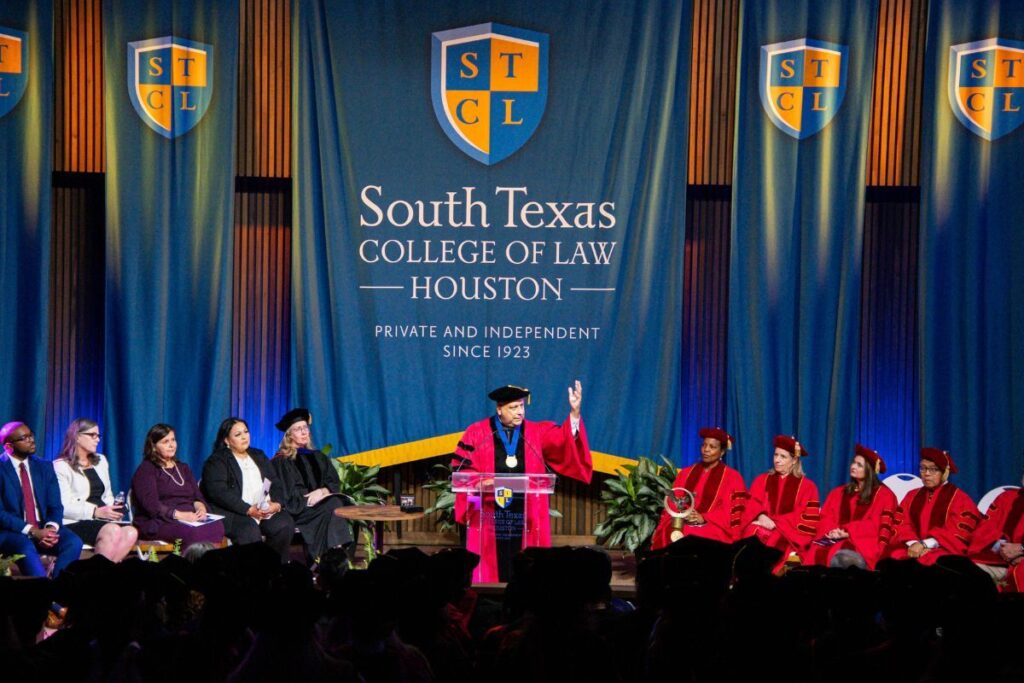
“It was light years away from any life experience I’d ever had,” Valencia told The Texas Lawbook in an interview last month ahead of his investiture at South Texas College of Law, where in July he became the president and dean. He is the first Hispanic and person of color to lead the school. Though he never ended up working for MALDEF, he said his career in law and academia has allowed him to “maintain true to my values of caring about issues of diversity, inclusion, equality.”
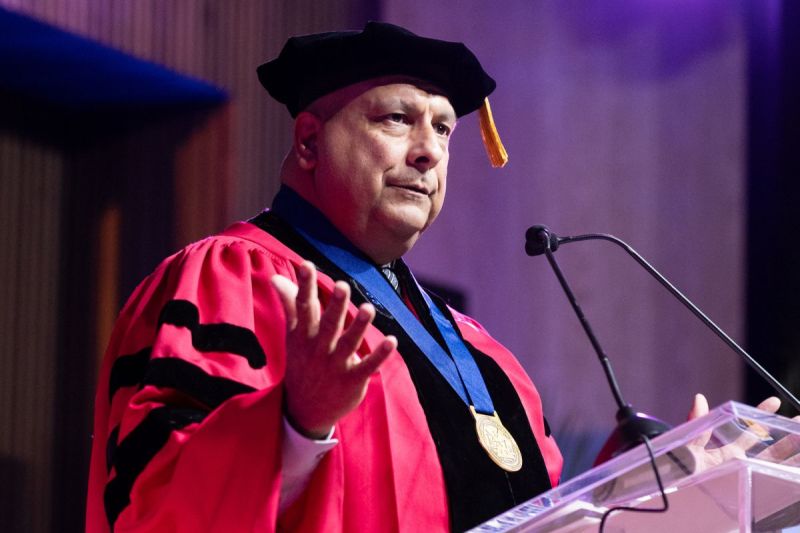
From 1999 to 2000, Valencia served as a White House fellow in the Office of the Chief of Staff, where he worked on race, civil rights, immigration and Hispanic education.
This interview on Sept. 30 took place four days after the Texas Supreme Court issued an order stating its “tentative opinion” that the American Bar Association should no longer decide which Texas schools can send graduates to sit for the state bar exam. Instead, SCOTX would have the discretion to approve law schools under proposed amendments that are available to public opinion until Dec. 1 and that would take effect Jan. 1. The ABA has come under fire by the Trump administration for its diversity, equity and inclusion practices.
Even before taking the helm at STCL, Valencia — who was named STCL’s incoming president in January — joined seven other law school deans who, in a June letter to the justices, urged the state’s high court to continue the ABA’s role.
In the following Q&A, Valencia discusses his response to SCOTX’s order, as well as the challenges and opportunities facing law schools as they adapt to new technologies, meeting students’ needs and the evolving practice of law.
Valencia’s experiences in law school laid the foundation for his career in academia.
During his second year, Valencia found himself searching for an escape from the harsh Cambridge winter. Harvard offered a January “independent field work” term — comparable to an externship these days — and he decided to return to Texas to help on a case he had been following closely: a Latina school board member’s lawsuit against the Lubbock Independent School District.
After the U.S. Supreme Court’s ruling in Brown v. Board of Education, many Southern school districts resisted desegregation, leading to legal challenges and lawsuits to enforce the decision.
“I called her, and I said, ‘Hi, my name is Ray Valencia. I’m a second-year law student. … I’d like to come and help you on your case,’ he said, chuckling as he recalled the woman’s initial confusion. “I tell students, ‘You’ve got to make your own opportunities.’”
Valencia connected with one of her attorneys, Texas Tech constitutional law professor Dan Benson, who agreed to take him on. Valencia returned to Lubbock, where he spent about six weeks helping to reopen a decadesold desegregation case.
“The original lawsuit to desegregate the Lubbock Independent School District was filed in the month and the year that I entered the Lubbock Independent School District,” Valencia said. “Twenty years later, I went home, and I worked at Texas Tech with that professor and the lawyers, and I wrote the brief that got us back into federal court.”
The legal team pressed Valencia to return to Lubbock, promising him a job. But he told them, “I really have been trying to get out of Lubbock my whole life and go see the world.”
Still, Benson planted a seed. He encouraged Valencia to return to Texas Tech as a professor. After accepting his offer at Jones Day, Valencia took Benson up on the idea part time. He met with then-Texas Tech Law Dean Frank Newton and proposed two courses that the school had never offered before: one on race and racism and one on gender discrimination.
“The law impacts race and gender,” Valencia recalled saying. “Race and gender impact the law.”
Newton agreed, and Valencia taught while practicing at Jones Day, an experience that helped him decide where he could make more of an impact.
“I was very fortunate that I was teaching at the same time that I was practicing right out of law school, and I could compare the two and make a life decision based on my actual experience,” Valencia said.
The following interview has been edited for length and clarity.
Texas Lawbook: You are the first Hispanic and first person of color to lead the South Texas College of Law. What significance does this milestone hold for you personally and professionally?
Rey Valencia: I am the grandson and son of migrant farm workers, and I cannot believe that I am in this position. It’s extraordinarily humbling. My mom went to the sixth grade. My dad went to the third grade. So everything I did after the third grade and the sixth grade, for my parents, was something that they didn’t understand. My parents were migrant farm workers until they married and settled down in Lubbock. I grew up in Lubbock, and my mom was a housekeeper, and my dad was a construction worker, so I’m the first in the family to go to college. I’m the first in the family to graduate college, first in the family to go to law school, first in the family to go to Ivy League, first in the family to do all that. So the notion that I would be the first person of color and the first Hispanic dean of South Texas is just very humbling, because when you look at my background, you would not have predicted that. But I’m very excited about it, and I think it’s a great thing for the school as well.
Lawbook: From your perspective, what are the most pressing challenges currently facing South Texas College of Law?
Valencia: I was just in Seattle at a conference called Promoting Diversity in Law School Leadership. This is a bunch of deans who get together, and we try to increase the pool and the diversity of the pool of people who will become deans, associate deans, those kinds of things. I was on a panel, because of my finance background, helping people who are interested in becoming a dean think about how you deal with finances at a law school and finances in general. We were talking with the other panelists on the panel, and I said, “There are some universals that face us all.” Some of those universals are things like the next-generation bar exam, called NextGen Bar Exam. It’s coming pretty soon here in Texas. It’ll go into effect in 2028, so we’re all thinking about what we need to do with our curriculum, if anything, to adapt and prepare our students for the next-generation bar exam. There’s always the question of loans and debt level that our students have, the price of tuition and all that’s tied into that. How do we make law school an affordable, as much as we can, option for people who are interested in becoming lawyers?
There is also a great question about how we prepare our students for the 21st century practice of law, including things like, how do we harness the power of AI and make it work for our students, rather than having — a bunch of lawyers are getting sanctioned for using AI in cases that are hallucinated and things like that — we want to get out in front of that and make sure that our students understand how to use AI as a tool to help the practice. We can’t bury our heads in the sand and say, ‘We’re just going to tell them not to use AI at all.’ AI is here. So how do we harness the energy of AI?
In addition, South Texas has not yet offered non-JD degrees. We are accredited by the American Bar Association to offer the JD, but we don’t offer a Masters of legal studies or an LLM, as many other schools do. We are in the process of seeking an accrediting body called Middle States Commission on Higher Education that we have applied to. If we get Middle States accreditation, we will be able to offer other kinds of courses in addition to the JD. We have just started an online program. It’s been in operation for a couple of years. So we’re exploring the ways in which we use technology to deliver and be more accessible and affordable for people who may not be able to come to campus, and those kinds of things.
The thing that’s distinct about South Texas is we’re not part of a university. We’re a standalone law school. We also have some kinds of pressures on that front, as the government keeps making changes to financial aid and those kinds of things. We have to look at it slightly differently because we don’t have a university.
Lawbook: What do you see as the greatest challenges facing today’s law students?
Valencia: I think the same things that have always faced students. They are always very concerned about the job market. They are always very concerned about being prepared for the bar exam. That’s just the universal of what students have to worry about. But beyond that, I think the other thing that has really changed is the onset of the Covid-19 pandemic has really helped a lot of universities and higher education institutions deal with issues of wellness in ways that we probably didn’t deal with very well before. Now, the students are demanding more wellness-centered activities and services. They want those kinds of things to be made available as part of their experience in law school, which is a good thing, I think. Rather than bury it and not talk about it, I think today’s students are willing to look and go get the kinds of help that perhaps generations of law students in the past weren’t. They worry about the cost of legal education, the debt level that they’re going to have, the job that they’re going to have. Do they understand how to use technology and all of those kinds of things? But I think they’re up for the challenge. And they just have to, like we did when I was a law student, you just have to believe that the law degree is ultimately going to be worth it. I tell students all the time: It takes a lot to get your law degree — a lot of sacrifices, a lot of time, a lot of effort, a lot of energy — but in the end, it’ll be worthwhile.
Lawbook: How have attacks on diversity initiatives affected student recruitment and the overall diversity of the student body?
Valencia: We are very fortunate. We are in a very cosmopolitan city, the fourth largest in the United States. And we are in a very diverse state. I’m coming from being the dean of an Ohio law school where they’re really worried about a population decline and who’s going to go to college and then, thereafter, who’s going to go to law school? We don’t have those issues in Texas because we have a very robust and growing population. Even before my arrival, and even before the changes in the federal government and the executive orders, we didn’t really need to rely on any of those indicators as much as other schools may have, because we’re in Houston, and our pool was so diverse and our applicant pool was so strong that we were having pretty good results without even taking race and gender or those kinds of things into consideration as overtly as other institutions might. When the executive orders came down, of course, we couldn’t [use race and gender as factors], and our entering class became more diverse. So we’re not struggling, luckily because of where we’re situated and the robustness of the pool.
Lawbook: In your view, what might be the long-term impacts of these attacks on diversity within the legal education and profession at large?
Valencia: Particularly in a state like Texas, we certainly want the legal profession to be reflective of the citizens of the state and the populations which they’re going to serve. I am a firm believer that it is in everyone’s best interest that we make legal education available to all, as much as possible, and that we engage and support a bar membership that is responsive to the needs of society, and that includes people like the people who are serving the clients. That just makes all the sense in the world to me. If we were to completely pretend that didn’t matter, that would be a disservice to people who need legal services.
Lawbook: How do you envision law school curriculum changing in the years ahead?
Valencia: I was very fortunate because in my last seven years at St. Mary’s, I was the associate dean for finance and administration. Then I got recruited by Judge Royal Ferguson and Ellen Pryor to become the inaugural associate dean of the University of North Texas at Dallas College of Law. The great thing about working at UNT Law was that it was a brand new school, so we couldn’t say we’ve always done it like this before. Ellen designed a curriculum that was very much geared with practice-ready skills woven throughout it. I think that’s where the ABA wants us to go, and I think that’s where we as an institution of legal education need to go. Some professors only want to give one exam at the end of the semester, but the ABA is pushing us to move away from that and to make students more practice-ready. Right now, our students are required to graduate with at least six hours of skills-related courses, and the ABA was considering increasing that to 12 hours. That’s how serious it is. I think where we’re going in the curriculum changes is what are we going to be doing to make students more practice-ready with more skills-based learning, with more clinical opportunities, if we could afford that. Clinical education is very expensive. And then again, how do we incorporate all of the technology and all of those tools to help the students prepare for the very different practice of law in the 21st Century?
Lawbook: On Sept. 26, the Texas Supreme Court issued an order stating its “tentative opinion” that the ABA should no longer have the final say on whether a law school’s graduates can take the bar exam. How does South Texas College of Law respond to that order?
Valencia: I think it’s so open right now. They said it’s their “tentative opinion.” What does that mean? And if it’s not going to be the final word, then what is going to be the mechanism, and what net effect does it have for everybody? The only thing I saw that particular order changed was that it did substitute the ABA. It struck the word ABA and then put the Supreme Court as the final say. But the whole thing is tentative. I think we’re getting a Supreme Court that is signaling it wants to move away from reliance on the ABA. But there’s not a whole lot more detail, and that’s what I suggested to the faculty when I shared the order. In terms of the question about what would be the alternatives, that’s the other thing that’s not answered. Some states do have state-only approved law schools. California is one of them. Tennessee has one law school that’s approved only by the state. So that does happen, but what would that look like, and what would a law school need to do? If the ABA, with all of its rules and all of its standards, is going to be supplanted by something else that’s more Texas-related, what are those rules going to be? Who is the body that’s going to be accrediting? What are those standards going to look like? All of that has yet to be determined.
Lawbook: What are your thoughts on the ABA’s role as the accrediting body for law schools? Do you believe the ABA should continue in this capacity?
Valencia: When the Supreme Court sent out its order in March, eight of the 10 law school deans in Texas sent a letter supporting the ABA’s continued role in being the body. We kind of laid out our ideas and purposes in that, and I stand by what we said in that letter.
Lawbook: What other current issues or trends are top of mind for you and your fellow law school deans or presidents?
Valencia: What our law school is going to look like in the future when there’s so much uncertainty in terms of the bar exam itself, the accrediting bodies for the bar exam and all of these rules about financial aid changing and causing tectonic shifts. Things are happening so fast we hardly have time to catch our breath. Things like financial aid. If we’re not going to have Grad PLUS loans, and we’re going to move to the system in which our students are, by necessity, going to have to have a cosigner — if I had had to have a cosigner when I went to law school, I would not have been able to go to law school. My parents didn’t have that ability. Those are the things that really worry us about our students. So we’re kind of trying to steer the ships in our respective schools in order to do the best that we can by our students and support our students, which is what this is all about.