
For fifth-generation lawyer and A&O Shearman partner Billy Marsh, a career in law seems like a natural fit.
Marsh’s great, great, grandfather, who was part of a Mormon pioneer community in Utah, started the trend by attending the University of Michigan Law School.
“It became a really good connection between a very insular community in Utah with the rest of the nation,” Marsh said.
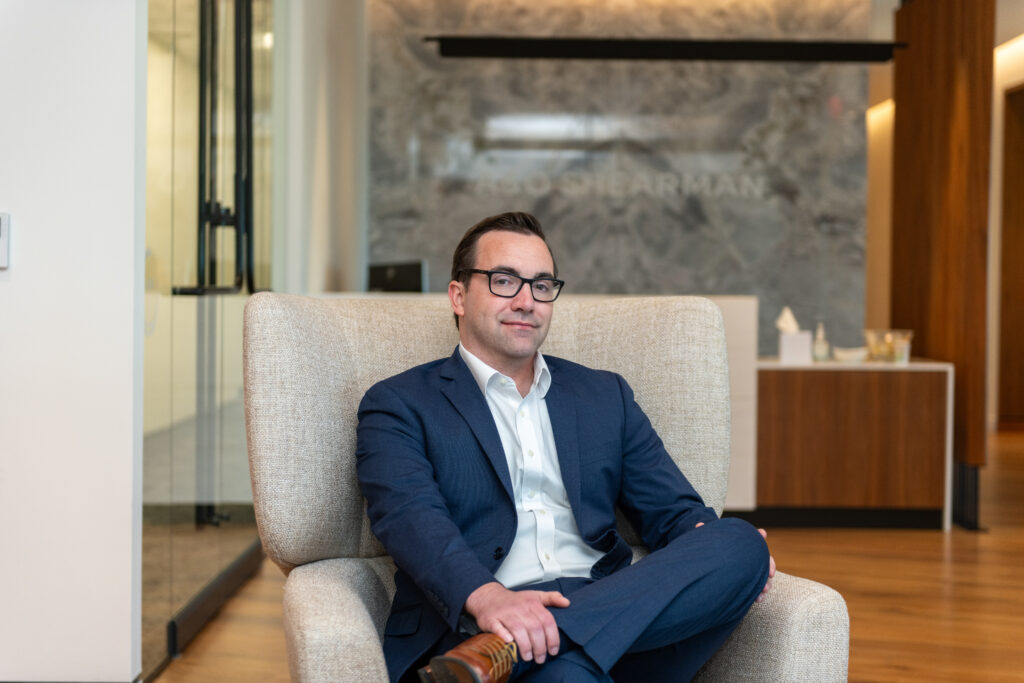
Marsh, who initially had some interest in working in investment banking or private equity, also found himself drawn to a career in the law. He went to Brigham Young University for his undergraduate degree. And while he planned to go to the University of Texas School of Law, a visit to the University of Virginia School of Law changed his mind.
During law school, the Houston native made his way back to Texas, serving as a summer associate at Haynes Boone in Dallas and later as a summer associate at Sidley Austin in Houston. In 2014, he began his career as an associate with Haynes Boone and stayed there for seven years.
Marsh joined what is now A&O Shearman in December 2021. The global law firm merged with New York-based Shearman & Sterling in May 2024.
Because A&O Shearman is a global law firm, Marsh is a registered foreign lawyer in England and Wales.
“We are a very integrated law firm,” Marsh explained.
Being registered doesn’t qualify him to work on international cases, but he has had opportunities to work with colleagues across the world, including traveling to Brussels and Amsterdam for meetings with partners and clients and advising clients on the American litigation system.
“Our litigation system is very, very different than what they’re used to. Some of them are very risk-averse. They’re very afraid of getting too wrapped up in litigation here in the U.S. because of horror stories they’ve heard. And so we have to tell them, ‘Yeah, it’s a different system, but it’s OK. We can manage it,’” Marsh said.
Marsh recently sat down with The Texas Lawbook at his Dallas office to discuss his career and more.
The following conversation has been edited for length and clarity.
Texas Lawbook: What trends are you seeing in your practice area?
Marsh: I specialize in shareholder and securities litigation and mass tort litigation. In securities litigation, we have seen a pretty sharp rise in the last several years in a new trend of what’s called event-driven securities litigation. So when you think of securities fraud litigation, you typically think of something like Enron, where there’s some sort of accounting fraud or maybe there’s been a misstatement of the financial statements. And that still happens. That’s still a big part of what securities litigation is. But now, a lot of times… [if there’s a] data breach, if there’s some sort of misconduct at the highest levels of companies, sexual harassment allegations, things like that, shareholders will file shareholder suits saying you failed to inform us that that was going on.
The other, you’ll see it whenever there’s an enforcement action brought by some regulatory agency — maybe it’s the FTC, maybe it’s the DOJ — there’ll be almost always some sort of securities litigation that follows, assuming that led to a drop in the stock price. So, event-driven securities litigation is one trend that’s happening.
On the mass tort side, we’re seeing a lot of PFAS-related litigation, and it’s really sprawling, and the plaintiff’s bar is really invested in trying to find all sorts of avenues for recovery. So we’ve seen more litigation in the consumer goods space with respect to PFAS. If consumer goods incorporate PFAS, the people who have bought those goods will say, “You failed to inform us that these products contain PFAS and are bad for our health,” and that type of thing. We’ve seen a rise there. And then we also see there’s been a bit of a step back at the federal level from environmental enforcement, and so private organizations are stepping in to try to vindicate their public interest causes.
[T]here’s [also] a rise in litigation relating to plastics and the recyclability of plastics. These NGOs and other plaintiffs, sometimes our municipalities, are saying that these companies that use plastics — and their products like Coke or Pepsi or manufacturers of plastics — are responsible for plastic waste and need to contribute to … the abatement of that nuisance by either contributing money to these municipalities [that] have to deal with the waste or doing other things.
Those are some of the trends we’re seeing so far, or as of late, in securities and shareholder litigation and kind of mass tort litigation.
Texas Lawbook: You represented Twitter in shareholder actions relating to Elon Musk’s acquisition of Twitter. How did you get on that case?
Marsh: After the deal was announced, there were shareholder actions filed against Twitter in Delaware and California that were trying to enjoin the deal, influence the deal in some way or collect on some sort of damages claim. After our firm was retained on the first matter, we were retained on similar matters that were filed later. I was fortunate to be part of the team that worked on those cases. That was a really interesting matter. Shareholder actions in connection with M&A deals are pretty common. It’s pretty standard that shareholders or someone from the plaintiffs’ bar will file a lawsuit. But these cases were unusual because the transaction received so much publicity, both in the legal field but also society in general. Everybody was watching. It was an interesting part of the litigation.
Texas Lawbook: You defended T. Boone Pickens and BP Capital Management in a case alleging misrepresentation of hedge fund strategy. What was that like? How did you get on that case?
Marsh: I worked on that matter with another partner at our firm, Dan Gold. We have a really great shareholder and securities practice here. We’re well known here in Texas for that type of litigation. We have a lot of good experience here in Dallas, in particular. That case was in Dallas County court, and we have a lot of great experience in Dallas County court defending executives and boards of directors, and we have a really great track record.
Texas Lawbook: You’ve practiced in the Delaware Chancery Court. Have you gotten a chance to practice in the Texas Business Court?
Marsh: Not yet. We’re eagerly awaiting the cases that we can take there. We’ve looked at a few cases we’re handling and ask, “Oh, can we remove it to the Business Court?” And we haven’t been able to find an avenue to get there yet, but we’re closely watching developments there. We’re familiar with all the judges, and we’ve had cases before them before. So we’ve not yet had an opportunity to take on one of the cases that’s been filed in the business court, but we’ll be excited to take on our first one when it comes.
Texas Lawbook: You’ve represented the NFL in a case with fraud claims. What was that experience like?
Marsh: I was a first-year associate. It was Super Bowl XLV in 2011. It was the year there was an ice storm [in Arlington], [and] there were all sorts of problems with seating. People were displaced. I was a brand-new associate, so it was my first taste of any work at all.
One of the issues in the case was what the views were like for some of these people who had had to move seats or were claiming to have blocked views. So, one of the important pieces of evidence was what the cameras around that area showed. At the Super Bowl, they have hundreds of cameras, as you might imagine, and they’re filming every second of the game from every single angle. They’re following players, they’re following people in the crowd, they’re doing all sorts of things. And so we had gathered up a bunch of footage from all these cameras around the NFL, and one of my first assignments was to watch it. And so I watched hours and hours of the Super Bowl over and over again. The DVDs that I got were of cameras that followed these individual players throughout the game. They were mic’d up, and so I saw and heard everything they did throughout the game, … [but] we weren’t interested, really, in what these players were doing. It was more about what the views were and what was happening, what was relevant to our case.
But it was really fun. There’s so much time, energy invested in that game. It’s an American icon. The NFL protects that with all that it can. There were some unfortunate issues with the seating of a game, and the NFL felt terrible about it, but it was very interesting to see how committed the NFL was to putting on the greatest show in America. It was a great experience working on that. I couldn’t have asked for a better gateway into the practice of law than having worked on that case. We went to trial within a year of my starting. It was a really excellent introduction to practicing law.
If you or someone you know would like to be profiled in a future edition of Asked & Answered, please let us know at tlblitigation@texaslawbook.net. Check out our other Asked & Answered interviews below:
Reid Collins & Tsai senior founding partner William Reid discussed his new book, Fighting Bullies: A Case for a Career in Plaintiffs’ Law. In late November, Reid led a team in South Carolina that secured a $112.3 million jury verdict for their client.
Haynes Boone counsel Catherine Robb talked about media defamation cases and what drew her to a First Amendment practice. Robb also discussed her family’s legacy and what she hopes hers will be.
Susman Godfrey partner Justin Nelson talked about settlements against Fox News and the AI company Anthropic, along with where he sees AI regulation headed. Nelson also discusses lessons learned in his career from clerking for U.S Supreme Court Justice Sandra Day O’Connor to running for Texas attorney general.
Kirkland & Ellis partner Kasdin Mitchell talked about getting to argue in the U.S. Supreme Court, where she once clerked for Justice Clarence Thomas, as well as her time before law school, working in the White House for First Lady Laura Bush. Her mother’s pursuit of a law degree inspired her own path.
Crawford, Wishnew & Lang partner Haleigh Jones discussed her career, memorable cases and mentorship. Jones coaches the moot court team at Southern Methodist University, which she says she hopes to do for her whole career. The 2024 team won the American Bar Association competition.