
William Reid of Reid Collins & Tsai came to Texas for the first time in 1991 when he interviewed for a clerkship with former Fifth Circuit Judge Reynaldo Garza.
“When he gave me the job in Texas in 1991 to commence after I graduated from law school, it completely changed my life,” Reid said.
In March 1991, Reid spent the weekend at Judge Garza’s house for the interview, and at the end of the weekend, he was offered the clerkship.
“I was like, ‘I don’t think I could do any better than this. This guy’s amazing. I want to spend a year with him.’ It turned out to be probably the best professional decision I made in my life,” Reid said. “I’ve never left Texas since.”
He said Judge Garza has been a lifelong mentor for him.
Reid now lives in Austin, where he splits his time between Texas and New York, where he grew up.
Reid recently led a team in South Carolina that secured a $112.3 million jury verdict for their client, JW Aluminum, in late November.
Reid and his firm represented X Corp., which voluntarily dismissed its $70 million lawsuit against Wachtell Lipton with prejudice, also in late November. The lawsuit accused the law firm of taking advantage of leadership change to take a large payout on the $44 billion deal before Elon Musk took over in 2022.
He is also part of the team representing the court-appointed litigation trustee in the GWG Holdings bankruptcy.
His book, which was published in September, Fighting Bullies: The Case for a Career in Plaintiffs’ Law, encourages people to follow a fulfilling career.
“Writing it myself forced me to think through much more deeply each of the concepts that I was trying to relay [and] caused me to think through some of the advice I was giving,” Reid said.
Reid graduated from the University of Connecticut with degrees in economics and accounting in 1989. He earned his law degree from St. John’s University School of Law in 1992.
Reid recently sat down with The Texas Lawbook to discuss his career and more.
The following conversation has been edited for length and clarity.
Texas Lawbook: Why did you decide to follow a career in law?
Reid: In ninth grade, I had this amazing history teacher named Dr. Lavino, and Dr. Lavino had us cover several segments, one of which was the Arab-Israeli conflict. I ended up being the lead Arab delegate. The class was, I think, roughly 40 kids. There were 10 delegates for the Israelis, 10 for the Arabs. There were 10 witnesses, and then there were 10 jurors. We studied the history of Israel and Palestine. I was the lead delegate, arguing that the land in Palestine rightfully belonged to the Arabs. And the Israeli team, they argued the opposite, that it belonged to the Jewish state. We had three Jewish people on our jury of 10, and I won nine to one. I even convinced the majority of Jewish folks. Anyway, that was kind of a glorified debate/trial. Ever since then, I’ve always been into debate and stuff like that. I wanted to be a lawyer, but I didn’t really see a path to it, because I didn’t really have any lawyers in my family. There was no one I could really talk to about it. I was pretty good at math, and math came easily to me. I just studied finance and economics in college, and then I had an accounting degree. And the more I dabbled in business — I was an accountant for six months — the more I was like, I don’t want to do any of this. I want to be a lawyer.
Texas Lawbook: What has been a memorable experience or case in your career?
Reid: The number one thing I’ve ever done as a lawyer was my pro bono representation of a woman named Olga Hernandez in 2018. She was a school board member in the Bexar County School District in San Antonio, and she was charged with bribery for really no more than being friends with some insurance brokers who were bribing the risk manager in the school district.
These insurance brokers were paying lots of bribes to the tune of hundreds of thousands of dollars to this guy named William Half. And William Half and the insurance brokers … to essentially orchestrate the multimillion-dollar insurance contracts that were signed every year with these brokers, unbeknownst to Olga Hernandez. But she was on the board who received this recommendation, as rotten as the process was that led to the recommendation.
Olga had no idea that these bribes were being paid or that the recommendation was anything but an honest recommendation. And she, along with all of her fellow board members, voted unanimously in favor of the recommendation every single time. And still the government decided [to prosecute] because Olga was friends with these insurance agents who chose to be friends with her because they wanted to curry favor with all the board members. But she was just a good-hearted person who didn’t really understand that these people were not being friends with her for the right reasons. Like, she literally said a rosary over one of their sisters’ deathbeds. She literally brought them baked goods at every turn, and then they brought her to various sporting events and trips and things like that.
The government’s theory of the case was that Olga Hernandez sold her vote irrespective of the recommendation and that she was essentially guilty of bribery. We went to trial in December of 2018, and we won an acquittal on Dec. 19, 2018. Olga Hernandez calls me every Dec. 19. She calls it her anniversary. She named her dog after me. The bottom line is it was the most rewarding. I didn’t make a penny doing the case. It was completely free, but it was the coolest thing I’ve ever done, winning her liberty. There’s not even a close second to that. I’ve won huge, multi-hundred-million-dollar settlements. I’ve done all kinds of things that any lawyer would wish to do in their career. I’ve won jury trials on all four sides of the V, something I don’t know many lawyers could say: I won as a civil plaintiff lawyer, civil defense lawyer, a prosecutor and then in defending Olga, I won a criminal defense case.
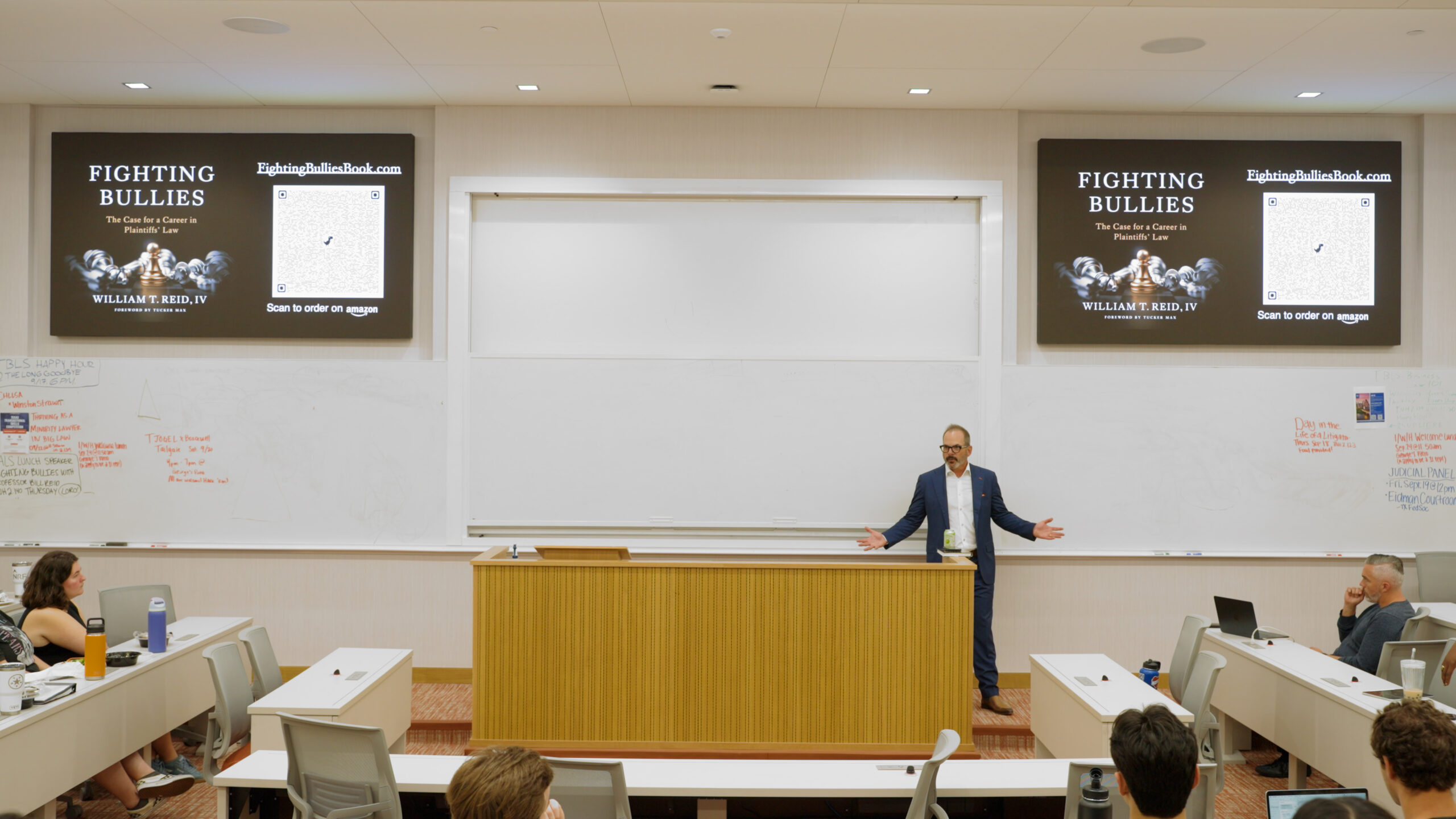
Texas Lawbook: You have a new book out. What was the inspiration behind writing it?
Reid: I’m going into my sixth year [of teaching] this spring, and I feel like I’m giving students a different perspective than they get in the largely doctrinal, largely theoretical, very academic, three years they spend in law school. But I only have 25 students here, and I felt like there might be a broader message. And candidly, the book that I started out to write became a much more encompassing book, from just the business of law to how to think about, you know, the way that money works in the law.
But if you can’t understand the business of law and how it works, then you really can’t see the future, right? You have to know exactly what’s going on right now to have any ability to predict how things might change [with] the advent of artificial intelligence and things like that. I tried to take a broad-based approach to meet students where they are and reach this broader audience. … The book was published Sept. 23. I’m hearing lots of feedback, even from nonlawyers, that the book is a really helpful framework for thinking about your professional life. It’s very rewarding. It enabled me to reach a broader audience, and it really caused me, over the course of the last two-and-a-half years, to really think through what message I would give to the next generation of lawyers beyond what I do as a professor, and so it’s been very rewarding.
Texas Lawbook: I saw you’ve been touring for the book. How has that been?
Reid: It’s cool to be able to go on the nation’s leading law school campuses. What I tell students is, you are going to be the leaders of this industry, 15, 20, 25 years from now. What do you think this world looks like in five or 10 years, much less 15 or 25? And where do you want to devote your substantial resources when you go to these elite schools that, I think, by and large encourage their students to go to Big Law if they’re going to be in private practice.
They’re not going to stand in the way of a student’s decision to become a plaintiff’s lawyer or to do public interest work. But I think that these elite schools suffer from the same malady that many students suffer from, which [is], they think employing their students for the highest starting salary is success. And I think it’s easy to look at it that way, and certainly easier to chart, and the statistics are very easy to accumulate, but the real measure of success of any law school, I think, is whether their students end up truly satisfied in their career, what their ultimate earning power is. And really, the way I ask students to think about this is, imagine you’re now on your proverbial rocking chair, and you’re retired, and you’re reflecting on the career that you have. Are you going to feel satisfied with a career of simply representing people accused of wrongdoing even take the most extreme example, like cases where maybe the plaintiff’s case is terrible and should be dismissed?
Getting a plaintiff’s case dismissed is kind of like, “What’s in it for you?” But holding someone accountable for truly bad conduct, and, more importantly, deterring future bad conduct, can be extremely rewarding, both financially and from a personal satisfaction standpoint. When you think about it in those terms, I think it really applies to almost any career, right?
“What do you want to do with your life?” is the question, and I think your generation is really interested in answering that question to their satisfaction. When I go on these law school campuses that I say to students, “You will be the leaders of your generation. What are you going to do with that leadership? Do you want to just simply do what prior generations did and chase the early buck in terms of starting salary, without regard to what difference, if any, you’ll make in the world and in society? Or do you want to make a difference? And do you want to be passionate about what you do?” And I feel like students get pretty charged up with that message.
Texas Lawbook: What recent books have you read?
Reid: I really like a book called Range, and I read it several years ago. But Range is a book written by a guy named [David] Epstein, who was a Sports Illustrated writer, and he talks about historic examples of people who had multiple disciplinary skills and put those multiple disciplinary skills together to become like the smartest people in whatever field they were passionate about. I think young people should absolutely read that book.
Another book I read a little more recently, on my mind because I go on an annual elk hunt, is a book called The Comfort Crisis by Michael Easter, and that book is about a 30-day caribou hunt in Alaska. It’s chock full of a lot of statistics about how we as humans have evolved and what some of our core needs are and how being outside in the wilderness and forest and things like that really, actually are, like, super great for your mental health. I really like that book, The Comfort Crisis.
I pretty much like anything [Yuval Noah] Harari has ever written, from Sapiens to Homo Deus to his new book, Nexus, which I just recently read.
I read a terrifying book just recently, in the last month, called The Nazi Mind [by Laurence Rees], which is kind of terrible in terms of how bad it was. There are some current events that remind me of what went on in that book, which is also very scary.
Texas Lawbook: What do you enjoy about teaching at the University of Texas School of Law?
Reid: I feel a debt to my profession. I really enjoy being a lawyer, and I feel like most lawyers hate what they do, which is why, in many of my speeches, I describe myself as a minority lawyer. I think that there are a lot of stats to prove that lawyers are stressed out, anxious, in many cases victims of substance abuse, … higher divorce rates, suicide rates, all of that. I think, in part, reflects the fact that it’s a high-stress job, but also reflects the fact that … a lot of lawyers end up headed down a career path that they didn’t really think through enough, and then they end up doing unrewarding work that causes them to be dissatisfied with being a lawyer. I think that describes the majority of lawyers.
The problem is that, I think, the way law school is set up today and the recruiting process that Big Law deploys really emphasizes the starting salary that young law students can earn. Candidly, I think it’s a mistake for most students to take those jobs, but they don’t really see another path to paying off their heavy student loans. So their starting salary becomes really the guiding force in choosing their career path. But once they make that decision, they end up headed down a path toward probably being a defense lawyer, if they remain a trial lawyer at all.
I don’t think that at the end of the day it’s nearly as rewarding to defend wrongdoers and limit the consequences of their wrongdoing as a career, right? I’d rather — and I think most students if they give it much thought would rather — be the person that holds the wrongdoer accountable. … If a defendant has done something wrong, would you want to devote all your energy and knowhow and knowledge to defending the quote, unquote, bad guy, the person that should lose? And would you feel super? I, for one, couldn’t be satisfied doing it. I think most students who think about it wouldn’t be satisfied either.
But yeah, you take the big starting salary, and you end up down the path to doing precisely that.
Texas Lawbook: You’ve created the class that you teach, “Complex Financial Litigation.” What was it like to create a class?
Reid: It was time-consuming but rewarding. I think that, first of all, law school in this country is very academic and very out of touch. … [It’s] very impractical in a lot of ways. … [S]tudents have a hard time visualizing or seeing how the material that they learn actually works in the real world. …
So bottom line is, I created a class that was really more designed on the Harvard Business School case-study approach to business but applied it to law. … I took actual cases that I handled over the years, over my 30-year career, and put them into subject matter segments like breach of fiduciary duty or fraud, or fraudulent transfer or professional malpractice, or the list goes on. Then I just discuss actual cases I handled, gave students the strategy that was deployed in the case, bring in experts, mediators, opposing counsel in some cases, and give students a real sense of “OK, you’ve learned all these silos of knowledge. How is it that you’re going to take the information that you’ve learned and apply it to a real-world problem?”
That’s the essence of my class. It was rewarding to put together, time-consuming, but now that I’ve created it, it’s a little bit easier to do year after year.
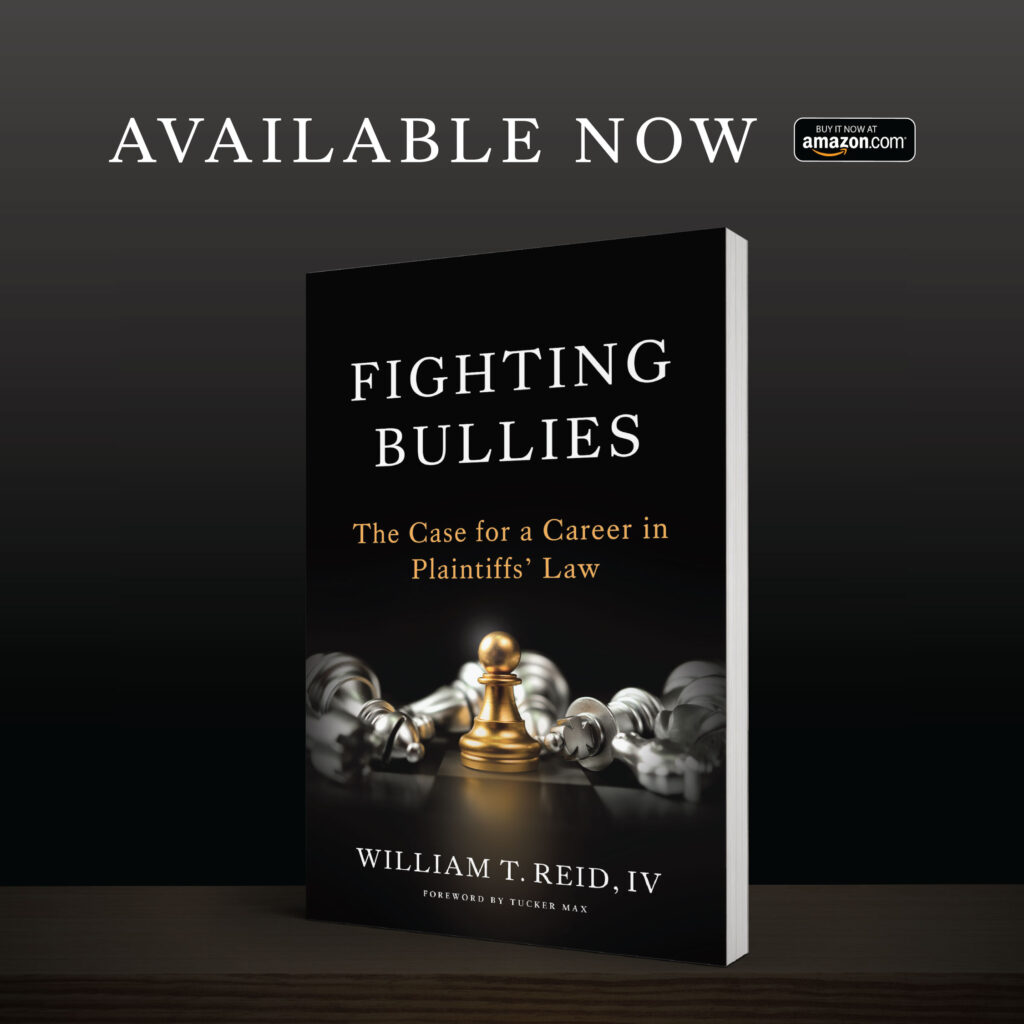
An exclusive excerpt from Fighting Bullies:
The Case for a Career in Plaintiffs’ Law
For Lawbook subscribers, William Reed has provided an excerpt from his book, which can be purchased here.
The excerpt can be seen by clicking here.