Publisher’s note: The Texas Lawbook is pleased to offer this column in partnership with Texas-based Half Price Books sharing our readers’ favorite reads. “My Five Favorite Books” will publish every other Wednesday. Please email brooks.igo@texaslawbook.net for more information.
When I set out to write this column, I thought about all the ways in which I’d try to impress you. Law is, after all, a see-and-be-seen profession! Perhaps I’d start with William Faulkner’s As I Lay Dying and its dense stream-of-consciousness prose (I can’t stand it). Or the scope and cultural impact of David Foster Wallace’s Infinite Jest (I couldn’t get through it). Or maybe I’d do something unexpected about influential children’s books and write about Shel Silverstein’s The Giving Tree (a truly awful, dreadful thing – I won’t be taking any questions at this time).
But what I kept coming back to was something that plays a huge role in my personal and professional life: humor.
Humor as a professional tool is underrated. It helps people connect. It encourages creativity and problem solving, increases resilience, and enhances leadership presence. A joke can deliver a point more sharply than a lecture all the while diffusing tension and criticism. And one well-timed witticism can reset an entire room.
So, I chose five books that never fail to make me laugh: The Hitchhiker’s Guide to the Galaxy by Douglas Adams; Callahan’s Crosstime Saloon by Spider Robinson; The Princess Bride by William Goldman; Johannes Cabal the Necromancer by Jonathan L. Howard; and The Man with One of Those Faces by Caimh McDonnell. I hope you enjoy them, too (although enjoyment is not guaranteed, all terms and conditions apply, and past performance is not indicative of future results).
The Hitchhiker’s Guide to the Galaxy by Douglas Adams

The Hitchhiker’s Guide to the Galaxy follows Arthur Dent – an ordinary Englishman whose life goes awry when the Earth is destroyed to make way for a hyperspace bypass – as he hitchhikes across the galaxy with his friend Ford Prefect. Ford is an alien (“from a small planet somewhere in the vicinity of Betelgeuse”) and roving researcher for the titular Guide. And as Adams writes, “In many of the more relaxed civilizations on the Outer Rim of the Galaxy, the Hitchhiker’s Guide has already supplanted the great Encyclopedia Galactica as standard repository of all knowledge and wisdom, for though it has many omissions and contains much that is apocryphal, or at least wildly inaccurate, it scores over the older, more pedestrian work in two important respects. First, it is slightly cheaper; and second, it has the words DON’T PANIC inscribed in large, friendly letters on its cover.”
Hitchhiker’s Guide is quintessentially the Monty Python of science fiction: dry British understatement of the absurd and in this case, the absurd includes epic questions about space travel, alien civilizations, and “life, the universe, and everything.” Adams’s descriptions include such things as, “the ships hung in the sky in much the same way that bricks don’t,” and his dialogue is as unpredictable as it gets:
“You’d better be prepared for the jump into hyperspace. It’s unpleasantly like being drunk.”
“What’s so unpleasant about being drunk?”
“You ask a glass of water.”
In 2003, the British public voted Hitchhiker’s Guide fourth on the BBC’s list of the best loved novels in the United Kingdom. And for an added treat, the original radio shows that started the whole thing are also available. I recommend that you pair this with a good towel for its immense physical and psychological value. Click here to purchase.
Callahan’s Crosstime Saloon by Spider Robinson
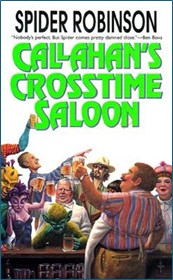
The Hugo and Nebula Award-winning Spider Robinson is known for a writing style that blends humor and wordplay with emotional resonance, and the Callahan Chronicles are a terrific example of his work. Callahan’s Crosstime Saloon features a collection of interconnected short stories set in an offbeat bar called Callahan’s Place, right off highway 25A in Suffolk County, Long Island. It’s too simple to call this science fiction; while it weaves together elements of science fiction, fantasy, and real life, the stories are really about people, empathy, and the strength of community to help overcome extraordinary problems. The regulars at Callahan’s are folks like you and me … and there are also telepaths, an ethical vampire, a handful of aliens and time travelers, a talking dog, and … you get the idea, and the mantra is “shared pain is lessened; shared joy is increased.” But I don’t want to mislead you: you’re going to have to put up with some of the most aggressive and deadly use of puns and shaggy dog stories that I’ve ever found, anywhere. For example , if one of the stories you’re reading takes place on a Tuesday, then “the boys begin assembling around seven-thirty, and after a time people stop piddling around with drafts and start lining up pitchers, and Fast Eddie gets up from his beat-up upright piano and starts pulling tables together. Everyone begins ever-so-casually jockeying for position, so important for Punday Night. Here and there the newer men can be heard warming up with one another, and the first groans are heard.”
In 1977, the American Library Association named Callahan’s Crosstime Saloon a Best Book for Young Adults. And Robinson’s callouts to John D. MacDonald’s Travis McGee and Donald E. Westlake’s Dortmunder make those stories well worth reading as well. I recommend pairing this with a Bushmill’s or Tullamore Dew – especially since you’ll see a glass poured in practically every one of these stories. Click here to purchase.
The Princess Bride by William Goldman
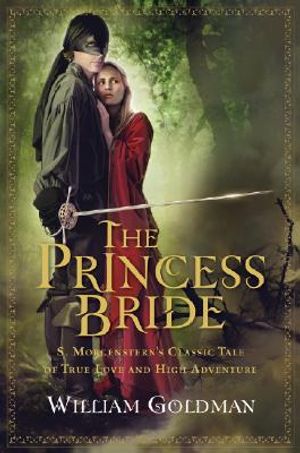
“Let me tell you what’s been going on—No. There’s too much, it would take too long, let me distill it for you”: I suspect that many if not most of you have seen the movie, the screenplay for which was also written by two-time Academy Award winning screenwriter William Goldman. But the book on which it is based is just as special, with virtually all the same witty repartee but a slightly darker tone and framed within an “abridged” version of a fictional classic story: the tale of true love between Buttercup and Westley. There are pirates, giants, sword fights, torture, eels, revenge, and even … <gasp> kissing.
And here’s something of an interesting anecdote, Spider Robinson (yes! He of Callahan’s Crosstime Saloon fame!) claims partial credit for turning The Princess Bride into a cult classic by excerpting the section about the swordfight atop the Cliffs of Insanity into a science fiction short story collection and boosting its exposure. That scene begins with this:
“You seem a decent fellow,” Inigo said. “I hate to kill you.”
“You seem a decent fellow,” answered the man in black. “I hate to die.”
Both book and the movie make a terrific pairing and both are as quotable as they get. Treat yourself immediately – anything else would be … inconceivable. Click here to purchase.
Johannes Cabal the Necromancer by Jonathan L. Howard
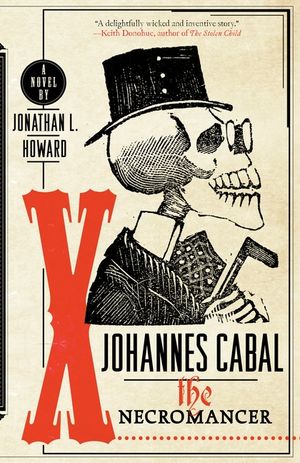
Johannes Cabal is not your typical protagonist, he’s an antihero: brilliant, clever, snobbish, sarcastic, and unapologetically pragmatic to an extreme. He is also a morally ambiguous necromancer – if that’s not an oxymoron – who sold his soul to Satan but now wants it back. Unfortunately, along the way, he will need to contend with local politicians (“Well, if I ever suffer brain damage I know there’s always a career waiting for me in local politics.”) and Hell’s bureaucracy (“Lots of forms. Stacks of forms. An average of nine thousand, seven hundred, and forty-seven of them were required to gain entrance to Hell. The largest form ran to fifteen thousand, four hundred, and ninety-seven questions. The shortest to just five, but five of such subtle phraseology, labyrinthine grammar, and malicious ambiguity that, released into the mortal world, they would certainly have formed the basis of a new religion or, at the least, a management course.”). It’s not quite comfortable to root for him, it’s not quite comfortable to root against him; this is a dark comedy mixed in with elements of gothic horror. But all is not lost: there is a redemption story in there, too (“We’re supposed to be doing the devil’s work and you’ve gone and contaminated it all with the whiff of virtue. I really don’t think you’ve quite got the hang of being an agent of evil.”). Click here to purchase.
A Man with One of Those Faces by Caimh McDonnell
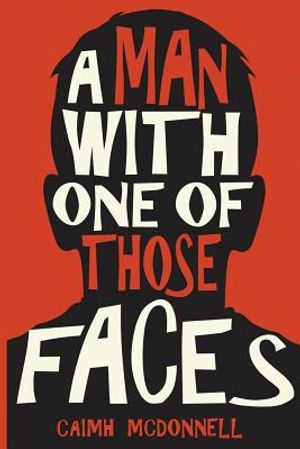
A Man with One of Those Faces is a crime thriller – a darkly comic crime thriller, mind you – set in Dublin, the first of a series. Paul Mulchrone volunteers to visit lonely hospital patients and inadvertently becomes the target of a murder attempt after being mistaken for someone else. Because, you see, Paul just has one of those faces: “There was nothing special about his face – just the opposite in fact – it was entirely ordinary, as was the rest of him. Five foot nine, blue eyes, brown hair. His sheer ordinariness was the whole point. He was a medium everything; his features were the most common in every category. He had nothing that came close to qualifying as a distinguishing anything. His every facial attribute was a masterpiece of bloody-minded unoriginality, an aesthetic tribute to the forgettably average. Collectively they formed an orchestra designed to produce the facial muzak of the Gods.”
Caimh McDonnell is a former professional stand-up comedian and BAFTA-nominated TV comedy writer and it shows: the dialogue is snappy and full of cultural quirks, the characters are eccentric (just wait until you meet Bunny McGarry), and otherwise ordinary scenarios spiral into chaos in ways that are both clever and hilariously improbable. A Man with One of Those Faces itself was nominated for best novel at the 2017 CAP awards. Click here to purchase.
One last note: If you open your average set of regulations, you’ll likely find that it’s really hard for lawyers to write without subsections. I was doing very well with my five regular sections here until I ran into Caimh McDonnell. Because while A Man with One of Those Faces is fabulous, the entire body of written work is absolutely terrific, so much so the “increasingly inaccurately titled Dublin trilogy,” as he calls it, now has a suggested reading order. So that reading order is my subsection. Every one of those books is laugh-out-loud funny.
***
So, there you have it. Five books that are guaranteed (some terms and conditions may apply) to make you laugh.
Shamoil Shipchandler is the chief counsel of the risk and regulatory group at Charles Schwab Corporation and a former director of the U.S. Securities and Exchange Commission’s Fort Worth Regional Office.