
In this edition of P.S., we cover a Texas House Criminal Jurisprudence Committee hearing on how the state’s law schools can help address a lawyer shortage in rural parts of Texas. Lawmakers heard from Texas A&M University School of Law Dean Robert Ahdieh and SMU Dedman School of Law Deason Criminal Justice Reform Center Executive Director Pamela Metzger, among others, about how the legislature, bar and universities can work together to ease the gap.
Despite the Trump administration’s accusations that Susman Godfrey employs diversity programs that violate federal discrimination laws — and citing the firm’s minority scholarship awards specifically — the Houston-based law firm announced it has increased the amount of its prizes to law students of color. The Susman Godfrey Prize, launched in 2021, is awarded to first- and second-year law students of color who have demonstrated academic excellence and overall achievement.
The Hispanic Bar Association of Houston raised a record-setting $387,000 during its 38th Annual Gala on May 15 to support scholarships, grants and public interest stipends. The event, themed “Noche de Alebrijes,” featured a fireside chat between Ruth Mendez, HisBA president and Head of Legal at Shell Mexico, and Travis Torrence, Head of Legal at Shell USA.
And in Dallas, the legal community raised $208,578 and collected 3,947 pounds of food for the North Texas Food Bank as part of the annual “Food from the Bar” campaign. See how the 28 teams fared against one another in the friendly competition to combat childhood hunger during the summer months when kids are out of school.
Hispanic Bar Association of Houston Raises Record-Setting $387K at Annual Gala
The Hispanic Bar Association of Houston raised a record-setting $387,000 during its 38th Annual Gala on May 15 to support scholarships, grants and public interest stipends.
The event, themed “Noche de Alebrijes” — a reference to spirit guides often depicted in Mexican culture as colorful, magical animals — surpassed the organization’s $300,000 fundraising goal and exceeded the $288,000 raised last year, said HisBA President Ruth Mendez.
Mendez emphasized how HisBA continues the legacy of spiritual guides by serving as earthly guides who uplift and support others in both the Houston and Hispanic communities.
“Together, we created a truly magical celebration rooted in community, culture and purpose,” Mendez said. “Guided by this year’s theme of being earthly guides, we were reminded of the power of using our voices to elevate others.”
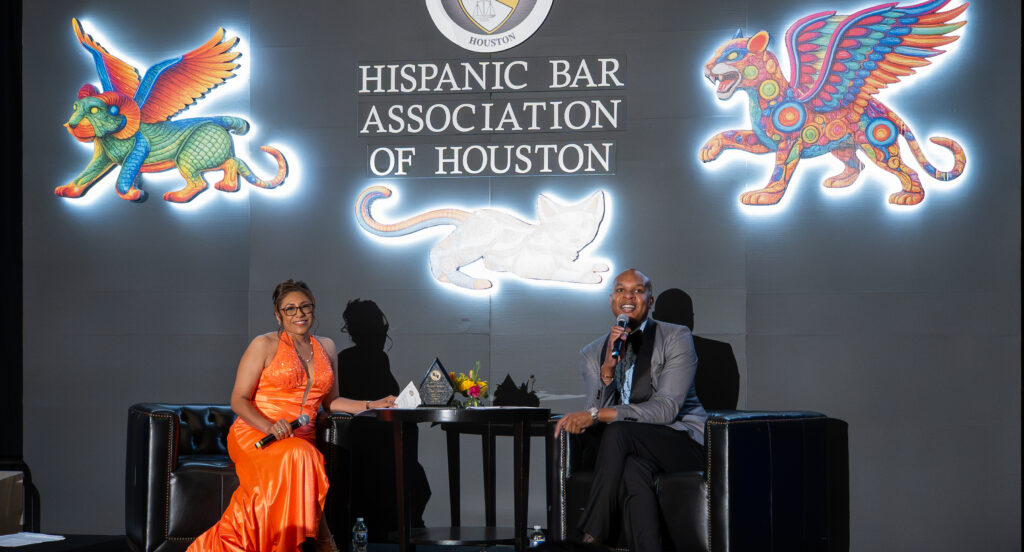
The evening featured a fireside chat between Mendez, who is Head of Legal for Shell Mexico, and Travis Torrence, Head of Legal for Shell USA. Mendez and Torrence reflected on how mentorship and sponsorship strengthened their voices and enabled them to intentionally pay that support forward within the legal community.
As part of its mission to advance Hispanic lawyers in the profession, HisBA has focused this year on a three-part strategy: advancing the pipeline through scholarships, public interest stipends and mentorship; elevating attorneys through mentorship and professional development grants; and empowering communities through pro bono legal services.
“I believe through our strategy, and consistently delivering that message, helped us to further our goals for fundraising,” Mendez said.
HisBA’s scholarship, grant and stipend awards has more than doubled over the past four years, organization leaders said, from $51,600 in the 2022-2023 campaign. The organization is distributing a projected $110,000 in scholarships, public interest work stipends and professional development grants during this fiscal year, which runs from August 1 to July 31.
HisBA will award $4,000 stipends this summer to law students in nonprofit, judicial or government internships and who aspire to work in public interest after graduation. The application period for the Public Interest Fellowship closes today at 5 p.m. Visit this link to review requirements and apply.
And HisBA paired 60 lawyers in its HisBA mentorship program for law students and newly licensed lawyers, Mendez said.
This year, HisBA also helped 360 people through its pro bono efforts, Consejos Legales, a program offered in partnership with Houston Volunteer Lawyers.
The organization also presented the following awards.
- Empower Award: Thomas J. Forestier, Shareholder and Leader of Eminent Domain Practice Group for Winstead
- Judge of the Year Award: Judge Irma Carrillo Ramirez, U.S. Court of Appeals for the Fifth Circuit
- President’s Awards:
- Danny Ramirez: HNBA Host Committee Chair
- Lisa Luz Parker & Daniel Avila: Scholarship Committee Co-Chairs
- Alex Farias-Sorrels: Holiday Party Chair
- Islara Irgit, Chris Domingo, & Leticia Hernandez: Mentorship Committee Co-Chairs
- Consejo Legales Awards:
- Travis Hookham
- Ruben T. Perez
- Benjamin K. Sanchez
- Judge Joe Villarreal
Susman Godfrey Increases Diversity Prize Amid Legal Battle with Trump Administration
Susman Godfrey has awarded 25 law students of color with $5,000 prizes through the Susman Godfrey Prize program, an increase from the $4,000 awards distributed last year.
The Susman Godfrey Prize, launched in 2021, is awarded to first- and second-year law students of color who have demonstrated academic excellence and overall achievement, according to a firm press release.
The firm increased the award amount last year from $3,500 and the number of recipients from 20 to 25 amid a battle with President Donald Trump over his accusations that the firm employs diversity programs that violate federal discrimination laws.
The Trump administration cited Susman Godfrey’s minority scholarship awards when it slapped the Houston-based litigation firm with an executive order declaring it was a threat to national security and revoked the security clearances of its lawyers in April 2025. Susman Godfrey sued and a federal district judge ruled the president’s EO was unconstitutional. The case is on appeal. The Texas Lawbook’s full coverage can be found here.
“The prize is one of many ways we aim to support positive change in the civil trial profession,” said Co-Managing Partner Kalpana Srinivasan. “We look forward to seeing these aspiring lawyers’ continued accomplishments in their legal careers, in the courtroom, and beyond.”
Recipients are nominated by a law school professor or administrator and are evaluated based on their resumes, transcripts and letters of recommendation. Finalists are then interviewed by Susman Godfrey lawyers.
“These exceptional law students have demonstrated focus, creativity, and, above all, a relentless commitment to excellence—all foundational principles of our firm,” said Susman Godfrey Co-Managing Partner Vineet Bhatia. “We are thrilled to celebrate the recipients of the Susman Godfrey Prize, now in its sixth year, and congratulate them for their dedication to the legal community.”
This year’s recipients are listed below, and their biographies may be found here.
- Farah Afify; 1L, Yale Law School
- Oswaldo Ambrosio Lomeli; 1L, Stanford Law School
- Melissa Barales-Lopez; 1L, Yale Law School
- Susana Barragan; 1L, Yale Law School
- Suzanne Castillo; 1L, Yale Law School
- Danna Castro-Galindo; 2L, Yale Law School
- Justin Chock; 2L, Yale Law School
- Nicolas Coleman; 1L, Stanford Law School
- Shanice Guthrie; 2L, Yale Law School
- Stephanie Lai; 1L, Yale Law School
- Alexis Lefft; 1L, UCLA School of Law
- Emily F. Liu; 1L, Stanford Law School
- Frederick Liu; 2L, Yale Law School
- Shyam Madhani; 2L, Yale Law School
- Riley Martinez; 2L, Stanford Law School
- Uma Menon; 2L, Yale Law School
- Yuko Nogawa; 2L, Northwestern Pritzker School of Law
- Karolyn Raj; 2L, University of Texas School of Law
- Chaka Tellem; 1L, Yale Law School
- Summia Tora; 2L, Yale Law School
- Liz Tran; 2L, Yale Law School
- Trinh Truong; 2L, Yale Law School
- Kia Turner; 2L, Yale Law School
- Liyu Woldemichael; 1L, Harvard Law School
- Alex Zhao; 2L, Harvard Law School
The Lawbook’s Mark Curriden contributed to this report.
Food from the Bar Campaign Boosts Support for North Texas Food Bank
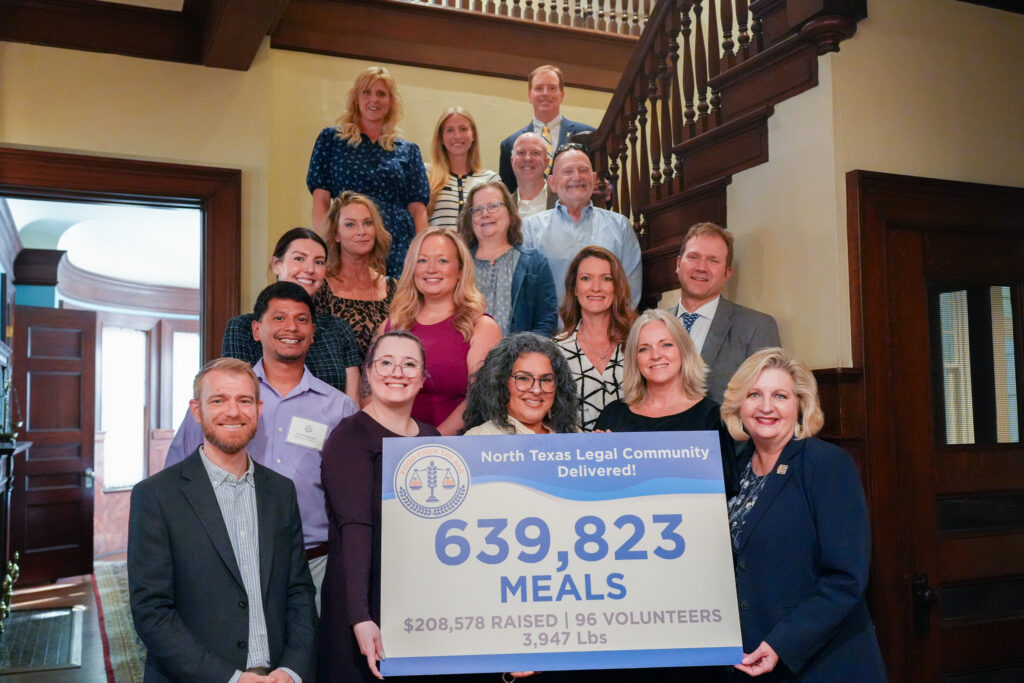
The Dallas-area legal community raised $208,578 and collected 3,947 pounds of food for the North Texas Food Bank as part of the annual “Food from the Bar” campaign in April. The effort also drew 96 on-site volunteers, collectively equating to about 639,823 meals for North Texans, the Food Bank shared.
Twenty-eight teams vied for various prizes that were announced during a celebration at the Arts District Mansion in Dallas this week. The winners are listed below.
Since the campaign’s launch in North Texas in 2019, it has raised more than $1 million and more than 3 million meals aiming to eliminate childhood hunger during the summer months when schools are out of session.
Award Winners:
Power Of Attorney Award – Dallas Trial Lawyers Association – Top Overall
Partner 4 Hope Award – Simon Greenstone Panatier – Top Per Capita
Broadest Appeal Award – Dean Omar Branham & Shirley – Widest Circle of Support
Collective Force Award – Waters Kraus Paul & Siegel; Simon Greenstone Panatier – Most Volunteers
#RaiseTheBar Award – Waters Kraus Paul & Seigel – Best social media campaign
Can-Do Award – Bank of America Legal Department – Most food collected
New Counsel Award – Haynes & Boone – Top first-year participant
Jan H. Howell Trailblazer Award – Amanda Cottrell – Honoring Excellence in Women Campaign Leadership
Texas House Panel Examines Law School Partnerships to Address Rural Attorney Shortage
Solving a lawyer shortage in rural parts of Texas requires a coordinated pipeline effort involving law schools, the bar and the legislature, representatives from North Texas law schools told the Texas House Criminal Jurisprudence Committee this week during a hearing on how the state’s law schools can help address the crisis.
Texas A&M University Law School Dean Robert Ahdieh and SMU Dedman School of Law Deason Criminal Justice Reform Center Executive Director Pamela Metzger spoke on a panel as the lawmakers explore the feasibility of partnerships with Texas law schools aimed at strengthening the pipeline of prosecutors and defense lawyers in rural communities.
“We have to acknowledge, as law schools with the help of the legislature and I hope the courts, that rural work is public service. It’s not leftovers for people that couldn’t get Big Law jobs,” Metzger said. “It is noble public service and it needs to be recognized as such. We need to think about that fact and we need to be teaching the idea that rural practice is an important part of our democracy.”
She added that Texas is also facing an access-to-justice crisis in civil law, and that boosting the availability of lawyers in rural areas would also ease that gap.
Ahdieh outlined a framework built around three areas he said lawmakers should prioritize: awareness, education and incentives.
“I think it will be critical to address each of these three areas,” Ahdieh said.
Among the ideas he proposed were developing rural-focused case studies that could be incorporated into law school coursework and expanding funding support for externships and clinics serving rural areas.
Ahdieh also pointed to student-focused incentives such as public interest scholarships and loan repayment assistance. He said some states are exploring bar-related incentives tied to rural service, including allowing students to sit for the bar exam early if they spend a semester working in a rural community, reducing bar exam cut scores for attorneys who commit to rural practice or admitting attorneys to the bar without an exam if they agree to serve in underserved areas.
Joe Stephens, chief public defender of the Caprock Public Defenders Office housed at Texas Tech, said the state’s public defense system has become increasingly competitive as offices compete against one another for grants and law school graduates.
“I think a wise proposition would be to consider studying the impact, resources-wise, of combining some of the smaller offices – bringing them together thoughtfully and meaningfully – so that people can focus on different tasks and there can be a more meaningful recruitment process,” Stephens said.
He pointed to a partnership forged with a neighboring public defender officer that allowed the two to maximize the impact of a grant.
Several committee members, some of whom are lawyers themselves, reflected on the stark pay gap between Big Law jobs and public service positions that law students face when choosing careers, often straddled with law school debt.
State Rep. Brent Money questioned how law schools are working to make law school more affordable. Ahdieh said Texas A&M Law has avoided tuition increases for at least five years despite inflationary pressure and invests heavily in scholarships.
State Rep. Wes Virdell, who is not a lawyer, challenged the belief that law school should be the only path to becoming a lawyer. Virdell previously introduced legislation that would have allowed experienced industry professionals, including paralegals, to sit for the bar exam after meeting certain requirements. He said he plans to file a similar bill again.
“I know lots of paralegals that have worked for a lawyer for a long time – they’re really good at what they do. I think they could go take the bar exam with a little bit of studying,” Virdell said.
“Y’all are putting a lot of emphasis on law school as developing competent lawyers but there are other paths to being a competent lawyer without the law school,” Virdell added.
State Rep. AJ Louderback questioned whether enough collaboration has taken place with the Texas Education Agency to promote legal careers to students in rural high schools.
Metzger said more outreach at the high school level is needed, while Ahdieh said law schools should play a more visible role in those efforts.
“The law schools themselves should be front and center in that,” Ahdieh said. “That’s a good use of our time.”