
Just a few days before joining Kirkland & Ellis as litigation associates, and while awaiting the results of their bar exams, Gabrielle Olubanke Howells and Lizeth Badillo Garcia notched their first court win — a precedent-setting decision from a panel of judges at the U.S. Court of Appeals for the Fifth Circuit.
In June, The Texas Lawbook featured the University of Texas School of Law graduates who, through a partnership between the school and law firm, got the unique opportunity to argue a pro bono prisoner’s rights case before the federal appeals court mere weeks after graduation and before sitting for the bar exam.
On the Friday before Labor Day and before they’d join the firm full time, Howells and Badillo Garcia learned they’d won their case.
“I expected this decision, because I believe in the case and I believe we were right on the law,” said Kirkland & Ellis partner Zack Ewing, who supervised Howells and Badillo Garcia. “But what I couldn’t believe was that we got a 24-page opinion that’s precedential, that was published by the Fifth Circuit. That’s what really made my jaw drop — that we created law with this case.”
From the Gallery to the Lectern
As Kirkland summer associates last year, Howells and Badillo Garcia traveled to New Orleans to watch firm attorneys argue a pro bono compassionate release case in the Fifth Circuit. They returned to Austin mesmerized.
Ewing wondered if he could emulate a program he participated in during his third year at the University of Pennsylvania Carey Law School, in partnership with a Philadelphia-area law firm that allowed him to argue an appeals case before the Third Circuit. He contacted UT Law leadership and the staff of the Fifth Circuit’s pro bono program, which assigns cases of pro se appellants to lawyers for pro bono representation.
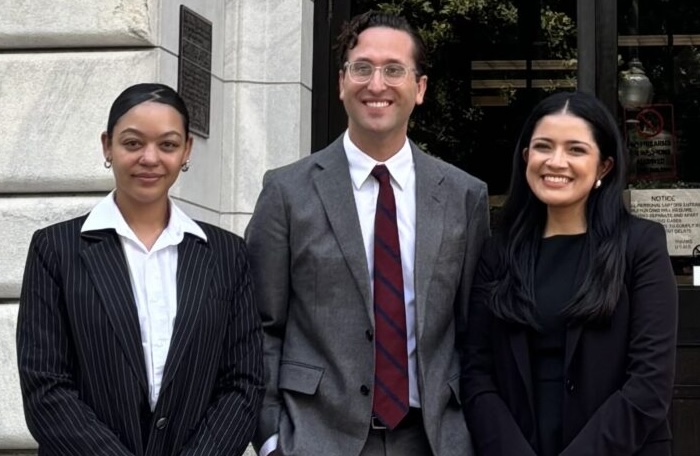
About a month later, Ewing received an assignment for Howells and Badillo Garcia: the case of Stephon Eric James, a Louisiana prisoner with a prosthetic eye who alleged he was denied appropriate care while in custody and who further accused doctors and prison officials of falsifying medical records to cover up their failure.
For the next 10 months, Howells and Badillo Garcia, under Ewing’s supervision, authored a supplemental brief and reply brief, and prepared for oral arguments, while simultaneously keeping up with the demands of their final year of law school and studying for the bar exam. Badillo Garcia also balanced the responsibilities of being a mother to her young son, Ezra.
Creating Effect on Future Civil Rights Cases
Their client, James, alleged that the deliberate indifference of prison officials and medical staff at St. Tammany Parish Jail led to a weekslong delay in treatment for an infection in his eye socket, which caused substantial unnecessary pain around his prosthetic eye.
James represented himself in a civil rights suit against doctors and jail officials, including the sheriff. In response, the doctors filed a motion to dismiss the claims against them, attaching James’ medical records in support of their argument that they were not deliberately indifferent to his medical needs. Because the records were submitted as part of the motion, the presiding magistrate judge converted it into a motion for summary judgement.
During the proceedings, James repeatedly sought court-appointed lawyers, but those requests were denied. He also attempted to compel discovery multiple times. A December 2022 motion was denied because he had yet to formally serve discovery requests to the defendants. A follow-up motion to reconsider the denial of counsel was also rejected.
James later requested to amend his complaint to include unnamed medical staff, asking to name them once discovery was complete. The motion was denied as well, with the judge finding that it failed to adequately respond to the arguments raised by the defendants and did not include any new factual allegations.
In March 2023, the magistrate judge recommended granting summary judgment in favor of the doctors. James then filed a second motion to compel discovery, stating that he had served the defendants’ lawyers with requests for documents and interrogatories but had received no response within the required 30-day period. The magistrate judge dismissed the motion as moot, noting James had acknowledged receiving the materials.
James submitted a third motion to compel in May, alleging that although the lawyers for the sheriff had responded, most of his inquiries were referred to the lawyers for the doctors, who did not respond at all. Within days, the magistrate judge ordered the defendants to reply. In their response, the jail officials argued that the motion was largely directed at the since-dismissed doctor defendants and that their own responses were adequate. James disagreed, stating that key evidence — such as video footage, audio recordings and disciplinary records — was still missing. The judge never issued a ruling on the motion.
The jail officials filed their own motion to dismiss, which the judge granted over James’ opposition. On July 20, 2023, the magistrate judge converted his earlier report and recommendation to grant the doctors’ motion for summary judgment to an order. Ten days later, the judge entered final judgment, dismissing all of James’ claims with prejudice — effectively closing the case.
Represented by Howells, Badillo Garcia and Ewing, James asked the Fifth Circuit to review two of the magistrate judge’s decisions: the grant of summary judgment for the doctors and the dismissal with prejudice of his complaint against one of the jail officials.
At oral arguments, Howells took on the task of arguing that the doctors’ motion to dismiss should not have been converted into a motion for summary judgment and granted without allowing discovery. Badillo Garcia led arguments that James should have been granted leave to amend his complaint regarding the jail official.
The judges reversed the grant of summary judgement regarding the doctors. They affirmed in part the dismissal of the claims against the jail officials but remanded the case with instructions to modify the dismissal to instead be without prejudice and to allow James to amend his pleadings.
Regarding the case against the doctors, the judges wrote that the facts taken together demonstrate issues of material fact and that the magistrate judge plainly erred in the findings that formed the basis of his recommendation. The judges further wrote that the error affected the outcome of the judge’s decision to grant summary judgement and therefore affected James’ substantial rights.
“In short, the doctor-defendants “had the burden of proving the nonexistence of material disputes,” the judges wrote, quoting another case. “They failed to do so. Yet the Magistrate Judge found they had and improperly shifted the burden to James. That error affected James’ substantial rights because it “undermines confidence in the outcome” that summary judgment was appropriate.”
Regarding the case against the jail official, the judges found that while dismissal was appropriate, James was not able to argue his “best case,” and therefore the court was not required to dismiss with prejudice and instead should’ve dismissed without prejudice.
“James has not been able to plead crucial elements of a plausible deliberate indifference claim because he lacked the necessary discovery,” the judges wrote.
Ewing said the judges clarified standards for granting a motion for summary judgment and a motion to dismiss that will be particularly helpful in future civil rights and prisoner rights cases.
“In the motion for summary judgment context, I think the court clarified that doing so before there’s a meaningful opportunity for discovery, or cutting off discovery, is plain error, which in this particular type of case can be a difficult standard to meet. So it’s remarkable that the court found that the cutting off of discovery did amount to plain error. That’s a great clarification from the Fifth Circuit,” Ewing said.
“In the motion to dismiss context, the court found that the failure to give a pro se plaintiff leave to amend — at least once, particularly when it’s been requested — is also reversible error,” Ewing added.
A Win Before Day One
The Friday before Labor Day — as that break-like period after taking the bar exam and before joining a firm full time wound down — Howells and Badillo Garcia got the news.
That morning, Ewing saw an email alert from the court that an opinion had been entered. He pulled into the parking lot of his kids’ school and began to read. He forwarded the email to Howells and Badillo Garcia with a subject line saying, “We won” and “about 50 exclamation points.”
Before she saw the email, Badillo Garcia saw a vague congratulatory text message from one of her former law professors. “What did I do?” she thought to herself.
Howells was in the car with her sister driving to a liquor store to prepare for the holiday weekend — her dad was visiting from out of town — when she saw the email. “I was bawling,” she said. “I was shaking.”
“I feel very affirmed that all of the late nights, all of the panicking, all of the scared emails to [Ewing] was all worth it,” Howells said.
The following Tuesday, Howells reported to the firm’s Houston office and Badillo Garcia began work in the Austin office. Ewing is a proud mentor.
“What an incredible way to go into your career,” Ewing said of them. “Before you even start as a full-time attorney, you already won a published precedential Fifth Circuit opinion.”