
An American president denounces the judiciary, accusing courts of usurping power and judges of being politically motivated. His supporters warn of judicial tyranny that undermines the Constitution.
What at first sounded like a description of current events turned out to be history. The political figures being described were President Thomas Jefferson, Alexander Hamilton and Samuel Chase, an associate justice of the United States Supreme Court.
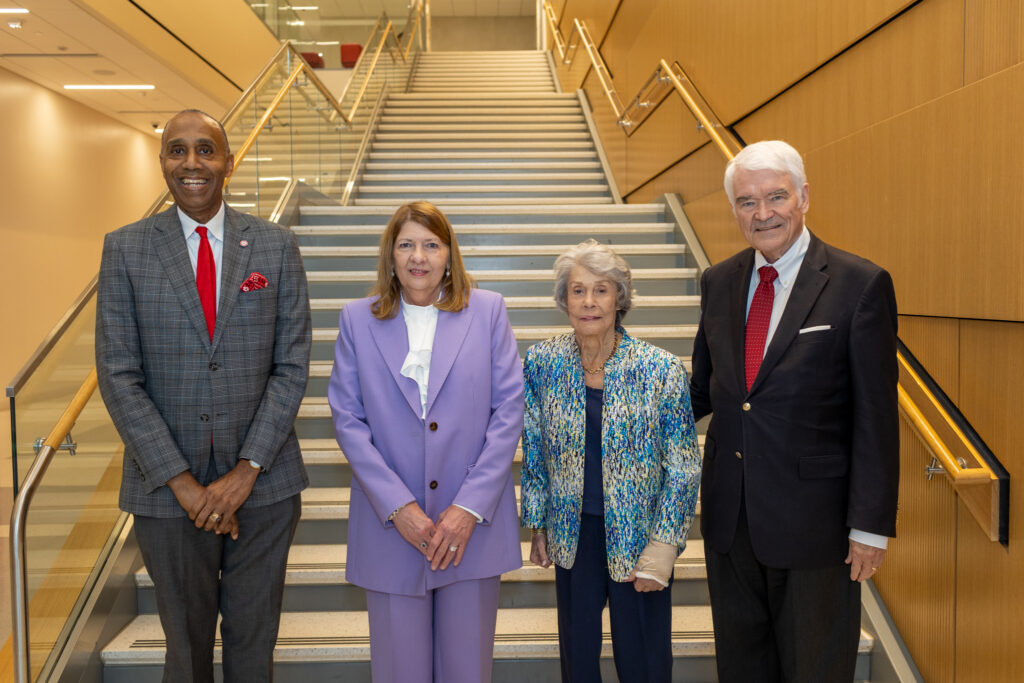
“Fooled you, didn’t I? You thought I was talking about another day,” Nathan Hecht told an audience at the University of Houston Law Center during a recent speech on judicial independence.
Chase was impeached in 1804 by the House of Representatives on allegations of political bias in his decisions. He was acquitted by the Senate and remained in office until his death in 1811.
Hecht, the former chief justice of the Texas Supreme Court, titled his lecture “Whose Side Are You on Judge, Ours or Theirs? Judicial Independence in a Riven Civitas.” It was delivered before an audience at the law school and broadcast online for the 2026 Justice Ruby Kless Sondock Lecture in Legal Ethics.
Sondock, a pioneering jurist celebrating her 100th birthday this month, looked radiant in a bright blue-and-cream jacket as she watched the speech from the front row and later raised a glass of champagne as she was toasted by Law Center Dean Leonard M. Baynes.
Sondock graduated as valedictorian and one of five women in the UH law class of 1962. She became the first female state district court judge in Harris County when she was appointed to the bench in 1977. She was appointed to the Texas Supreme Court in 1982 and served for six months, making her the first female justice to serve in a regular term. Instead of seeking election to the Supreme Court, she ran and won reelection to her district court seat.
Hecht called Sondock a role model for himself and other judges.
A theme throughout his April 15 lecture was the original dispute among the Founding Fathers over the nature of the judiciary.
“President Jefferson deplored the thought of judicial independence,” Hecht said. “‘The Constitution,’ he wrote, ‘is a mere thing of wax in the hands of the judiciary, which they may twist and shape into any form they please.’ What a great Tweet that would have made.”
Hamilton, Jefferson’s rival, supported an independent judiciary with federal judges appointed for life and, per 1803’s Marbury v. Madison, get to decide among the three branches what is constitutional.
Other presidents, including Franklin Roosevelt, Barack Obama and Donald Trump have publicly criticized SCOTUS rulings.
But, Hecht emphasized, the criticism has grown even louder, and polls show public confidence in the courts declining. The question most concerning to Hecht is whether the public believes state courts are political. In 2014, 48 percent of people polled said yes; in 2024, 59 percent answered in the affirmative. There was no variation based on a respondent’s side of the political spectrum, according to Hecht.
“So, here’s what I think,” he said. “The loss of public confidence in the justice system is due to accusing justices of taking sides and encouraging them to do so on one hand, and on the other, Jefferson was right about this: Removing justices and judges from popular political pressures with lifetime appointments can invite lack of accountability and even judicial overreach.”
In the end, Hecht said, Hamilton was right that the rule of law requires judges be independent of the popular political pressures that roil the other two branches.
Hecht, the longest serving member of the Supreme Court in Texas history, had some advice for jurists serving on appellate courts.
“Tone it down. Keep it issue oriented and not so personal,” he said. “I served for 36 years on the Supreme Court of Texas. We had some sharp opinions every once in a while, but it wasn’t routine, it wasn’t regular. And now it almost never happens.”
Dissenting opinions that insinuate the world will end because of the majority ruling are destructive and akin to a dirty bird that fouls its own nest, Hecht said, using his grandma’s aphorism.
“As lawyers, we should encourage the bench to hold the rhetoric down a little bit,” he said.
Although dissents, especially strident ones, are a rarity of the Texas Supreme Court, Hecht’s tenure there started in a time of partisan division on the court.
“There’s a lot of peer pressure to try to tone it down, but there needs to be more of that so the message to the people is, this is a justice system. You can trust that we’re trying to get it right and calling each other names and insinuating that you’re not is not helping.”
Hecht mentioned Justice Sonia Sotomayor’s recent criticism of a colleague’s concurring opinion in an immigration case in comments she made during an appearance at the University of Kansas Law School. She subsequently apologized to Justice Brett Kavanaugh, whom she did not name during the speech, for suggesting he had led a privileged life. In a statement issued by the court’s Public Information Office, Sotomayor said her remarks were inappropriate and hurtful.
Hecht also mentioned the growing number of threats against judges and Chief Justice John Roberts’ denunciation of the threats during a March appearance at Rice University. The U.S. Marshals Service reports 275 threats against federal judges so far this year, according to a news release from Speak Up for Justice, a group focused on judicial security.
Trump has regularly denounced federal courts who have ruled against his administration, recently saying in a social media post that a federal judge who had blocked construction of a White House ballroom was a “Trump Hating” judge who “has gone out of his way to undermine National Security.”
Other factors that could improve the public’s view of the Texas courts are improving funding to help the huge number of individuals involved in civil litigation who cannot afford a lawyer and having the state join 12 others that have authorized non-lawyer professionals to practice in limited areas to aid unmet legal service needs, Hecht said.
“Judicial independence is an exception in a democracy. It’s not the rule. The other two branches don’t have it,” Hecht concluded. “And so, we’ve got to earn it and show that it is justified, to prove that President Jefferson’s fears were mistaken and that Hamilton was right. Judges can be accountable to the rule of law even without being elected.”