
When the Texas Business Court opened its doors two years ago, there wasn’t a rush to the proverbial courthouse from litigants excited to take advantage of the state’s new venue for handling complex business disputes.
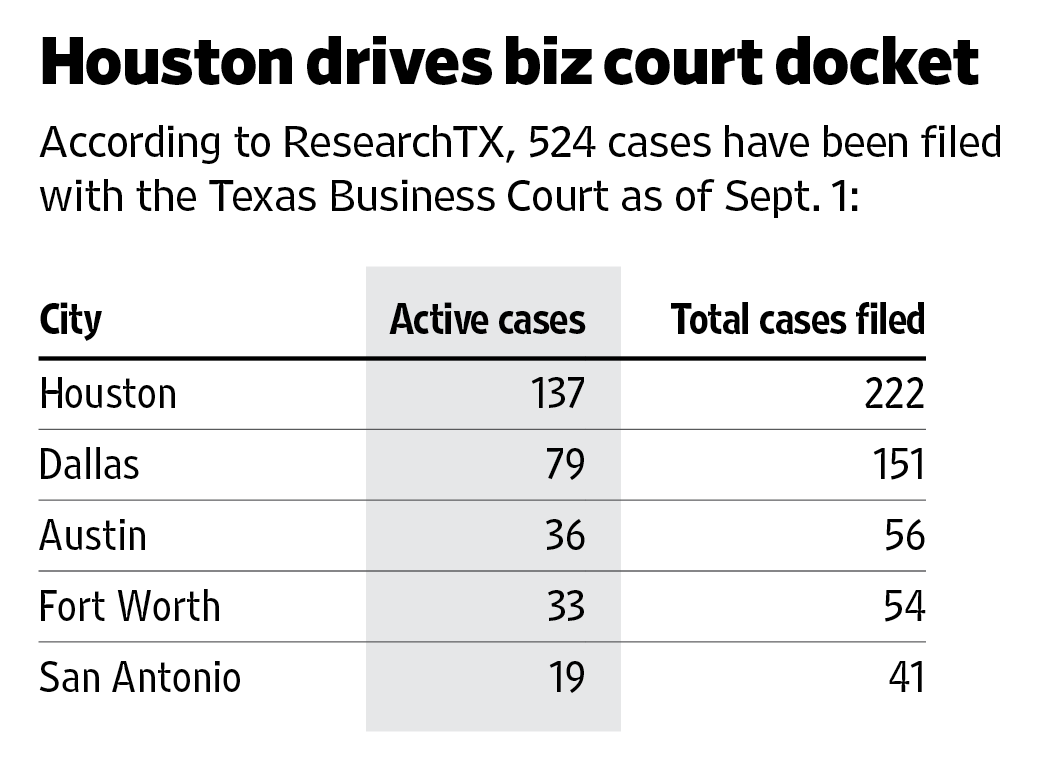
Instead, cases were filed at a rate of about one per day. Those metrics have largely remained steady, data shows, with a total of 524 cases filed with the court over the past two years, about one per business day. The fledgling court has seen its first handful of jury trials and verdicts, and it has quickly adjudicated a number of other high-profile commercial disputes that could have languished in state district court for years, including a fight between the Dallas Mavericks and Dallas Stars.
Lawmakers created the court three years ago with the intention of signaling to the business community that Delaware wasn’t the only venue that could provide quick, consistent results in complicated legal matters. Since then, businesses such as ExxonMobil and Tesla have reincorporated in Texas, and the term DExit has entered the vernacular of business lawyers statewide.
And utilizing docket equalization measures has ensured no single division is overloaded with filings. Houston leads the way with 222 total cases, and Dallas is next with 151.
But still, there have been growing pains.
Not having designated courtrooms has left parties wondering where their hearings or trials will take place. This has forced the courts to get creative, making use of space in a building in Houston that had previously been tagged for demolition, setting up in digs offered by Texas law schools and even using a hotel ballroom to administer justice when needed.
“We’ve solved all the logistical hurdles to date, but the one real serious one is courtroom space. That is existential,” Judge Grant Dorfman told The Texas Lawbook in a recent interview. “That’s the one that I sometimes lie awake at night thinking about.”
Chief Justice Scott Brister of the Fifteenth Court of Appeals told The Lawbook on Tuesday he had spent much of the prior day working in what has become cramped chamber space in the William P. Clements State Office Building at the corner of Lavaca and 15th in downtown Austin with ear plugs in.
“There was a guy working with a jackhammer, and he was relentless,” Justice Brister said, noting the construction has been ongoing for a year. “Just drilling one hole after another from 9 [a.m.] until 3 p.m.”
“It is hard to work in this office because of the racket going on around it.”
Aside from the construction noise, the space inside the Clements building can’t accommodate all the justices and their staff, he said. That problem will only get worse when another jurist and three staff are added in September 2027 — and again in September 2028.
“We literally have no desks left,” he said.
Those are chamber-space issues. There are also courtroom space issues. The Fifteenth Court of Appeals has utilized space offered for oral arguments at the Court of Criminal Appeals and the University of Texas School of Law. To get from chambers to UT, the justices pile into a van with their robes and related “paraphernalia” to hear oral arguments.
“They’ve been great hosts, but it’s not ideal,” he said. “And, of course, having judges walking across public streets is not what public safety officers would advise. It’s just not a great idea.”
While the Legislature created 11 divisions, lawmakers have only funded operations in the major metro areas — Dallas, Fort Worth, Austin, San Antonio and Houston. Six divisions remain unfunded, including the division covering the Permian Basin.
“I would love to be able to offer the Business Court as a venue for those cases,” Judge Dorfman said of the frequent oil and gas disputes that spawn in that part of the state. “The energy industry has been an early adopter of us. A plurality of our cases is clearly, far and away, energy sector-type cases.”
“I think the model has shown it works where it’s been put up and I’d love to see it expanded based on need.”
In 2027, lawmakers will head to Austin for the legislative session, but Judge Dorfman, who also serves as the court’s administrative judge, said talks are already underway regarding the possible expansion of the Business Court.
“Whether to take it statewide will be a topic of discussion,” he said, adding that lawmakers on “both sides” favor expansion.
In two stories set to run later this week, The Lawbook will examine the possibility of Business Court expansion as well as the issues and potential remedies surrounding the lack of dedicated courtroom space.
Chief Justice Brister said conversations with staff members on the Senate Finance Committee and the Texas Facilities Commission regarding courtroom space have been taking place already and will continue up to the 2027 legislative session. And hopes are high a resolution can be reached.
One of the goals for the creation of the court, he said, was to signal to the business community that there was a “first-class justice system that can handle their disputes.”
“And with this moving around, courtroom to courtroom month to month … it doesn’t create the feel of a first-class court system,” he said. “It’s got a bit of an ad hoc feel to it.”