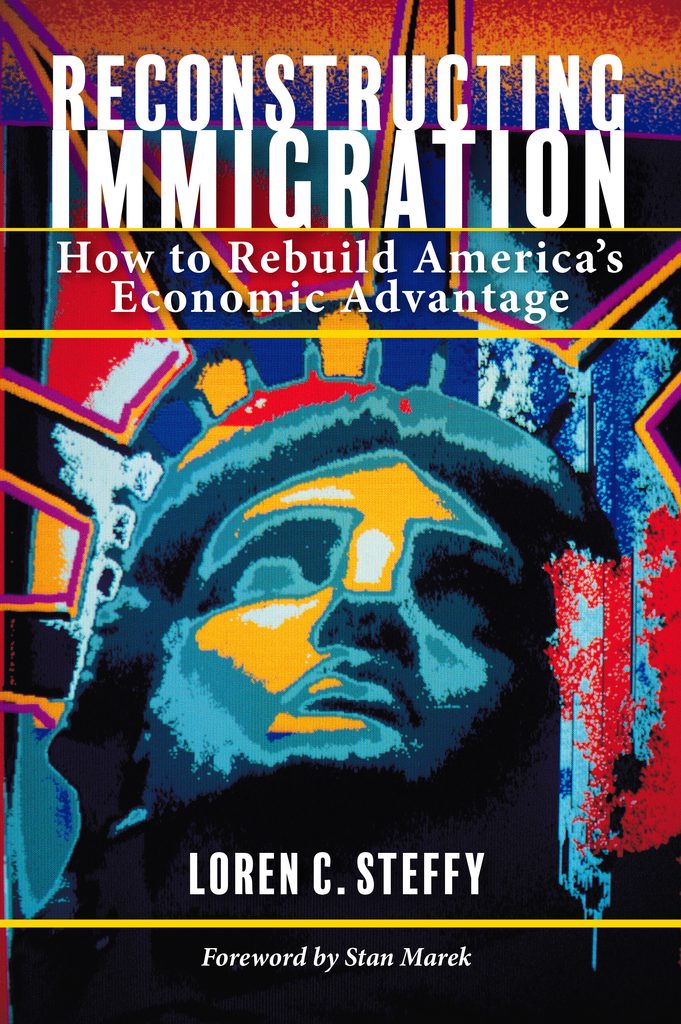
Publisher’s Note: The following excerpt is adapted from Reconstructing Immigration (Stoney Creek Publishing, October 2026). Loren will be speaking about the book at Interabang Books on Wednesday, Oct. 21 at 6 p.m. The conversation has been approved for 1 hour of CLE credit. Event details are here: https://interabangbooks.com/event/2026-10-21/loren-steffy-reconstructing-immigration.
The most visible part of the immigration crackdown is the part that ends up on television. The other part is quieter, and lawyers see it before anyone else does.
Elizabeth Mendoza has practiced immigration law in Houston for 33 years, and she’s seen how fear and intimidation generated by current immigration policy undermines legal protections. A woman raped in an apartment-complex parking lot, who clearly qualified for a U visa granting temporary status to victims of serious crimes, was afraid to file a police report after hearing that the Houston Police Department was working with ICE on another victim’s case, Mendoza said. An asylum seeker who had complied with every legal obligation was afraid to attend his first hearing because of reports that ICE was arresting people who showed up in courthouses. An Iranian client who had reported faithfully to ICE for twenty-five years was preparing for the near certainty that he would be detained the next time he walked into the federal building.
Mendoza’s firm had spent years giving “know your rights” presentations in churches. Now her team has to hold them for themselves before each event, in case ICE agents are waiting in the parking lot.
The tactical mix of public raids and quiet attrition is the same one Operation Wetback used in 1954 to drive its inflated departure numbers. The results are also similar, Mendoza said: communities are pulled apart, due process is eroded, and a workforce is frightened out of the legitimate economy without anything legal taking its place.
The docket empties
The asylum system has been a particular target. By the spring of 2026, The Economist concluded that “asylum in America is all but over,” describing how the second Trump administration had effectively closed access at the border. The administration set the annual refugee admissions ceiling for fiscal year 2026 at 7,500 — the lowest in the program’s history — with priority given primarily to white South Africans. In late 2025, after a shooting attributed to an Afghan asylum seeker, the administration paused all asylum decisions and suspended visa processing for Afghan nationals, including those who had aided the U.S. military as interpreters, guides and fighting partners during the 2001–2021 war. In June 2026, a federal court ruled that the government’s blanket refusal to process Afghan immigration requests was illegal.
Inside the immigration courts, ICE attorneys began asking judges to dismiss pending asylum cases without hearing them and to order applicants deported to third countries such as Guatemala, Honduras, Ecuador and Uganda — places to which many of those applicants have no connection.
Then, in late June 2026, the U.S. Supreme Court ruled 6-3 that a president’s decision to end Temporary Protected Status essentially can’t be reviewed. Courts cannot second-guess it. The immediate effect is that the government can begin removing more than 350,000 Haitians and Syrians who have been living and working here legally, in some cases for decades. The deeper effect is that the same logic now hangs over all 1.3 million people who hold TPS.
Some 830,000 TPS holders are in the American labor force. They add about $29 billion a year in spending power and pay close to $8 billion in taxes. According to an estimate by FWD.us, the total contribution since 2001 is about $262 billion, including roughly $20 billion into Social Security — a program these workers help fund and, lacking any pathway to citizenship, will almost certainly never draw a dollar from.
For employers, a status that can be revoked without meaningful judicial review is not a status at all. It is a scheduling risk.
States take the wheel
While the deportation debate has largely focused on federal enforcement, the most aggressive new front has opened at the state level. In 2023, the Texas Legislature enacted some of nation’s most restrictive legislation. Lawmakers expanded Operation Lone Star, the $11 billion border-security measure that began in 2021, and adopted a suite of new laws to push the boundaries of state power over immigration. Legislators ramped up the use of surveillance drones, authorized certain federal agents to make arrests for state felonies, funded border-security infrastructure, and empowered the governor to coordinate with other states. In a series of special sessions, lawmakers then passed three major immigration-related laws — two separate measures called SB 4 and a large funding bill — that increased penalties for smuggling-related offenses, poured additional resources into enforcement, and formalized more authority for state officials involved in Operation Lone Star.
The most far-reaching of these, often referred to as the “second SB 4,” creates state crimes for “illegal entry,” “illegal reentry,” and refusing to comply with an order to return to a foreign country. It also authorizes Texas judges and magistrates to order noncitizens expelled to Mexico regardless of their actual country of origin. The law directly challenges U.S. Supreme Court precedent by setting up a parallel, state-run deportation system.
Texas officials did learn one lesson from history and applied it to this case. Operation Wetback fell short of its stated objectives in the number of Mexicans deported under the program. So Operation Lone Star doesn’t have any defined objectives. Despite spending $11 billion of taxpayer money, the effort does not include a definition of success. Several years ago, I estimated the state was paying about $435,000 for each of the 23,000 migrants it stopped at the border during the first three years of the program. Governor Greg Abbott, the architect of Operation Lone Star, touts it as a success, but only because he never established any goals for the program, such as designating how many migrants it was designed to stop. Without any objectives, it’s impossible to assess the program’s effectiveness.
Where the litigation stands
The book went to press describing SB 4 as enjoined. It no longer is.
The original challenge — including a suit by the U.S. Department of Justice arguing that federal law preempted the state statute — collapsed on two fronts. The Trump administration withdrew the federal government’s participation. Then, in April 2026, the Fifth Circuit, sitting en banc, held 10-7 that the remaining plaintiffs lacked standing, reasoning that organizations that “voluntarily incurred costs to advocate for clients” had not shown injury sufficient to sue. The court did not reach the constitutional question at all.
A second challenge followed. On May 14, 2026, U.S. District Judge David Alan Ezra preliminarily enjoined four provisions, including the reentry crime and the authority of magistrates to order removal. Three days later, the Fifth Circuit lifted that injunction in an unpublished order, and the law took effect.
Ezra’s opinion contained the sentence that ought to concentrate the minds of anyone who advises a multistate employer: “It is implausible to imagine each of the fifty United States having their own state immigration policy.”
That is now closer to plausible than it has been since the nineteenth century. The take-matters-into-our-own-hands Texas laws are serving as a legal and political template for other Republican-controlled states. If more states follow suit, the country could end up with a fragmented, state-by-state immigration regime that undermines more than a century of federal primacy and produces widespread confusion, instability and fear — exactly the conditions that have historically proven most damaging to the U.S. economy.
The cost of a chilled witness
The economic argument against all of this is the one I spend most of the book making. But there is a narrower, more immediate cost, and it falls on the justice system itself.
Chief Andy Harvey, who has served as a commander in the Dallas Police Department and as chief in Palestine, Texas, and the Rio Grande Valley city of Pharr, has spent three decades policing communities where documented and undocumented immigrants live alongside native-born Americans. “Crime rates in immigrant neighborhoods are really low,” he said. The people who arrive at the border are overwhelmingly “families that want to come over here and contribute and do well for them and be good citizens.”
Harvey’s warning is not sentimental. If the only witness to a serious crime is an undocumented immigrant too afraid to speak to police, the crime goes unsolved, and every American in that community is less safe. The mass deportation campaigns of history did not just fail economically and morally. They actively made communities more dangerous by destroying the trust that effective policing depends on.
The same dynamic now runs through wage-and-hour enforcement, workplace safety complaints, U visa petitions and, increasingly, immigration court itself. A legal system that cannot get witnesses through the door produces a predictable result: fewer cases, weaker cases, and a growing share of the economy operating beyond law’s reach.
Strip away the culture war and immigration is a labor-supply question — open jobs, too few workers, prices that climb. What Texas has built in the last three years is something else: a second, parallel enforcement apparatus with no stated objective, no measure of success, and, as of this spring, no injunction standing in its way.
Loren C. Steffy is the author of Reconstructing Immigration: How to Rebuild America’s Economic Advantage (Stoney Creek Publishing, October 2026) and co-author, with Stan Marek, of Deconstructed: An Insider’s View of Illegal Immigration and the Building Trades. For four decades, he has written about business and economics for The Dallas Times Herald, Bloomberg News, the Houston Chronicle, Texas Monthly and other publications.