
Professional and college sports venues increasingly serve as anchors for much larger mixed-use districts. Hotels, multifamily, retail, restaurants, entertainment, office and public infrastructure are being developed together to create destinations intended to generate activity well beyond game day. These projects present an unusually broad set of development, financing and structuring issues.
Opportunity Zones may now add another piece to that equation.
The Opportunity Zone program is permanent, and the map for its next round is now final. On Nov. 5, 2026, Treasury and the IRS designated all 6,576 census tracts nominated by the states, including 2,594 rural tracts, as Qualified Opportunity Zones. The new zones take effect Jan. 1, 2027, and retain that designation for 10 years.
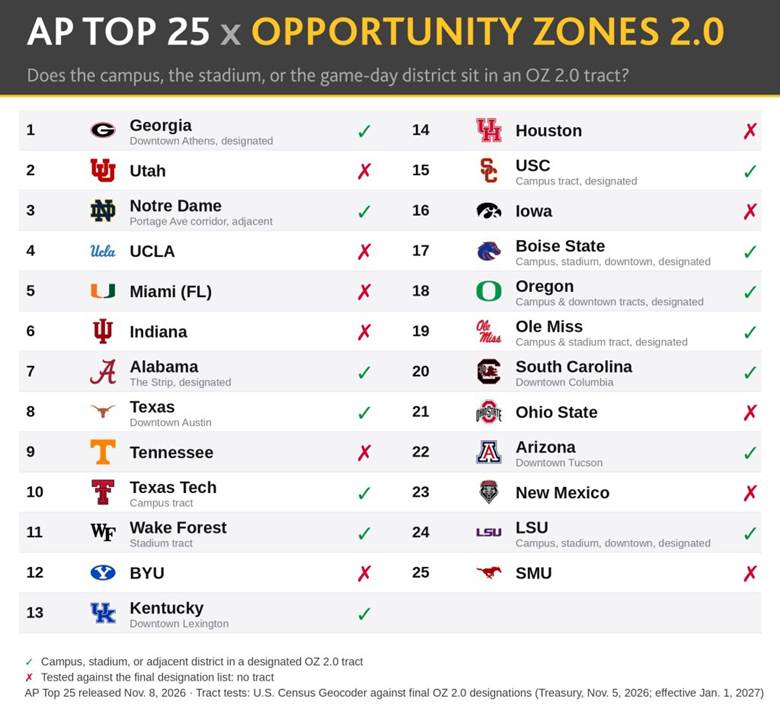
For owners and developers working around professional and college sports facilities alike, the new map deserves a close look. The relevant question is whether the surrounding development opportunities align with designated tracts and a long-term investment strategy.
Why Stadium Districts and Opportunity Zones Can Fit
The potential fit goes beyond geography.
Sports-centric districts increasingly combine exactly the types of assets that can work well with the Opportunity Zone holding period: hotels, rental residential, retail, entertainment and other mixed-use assets designed to be owned and operated over the long term. Winstead’s broader sports development work includes projects such as The Battery Atlanta, The Star in Frisco, the Arizona State University/Novus district and Omni PGA Frisco, illustrating the range of uses that can surround an athletic or entertainment anchor.
That matters because the principal Opportunity Zone benefit is also a long-term proposition. An investor that holds a qualifying fund investment for at least 10 years can exclude the appreciation on that investment. A hotel or rental project intended to operate for a decade or more therefore has a fundamentally different OZ profile from an asset developed for immediate sale.
Just as important, the tax incentive does not have to create the economics. A successful stadium district already has an underlying demand driver. The Opportunity Zone benefit can improve the after-tax return on a project that makes economic sense on its own.
Where the Tax Structure Matters
The opportunity does not mean every project near a stadium works as an OZ investment. Three issues should be addressed early.
- First, match the product to the hold. For-sale product generally does not fit the 10-year OZ strategy. A condominium sold shortly after completion exits the investment before the investor can realize the 10-year exclusion. Rental residential, hospitality and other operating assets are generally more natural candidates.
- Second, solve for the land. Many stadium-adjacent projects begin with a landowner contributing property to a development venture. That can create an OZ issue because contributed land is not purchased property. The structure therefore needs to account for the land, the amount of new construction and the applicable asset tests before the joint venture economics are finalized.
- Third, verify the tract. Eligibility, nomination and designation are different things, and the designations are now final. A tract that was eligible under the statute is not an Opportunity Zone simply because it could have been selected. OZ underwriting should therefore start at the parcel level, checked against Treasury’s final list and map of designated zones, rather than with a marketing map.
Timing matters as well. Capital gain generally must be invested in a Qualified Opportunity Fund within the applicable 180-day period. Under the new round, investors also have a five-year deferral and a 10 percent basis step up, with a larger 30 percent step-up available for qualifying rural investments. For projects expected to begin in 2027, those rules make advance structuring particularly important.
The Opportunity Beyond the Stadium
The development model surrounding major sports venues increasingly looks like the type of long-duration, mixed-use investment for which the OZ rules were designed.
Developers evaluating land around a stadium should determine whether the site is in a designated tract before the development plan and capital stack are locked in. If it is, the OZ analysis should happen early enough to influence how the land is contributed or acquired, how the fund and operating business are structured, and which portions of the development are intended to be held rather than sold.
Whether the anchor is a professional franchise or a college program, the practical question is the same: can the land around the venue support a durable development strategy, and can Opportunity Zone treatment strengthen that strategy?
Josh Prywes delivers strategic, practical and efficient guidance on complex tax matters, with a particular focus on Opportunity Zone investments and real estate joint ventures. He advises sponsors, investors and fund managers on structuring, forming and deploying Qualified Opportunity Funds and underlying investments, including compliance with Opportunity Zone requirements and integration with broader joint venture and capital stack considerations. He can be reached at jprywes@winstead.com.