
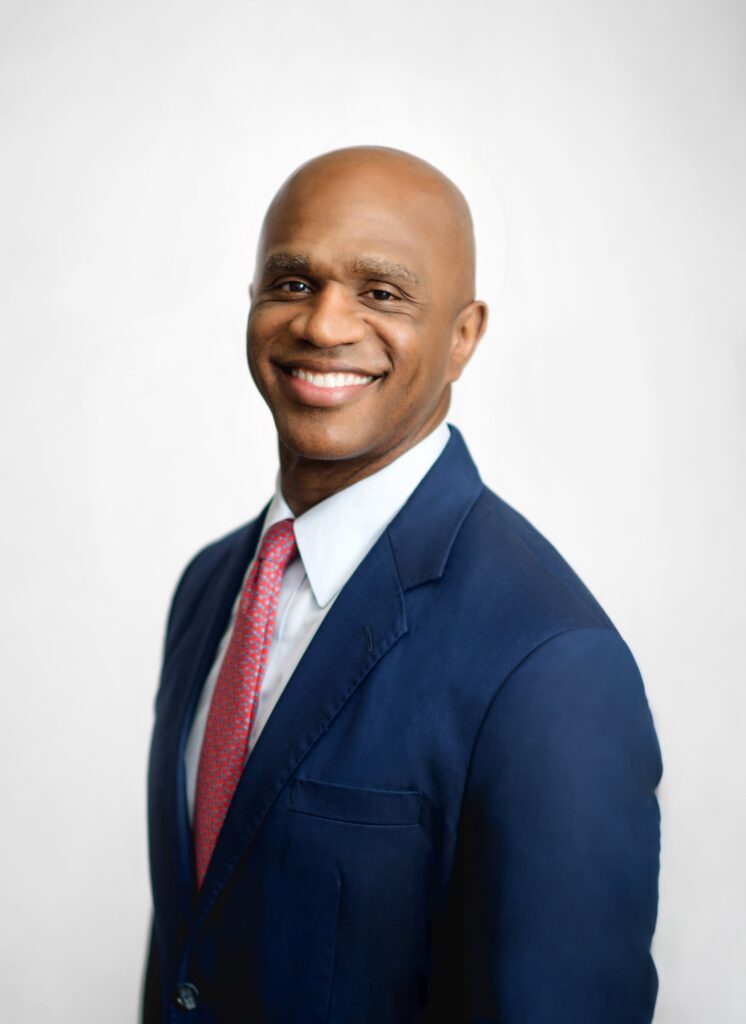
Going to law school wasn’t initially the plan for Quinn Emanuel Urquhart & Sullivan partner Chris Porter.
Porter had his sights set on playing football, getting a master’s in business administration and opening a steakhouse called Porterhouse Steakhouse. However, what was supposed to be a three-day minicamp with the Miami Dolphins ended abruptly.
“I went down there, worked out, packed for two days too many, because they sent me right back home,” Porter said.
After that, Porter, who was a star running back and captain of the University of Texas at El Paso’s football team, went on to work in retail for a while and then moved to Philadelphia, where he took a job as an underwriter with Chubb Insurance.
While in Philadelphia, Porter remembered a professor at UTEP who encouraged him to go to law school.
He reached out to that professor who helped him study for the LSAT by mailing books and tests back and forth.
The Houston native graduated from the University of Michigan School of Law and then returned to Texas to clerk with U.S. District Judge Philip Martinez in El Paso. He joined Yetter Coleman in 2009 and has been with Quinn Emanuel since June 2018. The winding path led him to discover his true calling: being a trial lawyer.
“There was a senior trial lawyer who told me that there’s a difference between being a litigator and a trial lawyer,” he recalled. “A litigator is a person who can write briefs, who can argue motions, who can take depositions and things of that nature. But the trial lawyers, [they] stand up in front of the judge, jury, arbitrator, and tell the story. And after that, I was like, ‘Yeah, I want to be a trial lawyer.’”
The following conversation with The Texas Lawbook has been edited for length and clarity.
Texas Lawbook: What trends are you seeing in your practice area?
Porter: With the use of AI, that’s something that you’re seeing more of. But I’m also looking back to when I was a young associate, and we would look to see if [the case cited] said what they said it said, and things of that sort. And how do we counter it? Now, you’re looking, frankly, to see, does the case even exist?
Texas Lawbook: You are on the board of directors for Houston Parks. Why is that important to you?
Porter: A lot of folks have this impression of Texas, it’s the impression of Houston that we’re just a concrete jungle, and we don’t have green space. And nothing could be further from the truth. We have a lot of great parks. We have a lot of green space. And I just really wanted to bring attention to that and to help grow those areas where it exists, and help [encourage] connection to the bayou trails and things of that nature, that we’re able to get out — to go to these different parks, go to the different playgrounds, ride your bike on these trails, run on these trails. And it really is beautiful — it’s really green. And it’s something that’s important to me, because I just think that there’s this misperception about Houston again, like it’s that there’s this concrete jungle, and everyone drives around with Cadillacs with the big horns attached to the hood. And that’s just — well, maybe some people do that — but that’s not really the Houston that I know. And we are a city that values and loves green space.
Texas Lawbook: How has being the captain of UTEP’s football team prepared you for other leadership roles, like being cochair of the national trial practice?
Porter: I tell people all the time, you have to meet people where they are. And the one thing that I try to do is, at the end of the day, I try to be fair, right? And you learn you need to be fair across the board. Because everyone comes from a different place, you have to understand that. And I learned that not everyone is going to be the same — not everyone’s going to fit the same mold. You have to understand this person may need this motivation but that person may need a different motivation. This person may have this particular, idiosyncratic way of thinking. And you just really have to learn how to understand people.
It’s obviously great to have a high IQ, but you also should have a high EQ (emotional quotient) as well, because you’re really dealing with people. You’re reading people, you’re reading situations. You’re trying to understand where different folks are coming from. You’re trying to connect with people on different levels. And so I think that having that experience, then also working in retail when I did — just kept being a manager in retail and dealing with all the different types of folks that were coming to the store and having to be able to connect with them — that also helped as well.
Texas Lawbook: What has been a memorable moment in your career?
Porter: I think the very first memorable moment I had was the very first trial that I did, where I actually had a really substantive role. The opposing counsel, after the trial, called and offered me a job and at one point told me, “I’ve done 195 trials. You’re one of the top five trial lawyers I’ve seen.” It was a really nice compliment. It really kind of made me think, “OK, I can do this.” When people ask me what I do, I tell them I tell stories for a living. And that’s really the job of a trial lawyer. To get that compliment really my first time out — I had 17 witnesses in that trial — it was a huge compliment.
And then the first trial that I had here at Quinn, the federal judge reached out — not to me but to the head of litigation at a company here, whom I know. And that head of litigation emailed to tell me that the judge said that my opening was the best opening she had seen in her 25 years on the bench And so to get that accolade, for my first trial when I was at Quinn Emanuel, was really cool and, again, just made me think, “Yeah, this is something that I can do.”
Texas Lawbook: What brought you back to Texas?
Porter: When I went to law school in Michigan, a substantial number of my classmates wanted to go to New York or Chicago or D.C. or LA, and I went, and I said, I’m from Texas, right? That’s it. I know where I’m going. And so I always knew that I wanted to come back to Houston to start my practice. I kind of flirted a little bit with the idea of maybe D.C. for a year or two, but I just knew I’m a Texan, right? I’m a proud Texan — and everybody in Michigan knew that. Sometimes they would make fun of me about how Texan I was, and then some of those folks would even end up moving to Texas themselves in later years. I knew from the start when I was heading up to Ann Arbor, Michigan, that I’d be coming back to Texas.
Texas Lawbook: What was your biggest takeaway from clerking for Judge Philip R. Martinez?
Porter: Learning how judges think and make decisions, and what goes into it. It was a really, really phenomenal year. I’ll never forget my first year, my first semester in law school, when one of our professors did a talk on clerkships. And I remember at the time, I think the starting salary your first year at a law firm may have been like $125,000, and I was like, “Man, I’ve got a lot of law school debt coming out.” And he was saying, “Well, if you clerk, your salary is going to be like $50,000 or $55,000.” Why would I do that? Why would I ever clerk, right? I’m going to go be an associate at a big law firm. And by the time I graduated, the starting salaries had bumped up, I think, from $125,000 to $160,000. However, I learned through the process of being a summer associate and just kind of getting more into the law how valuable a clerkship is and that it’s a credential that people can never take away from you. It’s something that you did. And by the time I left law school, I couldn’t wait to get back to El Paso, this time as a clerk. gain, that was a phenomenal year. Judge Martinez was just a brilliant man, a brilliant jurist. He unfortunately passed away a few years ago, but he was an amazing mentor to me, somebody whom I felt like I could reach out and talk to about different things that came up. And so it was a great year.
But again, I got to see truly behind the scenes, like truly behind the bench, because that’s where the chambers are, and seeing behind the bench how decisions are made, how judges kind of think about things and what resonates from different lawyers. I think I saw maybe like 10 trials during that year. So I really got to see what landed with jurors, what didn’t land with jurors, how stylistically things that landed with the court versus things that didn’t land with the court. And so it’s an invaluable experience. I tell people all the time, if you have an opportunity to clerk, do it.
Texas Lawbook: Are you still going to open a steakhouse?
Porter: Not anytime soon. I’m having too much fun telling stories. I know that restaurants are a lot of work, and I don’t think I could do both right now, so not anytime soon. But who knows in the future?
If you or someone you know would like to be profiled in a future edition of Asked & Answered, please let us know at tlblitigation@texaslawbook.net. Check out our other Asked & Answered interviews below:
Hilgers partner David Sillers talked about his First Amendment practice and shared the most memorable moments in his career so far. Sillers recently joined the firm and reunited with managing partner Grant Schmidt and partner Cynthia Schmidt, whom he met while clerking alongside them for former U.S. District Judge Barbara M.G. Lynn.
Mo Lovett Law’s founder discussed opening a new office in the Dallas-Fort Worth area and growing her law firm a year after opening. She also talked about mentorship and the state of the profession.
Trial lawyer Chrysta Castañeda reflected on her career and offers advice for young lawyers. While she has closed her firm, retiring for good is not in her plans.
A&O Shearman partner Billy Marsh discussed trends he’s seeing in shareholder, securities and mass tort litigation. He also talked about what it was like as a first-year associate to defend the NFL against fraud claims brought by a group of fans.
Reid Collins & Tsai senior founding partner William Reid discussed his new book, Fighting Bullies: A Case for a Career in Plaintiffs’ Law. In late November, Reid led a team in South Carolina that secured a $112.3 million jury verdict for their client.