
Ginger Appleberry was a litigation partner at Locke Lord in Dallas when she received a call in December 2014 that an Irving-based biotech company was seeking an in-house.
“They think they want a contract lawyer,” the caller told Appleberry. “They think they want someone who can do hospital contracting. They don’t. They need you. I think you should talk to them.”
Appleberry agreed, and, just two days before Christmas, she met with Caris Life Sciences CEO David Dean Halbert in his office for more than two hours. She still remembers his first words to her.
“I hate trial lawyers,” he said.
“I told him that I understood, because trial lawyers are people that they’re always calling when they’re upset [when] either something really terrible has happened to them or someone is suing them,” she said. “But I said your team is stronger if you have one on your team. You need one.”
A few weeks later, Caris — a business that seeks to offer personalized cancer treatments through use of its massive genetic database and large-scale molecular profiling powered by artificial intelligence — offered Appleberry the job.
“It has been an incredible 11 years,” she said.
The recent successes for Appleberry and her team at Caris include finding a “$30 million tax savings for the company that nobody knew about,” helping navigate around a potentially devastating legislation proposed by the Texas House of Representatives and guiding Caris through a significant competitor litigation matter that has major business and market implications.
The professional highlight of 2025, Appleberry said, was standing on the platform of the NASDAQ, ringing the opening bell on June 18 as Caris Life Sciences went public, raising $494 million under the ticker symbol CAI.
“The work has just been amazing. I have learned so much,” said Appleberry, who was promoted to deputy general counsel and chief compliance officer in 2021. “But the truly best days are when a family member calls to say the work Caris has done extended the life of their loved one. Nothing else can really compete with that.”
The Association of Corporate Counsel’s DFW Chapter and The Texas Lawbook have named Appleberry one of two finalists for the 2025 DFW Corporate Counsel Award for Senior Counsel of the Year for a Small Legal Department (2-5 lawyers). The finalists will be honored and the winners announced at a ceremony Jan. 29.
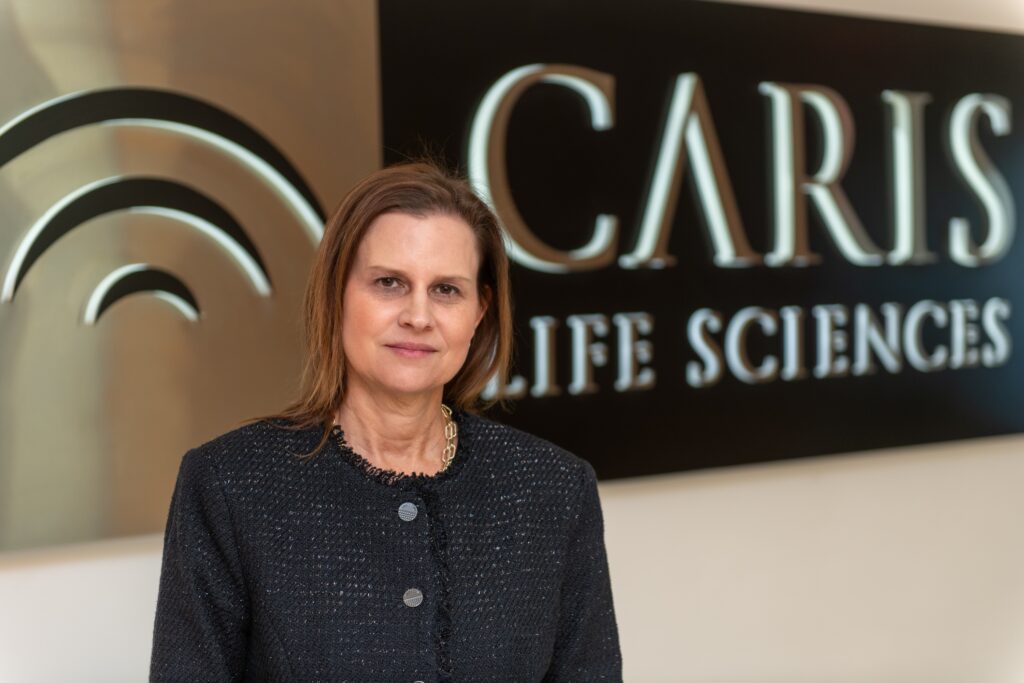
“Ginger has transformed the role of in-house counsel into one of proactive strategic partnership, grounding her leadership in a deep understanding of the company’s mission to advance precision medicine and revolutionize cancer diagnostics,” said Paul Hastings partner Paul Genender, who nominated Appleberry for the award. “Her ability to synthesize scientific complexity, regulatory nuance and operational realities enables the executive team to pursue ambitious growth while maintaining a well-calibrated risk posture.”
“Leading a lean legal team, she maximizes resources through strategic delegation and close coordination with outside counsel, ensuring the department delivers results typically associated with much larger organizations,” Genender said.
Baker McKenzie partner Jessie Greenwald said Appleberry “embodies the business pragmatism necessary to be an effective and well-followed in-house leader.”
“Ginger is direct in her instructions, advice and feedback and has high expectations of those around her,” Greenwald said. “However, her fairness and compassion prevent these earlier stated qualities from tipping the scale, and instead provide a foundation for those around her to view her as a respected and trusted advisor and leader.”
Premium Subscriber Q&A: Ginger Appleberry discusses the traits she seeks in outside counsel, what outside counsel need to know when working with her and more.
Jason Katz, a litigation partner at Carrington Coleman who is married to Appleberry, is thoughtful in her decisions — be it in decision-making at home or helping Caris transform from the smaller company she started at in 2014 to what it is today.
“She’s filed claims against large, national insurance companies to solidify coverage of Caris testing for cancer patients. She handled the purchase of a plane directly from Gulfstream and learned a lot about aviation issues. She helped Caris raise 1.8 billion dollars while they were a private company and some of those transactions were extraordinarily complicated,” Katz said. “Ginger’s best day at Caris was her first day on the job. Ginger drove to Caris through ice and snow to be there on day one — surprising everyone including building security who had to let her into the office because most people stayed at home that day because the roads were very hazardous.”
“Ginger is not as serious as she seems and she loves laughing with — or at — me,” he said. “They also need to know that she has your back at all times.”
Appleberry was born and raised in Dumas, Arkansas, a three-square-mile farming town of less than 5,000 people that sits just miles from the Mississippi border.
Her father was born into a farming family, and he operated his own farm of cotton, soybeans and rice for 49 years.
“He never moved more than 15 miles from his childhood home,” she said. “I don’t want to belittle that. My dad was quite good at farming. We grew up in a great little community. We didn’t know what we didn’t know. We didn’t know what we didn’t have.”
Appleberry’s mother was a math teacher because “she loved helping people” and “because there was no other way for us to have health insurance.”
When Appleberry was 8 years old, she started reading chapter books and said she “distinctly remembers making the decision” that she was going to escape rural farm life.
“I didn’t know what was actually out there, but in the books that I read, I could tell that there was more than we had,” she said. “There were bigger places. There was more to do. There were more people. There was just everything — this whole world out there.”
“So, I decided right then that I wanted to be a lawyer,” she said. “I didn’t know what that was. I didn’t know lawyers, but I knew that it was a way for me to get out. I liked reading. I loved sort of scoping arguments. I was pretty good at it. And I loved watching lawyers on television. At the time, I thought I was going to go be a DA and put bad guys in jail, you know, because what they did.”
At 16, Appleberry moved out of her parents’ house and went to a boarding school in Arkansas for math and science. It was state-funded and free. She applied and was accepted.
“That was the scariest thing I had done at the time, but it was the right decision, because I needed access to the advanced classes to be able to take next steps in my education,” she said. “And that is one thing my mom always supported was being educated.”
Appleberry went to the University of Missouri on a full scholarship to study applied mathematics.
“I bet I’m one of the very few people that you’ve talked to who is a lawyer who went to college to learn math because it’s really hard,” she said. “There were much easier paths that I could have taken. But they recruited me. I had good scores. They were willing to pay for it. And it was not the University of Arkansas, which was where everybody I knew was going. I needed it to be a little different.”
Appleberry said the same analytical portion of her brain “that makes me good at math helps me tremendously in being a lawyer,” letting her “refine arguments” and identify things that do not matter in a case.
“One of the things that I really excelled at in private practice was creating the trial board and the trial plan and knowing what do we have to show and how we going to get there,” she said.
After graduating from Vanderbilt University Law School in 2003, Appleberry and her husband, Jason Katz — who is a litigation partner at Carrington Coleman — decided to move to Dallas because “the Texas economy was better than some of the others.”
“We looked around at big cities we were interested in and asked, ‘Where would we like to go?’ We landed on Dallas, and we love it, and we’re so glad that we’re here,” she said.
Appleberry, who spent 12 years at Locke Lord in Dallas and made partner in 2012, said her focus on healthcare law was organic.
“I started gravitating toward a lot of the pharmaceutical work that Locke did,” she said. “These were bigger cases, the ones that companies spend money on with real lawyers, and … more bet-the-company-type litigation than your typical products liability.”
She said it also allowed her to work one-on-one with in-house counsel for the pharmaceutical and biotech companies and learn about their business.
Former Locke Lord partner John McDonald has known Appleberry since she was in law school.
“She did a lot of work for me during her time at Locke,” McDonald said. “Besides being very smart, the characteristics that make Ginger a good lawyer is that she is tenacious, intellectually curious and has a drive to win. Ginger is a good leader in that she listens to others, builds consensus and leads by example.”
As a partner at Locke Lord, Appleberry developed her own book of business with doctors, hospitals, pharmaceutical companies and hospice operations as clients.
“When you have those clients, you immerse yourself into what they need, because you’re trying to help them,” she said. “I read and learned everything I could about the space, and it’s very highly regulated, and there are a lot of nuances to what you have to help them with.”
Then came the call about the position at Caris and her meeting with the CEO.
“I liked him immediately,” she said. “Looking back, he saw everything that was going to happen in the space — like he knew where we were headed. He was there before the technology was there. I remember thinking, ‘This guy’s an amazing visionary.’”
Appleberry said of the biggest challenges she has faced involved legislation and regulations not keeping up with the technology, which makes it difficult to accomplish certain efforts.
“The state of Texas — this year, without telling anybody — threw together a bill saying that no company could run your DNA without consent, except for in an emergency health situation or a paternity court-ordered situation, which would have prevented us from doing the work that we do for cancer patients, where their consent comes through that discussion with their doctor,” she said. “They were trying to stop 23andMe from selling people’s residual data. But just say that. Just say, ‘23andMe — stop selling data.’ Don’t try to block everybody from doing this work.”
“Thankfully, we learned about this the Friday before the vote was supposed to happen,” she said. “MD Anderson sent their lawyers to make the same arguments that this really is catastrophic for patients who have cancer.”
Those challenges, while significant, did not match the success of finally getting the Caris initial public offering across the finishing line.
When CEO Halbert interviewed Appleberry in 2014, he mentioned the company’s goal of going public.
“The IPO was a sort of a labor of love,” she said. “We had many stops and starts. It was something that we’ve been trying to do forever. Either timing wasn’t right, the market wasn’t right, something wasn’t right.”
Appleberry, who is a renowned hard worker, said she underestimated the amount of work that was required for an IPO.
“There is just so much that goes into this — so much balancing, so much working with outside counsel to try to tell the company story,” she said. “You have to capture all of the things that could possibly go wrong. We drafted hundreds and hundreds of pages of risk factors for the S-1 [filing], which was basically everything that you can think of in the world that could not go the way you want it and put it in here so that the company has protection. You’ve got to redo all of the corporate governance infrastructure. You have to make sure that you have employment agreements with all key personnel.”
“I mean, it was just a tremendous amount of work,” she said.
By the end, Appleberry estimates that she and her team put more than 10,000 legal work hours into preparing for the IPO.
“The day we were in New York, and we’re standing on the stage, there was just this release of so much pent-up emotion,” she said. “I got lots of texts from a lot of old friends, and it was just a really emotional, exciting, but emotional time.”
“My parents have no idea what I do. They know I’m a lawyer, but they have no idea what I do day to day,” she said.
But then, a family from her parents’ church received help from Caris.
“They were like, ‘One of the ladies in my Sunday school class had your test, and it helped her doctor. And you know, she’s still here and she’s able to come to church.’ And I was like, ‘See mom and dad, I do good stuff,” she said. “But when we did the IPO, my dad said, ‘I can’t believe someone from Dumas, Arkansas, was standing on the [NASDAQ] stage. Can I tell my friends?’ I’m like, ‘Yes, you can absolutely tell them.’”
“The best part about working at Caris and why I love being here is that David has always run this company to be patient-first,” Appleberry said. “It is always patient-first. That is how he’s always built it, and that has always been very important to me. He founded the company because his mom died of multiple myeloma, and nobody could stop it, and he wanted to be able to help. I had three of my four grandparents pass from cancer, so cancer touched all of us.”
Fun Facts: Ginger Appleberry
- Favorite book: Fahrenheit 451 – Although it has been years since I’ve read it, Fahrenheit 451 was the first critically acclaimed and “grown up” book that I read on my own. It is a well-written novel that stimulates critical thinking about the relationship between law, society, and personal choice.
- Favorite music: I can’t answer this honestly because you would be able to steal my identity because it is my security question for a lot of accounts. Could be Bon Jovi, Guns N Roses, Matchbox 20, or Garth Brooks.
- Favorite movie: A Few Good Men and Good Will Hunting. These movies highlight two of the things that have touched my life the most – the law and mathematics. Both films also benefit from being about something other than the surface plots, whether that be institutional accountability and moral courage or self-worth and vulnerability in the other.
- Favorite restaurant: Any restaurant that has queso and guacamole. I prefer to enjoy appetizers/dips in excess over anything fancy.
- Favorite beverage: Iced Tea (unsweetened but with SweetNLow)
- Favorite vacation: My family went to Grand Caymen in 2017. We had an amazing time. We had a short, direct flight to a beautiful location and swam with stingrays. We had to learn to drive on the “wrong” side of the road, and I had to do most of the driving because my husband could not master it. This led to several hilarious situations and priceless laughter. This was the first vacation that my boys were old enough to fully participate in everything we did.
- Hero in life: My dad, who made a series of sacrifices in order to support his family. He gave up a chance at a college education to help his family continue to operate their farm. When I was growing up, we learned the value of hard work and witnessed first-hand how difficult it was to run the operation that he grew. He worked from sun up to sun down during the season and never complained. In the off season, leveled fields, put in extra work preparing the land, and planned for the following year. We heard a lot of talk about how “easy” things were for my dad. I can tell you they were anything but easy. He put in the work while others were taking vacations or relaxing after crops were in. We saw that a lot of the “secret” to his success was the extra work he put in. He is also devoted to the service of others. He taught us that when you do good things, you do them because you are moved to do so and not for recognition or accolades. For nearly 40 years, dad locked and unlocked the doors at our church and made sure the heat (or AC) was on so that things were comfortable every single weekend. He never missed a week. He is fiercely loyal to his family and friends and someone you would call in an emergency. He is also the most stubborn person I know (outside myself).