
When Jackson Walker partner Robert L. Soza Jr. accepts the prestigious C. Lee Cusenbary Ethical Life and Leadership Award on Oct. 29, it will mark his first major recognition since the August death of his father, a small-town pharmacist in far West Texas who taught him his earliest lessons in ethics.
Soza, now 62, grew up in his father’s pharmacy in Alpine, where he watched his father, also Robert L. Soza, build relationships with customers that extended beyond filling prescriptions.
The elder Soza often opened his pharmacy late at night or on Sundays to serve people in need.
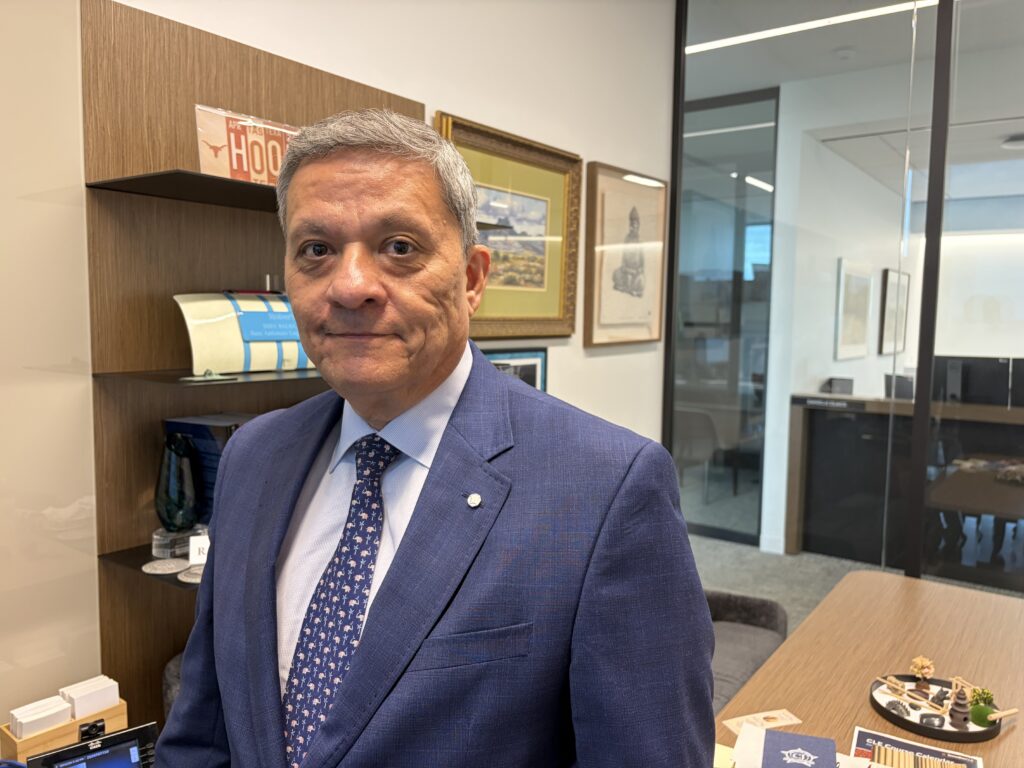
Over time, his son came to realize that a trial lawyer and a small-town pharmacist have more in common than people might assume.
“My father’s customers trusted him with their health and their privacy, and he earned that trust one conversation at a time,” Soza Jr. said. “A jury gives a lawyer that same kind of trust.”
Soza’s younger brother, Alfredo A. Soza, also became a lawyer. In his Odessa practice, he handled criminal defense, family law, personal injury, commercial litigation and bankruptcy matters, often providing free legal representation to those who could not afford it. His pro bono work earned recognition from the Ector County Bar Association and Legal Aid of Northwest Texas. Alfredo Soza died in 2023.
Like his brother, Soza Jr. has dedicated much of his career to pro bono work. A partner in Jackson Walker’s San Antonio office, he has spent much of the past seven years leading the San Antonio Legal Services Association (SALSA) as its board president, navigating challenges from the COVID-19 pandemic and a funding shortfall while championing the community’s legal needs.
For his leadership at SALSA and in the legal industry, Soza is one of two recipients of the 2026 C. Lee Cusenbary Award, presented by the Association of Corporate Counsel’s San Antonio Chapter and The Texas Lawbook.
The award honors one in-house counsel or legal department and one private lawyer or law firm exemplifying exceptional ethical behavior and leadership in the practice of law. Vericast Deputy General Counsel Shelayne Clemmer is this year’s in-house recipient.
For Soza, the honor comes during a deeply personal year.
“In my mind, I will be sharing it with [my father] and with Alfredo,” he said. “My father spent half a century showing a whole region what dignity and service look like. Alfredo won his own pro bono award in Odessa 16 years ago, serving people no one else would. Any ethical life I’ve managed to live, I learned from them first.”
Exemplifying ‘Access to Justice’
Soza was born in San Antonio to parents whose roots trace back to Presidio County, some 400 miles west along the Mexico border.
His father graduated from pharmacy school at the University of Texas and worked as a hospital pharmacist in San Antonio before an opportunity arose to purchase a pharmacy in Alpine, closer to home.
The Soza boys grew up helping run the fountain counter and cash register, serving customers who traveled from throughout the region, including Presidio, Marfa, Fort Davis, Marathon, South Brewster County, Sanderson and across the river in Ojinaga.
“Ranchers, schoolteachers and families from both sides of the river all came through my father’s door, and he knew most of them by name,” Soza Jr. said.
With the nearest doctor sometimes hours away, customers occasionally needed prescriptions outside regular business hours. Soza’s father would open the store to help them.
Medicine was not the only reason people came to the pharmacy. Sometimes, they simply wanted someone to talk to.
“People came in for prescriptions, but also for conversation, reassurance and help. I learned a lot just by watching him,” Soza Jr. said.
His father understood the responsibility that came with being a trusted member of the community, and he took his role seriously.
“I think that’s where I first understood that a profession is a trust before it is a business,” Soza Jr. said.
His mother, meanwhile, became an educator and later a special education diagnostician, “making sure that children who learned differently were seen, tested fairly and given what they needed to succeed.”
“My parents never used the phrase ‘access to justice,’ but they lived it,” Soza Jr. said.

Finding His Way to the Courtroom
Soza did not initially envision himself as a lawyer.
When he enrolled at the University of Texas, he wanted to become a writer. He studied under writers and teachers including Rolando Hinojosa-Smith and John Trimble, pursued freelance writing and came to know prominent Texas writers including Gary Cartwright, Liz Carpenter and Skip Hollandsworth.
But when Soza graduated in 1986, the state was in an economic downturn, and writing jobs were scarce.
Of the graduate school entrance exams, Soza figured he was only equipped to take the LSAT. He took it, was admitted to law school and soon felt that he had made a terrible mistake.
“Many of my classmates seemed fluent in business terms that came up in the cases, and I felt like a literature major who had wandered into the wrong building,” Soza said.
His liberal arts education, however, proved an asset when it came to the three-hour written exams. He went on to earn law clerk positions with firms in El Paso, San Antonio and Los Angeles.
“I came to see that the law is, in many ways, a writing profession,” Soza said. “A good brief, a good closing argument and a good letter to a frightened client all need the same thing: telling a true story clearly and persuasively.”
That realization helped draw him to trial work.
“A trial is a story, and the jury is the toughest and fairest audience there is,” Soza said. “You have a few days to take a complicated set of facts, and make a clear, honest and compelling story to 12 people who have never heard of your client. That’s the same discipline my English professors drilled in me.”
After law school, Soza joined O’Melveny & Myers in Los Angeles, where an assignment gave him an early lesson in the role lawyers can play in civil society.
Following the 1991 police beating of Rodney King, O’Melveny chairman Warren Christopher led a commission examining the Los Angeles Police Department. Christopher asked Soza to help lead outreach to the Latino community as part of that work.
At public meetings, many residents expressed anger over how police treated them. Soza watched Christopher respond with compassion.
Christopher told the residents he was not there to defend the department. He wanted to listen and understand their experiences. Soza remembers sensing the mood in the room begin to change.
“He later became secretary of state, but what I remember most is a powerful lawyer who knew that listening is a form of respect,” Soza said. “I’ve tried to carry that into every deposition, every negotiation and every SALSA board meeting since.”
Soza eventually returned to San Antonio and worked at Jenkens & Gilchrist, where he first worked with Julia Mann, now managing partner of Jackson Walker’s San Antonio office and the lawyer who nominated him for the Cusenbary Award.
Jenkens & Gilchrist dissolved in 2007 following a federal investigation and a $76 million settlement related to fraudulent tax shelters developed by its Chicago practice.
Jackson Walker brought over the firm’s entire litigation department and most of its San Antonio office, Soza said.
“Jackson Walker gave me a home where I could be a serious trial lawyer and a citizen of my community at the same time, and the firm has never treated those two things as being in competition,” Soza said.
Today, Soza’s practice spans trial and appellate litigation, environmental and natural resources matters, international trade and regulatory compliance. His work includes anti-corruption, anti-money laundering, export controls, sanctions and national security-related compliance.
A licensed U.S. Customs broker, Soza has represented clients in administrative, civil and criminal enforcement proceedings before federal agencies.
“His work requires judgment, discipline, credibility and an unwavering commitment to the rule of law,” Mann said.
Among his significant courtroom victories was a unanimous Texas Supreme Court decision in 2023 on behalf of Helena Chemical Company in a dispute involving alleged herbicide damage to cotton fields.
The dispute began in 2015, when farmers alleged that Helena’s negligent aerial application of Sendero, an herbicide used primarily to kill mesquite, damaged crops across 111 fields in Mitchell County.
The 32nd District Court in Mitchell County initially granted Helena’s no-evidence motion for summary judgment. But the Eleventh Court of Appeals in Eastland partially revived the farmers’ suit.
Helena took the dispute to the Texas Supreme Court, asking the court to decide whether the farmers had presented sufficient evidence to proceed.
Soza had handled the case since the beginning, representing Helena in the lower courts before arguing before the state’s highest civil court.
“Our argument was simple, even if the record wasn’t,” Soza said. “The plaintiffs had to prove injury, specific causation, and a link to our client for each of those 111 fields, and the court of appeals had blurred the standard for reviewing a trial court’s decisions about expert testimony.”
On March 3, 2023, the Supreme Court unanimously ruled that the farmers take nothing on their claims. The justices found an “analytical gap” between the observed crop damage and reduced yields months later, which the court said was supported only by the “the experts’ say-so.”
Soza said the 28-page opinion closely tracked the arguments in his team’s briefing and in his oral argument.
“The decision set important precedent on causation and expert testimony in Texas,” Soza said.
“When a unanimous court agreed that causation had to be proven with evidence and not assumed, it felt like vindication not just for our client but for the principle that the law should rest on proof,” Soza said.
The farmers subsequently petitioned the U.S. Supreme Court to review the decision, but the justices denied certiorari, leaving Helena’s victory intact.
Mann said Soza’s accomplishments in the courtroom are only part of his legacy. Throughout his career, she said, he has invested considerable time in mentoring younger lawyers and expanding opportunities for women and minority attorneys, many of whom have gone on to leadership positions in law firms, businesses and civic organizations.
“His commitment to developing others, particularly women and minority attorneys, reflects a broader vision of ethical leadership: one measured not only by individual accomplishment, but by the opportunities created for others and the strength of the profession he helps build,” Mann said.

Building SALSA and Helping It Survive
In August 2019, the San Antonio Bar Association voted to establish an independent board of directors to expand pro bono legal services in the region.
Soza had been a driving force behind the effort.
For more than two decades, the association had provided pro bono services through its Community Justice Program, established by Justice Phylis Speedlin and Judge Karen Pozza.
But the program faced limitations in its resources and reach.
Soza envisioned transforming the program into an independent nonprofit with its own board of directors, giving it the structure and resources to serve more people in need of civil legal assistance.
“Soza took the lead in revitalizing CJP and championing a bold vision: that the program needed to become an independent standalone nonprofit with a dedicated board of directors to truly scale pro bono services to meet the enormous unmet need for civil legal representation in San Antonio,” Mann said.
Soza was named the inaugural board president of the resulting organization, SALSA.
SALSA recruits, trains and supports volunteer attorneys who provide free legal representation to low-income clients. Its work focuses on housing, estate planning, guardianship, education, and probate and title issues, with particular attention to veterans and people with disabilities.
“Our staff attorneys mentor every volunteer, so a corporate lawyer who has never handled a veterans’ benefits case can walk into our clinic and change someone’s life,” Soza said.
The organization was preparing to celebrate its formal launch in March 2020. Space had been reserved at the Bexar County Courthouse, and the San Antonio mayor and Bexar County judge were scheduled to attend.
Then the COVID-19 pandemic reached San Antonio.
The launch celebration was canceled, but the need for legal services rapidly multiplied.
SALSA quickly turned its attention to helping frontline healthcare workers prepare critical estate planning documents through its Wills for Healthcare Workers Project.
As pandemic-related job losses triggered a wave of eviction threats, Soza helped mobilize Jackson Walker attorneys to work alongside SALSA, Texas RioGrande Legal Aid and St. Mary’s University School of Law to assist families facing the loss of their homes.
When Winter Storm Uri struck Texas in February 2021, Soza guided SALSA’s efforts to help appeal FEMA decisions and access federal disaster relief.
“Under Robert’s leadership, SALSA has responded to complex legal needs demonstrating the organization’s capacity to address the most urgent and sensitive needs of the community,” Mann said.
In December 2023, Soza passed the presidency to Michael Gibbs, who had retired as Whataburger’s general counsel and executive vice president of franchising and human resources.
Years earlier, Gibbs had volunteered with the Community Justice Program and served on its advisory board.
Gibbs was impressed with SALSA’s programs and then-Executive Director Sarah Dingivan, who had joined CJP in 2017 and became SALSA’s first CEO and executive director. The board, in turn, was excited about Gibbs’ business experience.
But in March 2025, SALSA faced a crisis that threatened its existence.
COVID-era grants and contract funding that had helped sustain the organization were not renewed, leaving a significant budget shortfall. Three employees of the small organization were laid off, and SALSA, facing the possibility of closure, issued a public appeal for donations.
Gibbs and Dingivan departed in the aftermath.
Soza, who had remained on the board, stepped back into the presidency to help steer the organization through the turmoil.
The crisis prompted SALSA’s leadership to reassess the organization’s funding model and management structure. Board members recognized the need for a broader base of unrestricted operating support to supplement grants and contracts. They also concluded that too many responsibilities, particularly legal oversight of fundraising, had been concentrated in the executive director’s position.
As the board searched for a new leader, it prioritized nonprofit management and fundraising experience. It selected James Martinez, a San Antonio native with two decades of nonprofit leadership experience.
Beyond Soza’s leadership duties, he continues to volunteer at SALSA clinics and to represent pro bono clients in long-term matters.
He counts some of those cases among his greatest professional successes, “because the stakes for those clients were everything.”
One involved an unhoused client whose brother, serving as administrator of an estate, had deprived him of an inheritance. Soza pursued a breach of fiduciary duty claim on the client’s behalf.
In another, he represented a man facing an adverse possession dispute over the only home he had. The man had long lived in the house, making it livable with his own hands despite not holding title to the property.
“No verdict in a commercial case has ever meant more to me than helping someone keep the only home he has,” Soza said.
His work with ABODE Contemplative Care for the Dying has also been dear to his heart. His friends, Edwin and Patsy Sassek, founded the charity that provides around-the-clock residential care for terminally ill people in the final months, weeks or days of life.
“Their work still inspires people to find meaning in the process of dying, and serving as president of ABODE’s board has been one of the great privileges of my life,” Soza said. “Working at the end of life gives you perspective. It reminds you that most of what keeps lawyers up at night matters far less than how we treat each other.”
For Mann, Soza’s commitment to others is what makes him deserving of an award that honors a lifetime of ethical leadership.
“Across his legal practice, civic commitments and work to expand access to justice,” she said, “Robert has consistently used his skill, credibility and influence to strengthen institutions, develop people and serve those most in need.”
Fun Facts
Favorite book: It’s a tie between two books by Mexican writers, Carlos Fuentes’ The Death of Artemio Cruz and Octavio Paz’s The Labyrinth of Solitude. Fuentes tells the story of a powerful man who was a soldier in the Mexican Revolution on his deathbed asking what his ambition cost him and everyone around him. Paz’s essays on Mexican identity helped me understand my own family’s border heritage and the culture I grew up around in Presidio County and Alpine. I turn to these books often when events in my life mirror the scenes narrated by these two great writers.
Favorite movie: My Cousin Vinny. Every trial lawyer I know loves it, and for good reason. Behind the comedy are some of the best cross-examinations ever filmed, a judge who insists on proper procedure and a reminder that the truth often turns on a detail nobody else bothered to check. I can recite most of the lines in the movie by heart.
Favorite music group: Grupo Mazz and Marco Antonio Solis
Favorite vacation: A four-day, three-night hike on the Inca Trail in Peru that ends at the Sun Gate that is the entrance to Machu Picchu. My wife, Roxanna, and I have four children, Gabriella Marie, Manuel Diego, Roberto Javier and Ileana Isabel, and sharing this experience with them is one of my favorite lifetime memories.
Heroes in life: My heroes are Edwin and Patsy Sassek who founded ABODE, a contemplative home for the dying. They created a place where people at the end of life are cared for with dignity, quiet and love, often when they have no one else. They taught me to honor the last part of our lives as much as we honor the beginning. What they started keeps helping people find meaning in dying, and I’ve been proud to carry their work forward as president of ABODE’s board. And my father, Robert L. Soza, who showed me that a boy from Presidio could earn a professional degree, come home to Far West Texas and serve his community with honor for 50 years.