
In a recent joint appearance at a public policy forum in Austin, three former Texas Supreme Court chief justices discussed encroachments by the legislative branch on judicial independence and an increase in hot-button issues being directed into state courts.
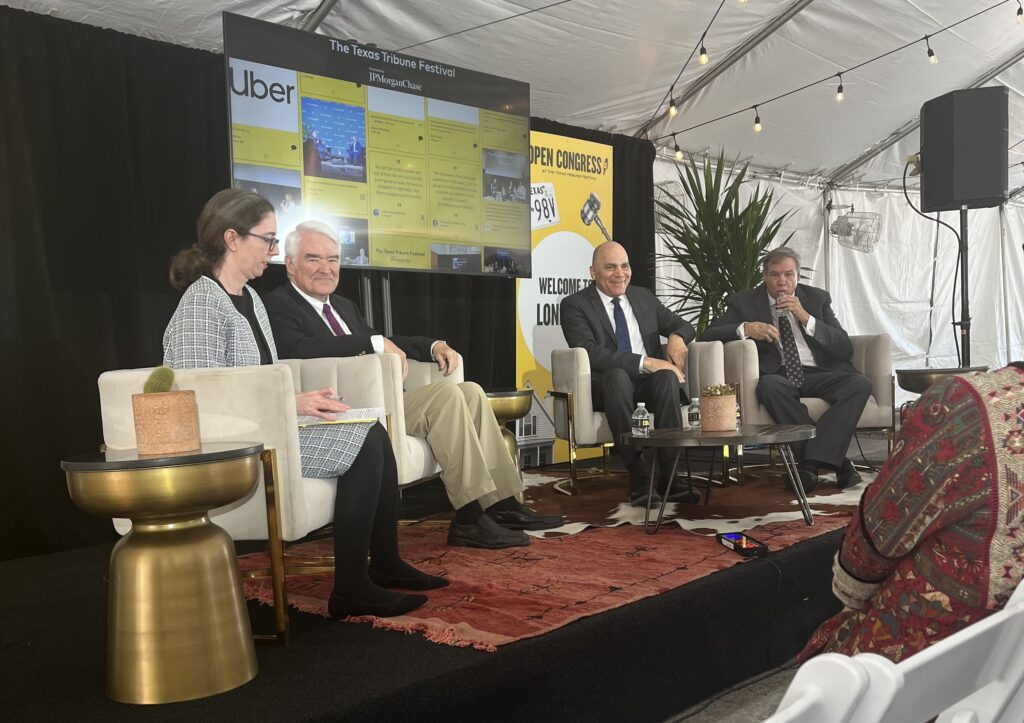
The former chiefs — Nathan Hecht, Wallace B. Jefferson and Thomas Phillips — addressed more than 100 people gathered in a large tent on Congress Avenue as part of the 2025 Texas Tribune Festival. The discussion, free and open to the public, was moderated by Alicia Bannon, head of the judiciary program at the Brennan Center for Justice.
Bannon said the center has seen a trend in many states, including Texas, where state legislatures and governors have limited the power of state courts to exercise political influence.
“One example just this month, Texans amended their constitution to give the governor a majority of appointments on the state Judicial Conduct Commission, which handles judicial discipline,” Bannon said. “I’m curious to hear your thoughts on this trend, on this dynamic between the quote unquote, political branches of government and the courts, and to the extent to which you see this as concerning from the perspective of rule of law.”
The amendment, known as Proposition 12, replaced two attorney members named by the State Bar with two additional citizen members appointed by the governor. The 13-member commission, which considers complaints against judges, will be comprised of six judges named by the Supreme Court and seven citizens named by the governor.
Supporters of the amendment said the additional public members would increase the commission’s independence and transparency. Critics said it could allow for more politicization and partisanship in the judicial disciplinary process.
Jefferson, who led the court from 2004 to 2013, said “it’s concerning when the legislative branch goes after the judicial and tries to strip authority away.”
“The independence of the judicial branch is extremely important to the freedoms and to democracy in general,” Jefferson said, adding that the judiciary has little recourse unless what the legislature does is unconstitutional.
“It’s something that people have to be vigilant about if they think that there’s been too much erosion of the judicial prerogative,” said Jefferson, a partner in the appellate firm of Alexander Dubose Jefferson.
Hecht, chief justice from 2013 to 2024, said the judiciary is often called the weakest branch of government because it does not appropriate money or control a militia.
“It depends on reason and the support of the people who believe in the rule of law and all of these kinds of things,” said Hecht, a partner at Jackson Walker. “And so, it has to be very cautious when you see an amendment like we just voted on because it is going to make a difference going forward.”
Phillips, who served as chief justice from 1988 to 2004, said short of Texas elected leaders saying they would not follow a judicial ruling, “I don’t think we’re in a crisis in terms of our relations with the other branches.”
Noting that 95 percent of all legal cases are filed in state, rather than federal, courts, Bannon said high-profile U.S. Supreme Court cases on abortion rights, partisan gerrymandering and transgender rights has “led to a real flurry of litigation around those issues in state courts, including at least some of those issues in Texas.”
Since World War II, Phillips said most litigants have looked to the U.S. Constitution “because the federal courts were so expansive in the way they interpreted the [Bill of Rights] that that kind of gave most litigants the only hope they needed.”
Courts are starting to see more briefing about the Texas Constitution, Phillips said, which can be challenging because of the thin record about the framers’ debates in drafting the 1876 document.
“It’s harder to do because a stenographer was a dollar and a half a day. So, our framers chose not to hire anybody to write down their debates,” Phillips said.
“I think states are going to be making more important life decisions for their citizens. And that’s probably not a bad thing because we have a large and very diverse country,” said Phillips, a Baker Botts partner.
Jefferson agreed that the lack of documents about the state’s constitutional convention along with the hundreds of amendments that have been added since make it difficult for lawyers wanting to raise state constitutional grounds.
“It used to be when a case came to the Supreme Court, if it was a First Amendment issue, there would be a footnote in our opinion that said the parties have not said that there’s any difference between the state constitution and the U.S. Constitution on this question. But now people are starting to plumb the differences. And if it’s a constitutional issue, you’ve got to be ready to explore those differences,” Jefferson said.
Hecht said a movement started in the 1970s to focus on state constitutional language versus the federal constitution but stalled out. He turned to Bannon to explain what kicked off the movement.
“Well, among other things, and I say this coming from the Brennan Center, Justice Brennan wrote a very significant article calling on state courts to look to their state constitutions as alternative sources of rights, reminding us that the U.S. Constitution, when it comes to rights, is a floor, not a ceiling,” she said.
Bannon said she has heard from many judges around the nation that historically litigants don’t raise state constitutional issues or raise them in a very summary way.
“That’s starting to change, but it’s been a real hurdle to developing [the common law] if you’re not getting those arguments as a judge,” Bannon said.
In response to an audience question about the high-profile case of Texas death row inmate Robert Roberson, Hecht said he soon may be representing Roberson. Lawyers for Roberson have raised issues about evidence presented in his 2003 trial for the death of his two-year-old daughter. Roberson would be the first person in U.S. history executed in a shaken baby syndrome case.
The case tested the separation of powers last year after a Texas House committee subpoenaed Roberson the day before he was set to be put to death. The Texas Supreme Court temporarily delayed the execution.
Last month the Court of Criminal Appeals blocked Roberson’s execution and sent the case back to the trial court for review under the state’s junk science law, passed after Roberson was convicted of capital murder.
Jefferson said the case is an example of the government branches “working to say this is an issue that needs more attention.”