
Executives at the Charles Schwab Corporation announced in 2019 that they were relocating their global headquarters, including its 150-member corporate legal department, from San Francisco to North Texas.
Six years later, Schwab’s move from San Francisco’s downtown financial district to a 70-acre campus in Westlake’s Circle T Ranch development is complete, and by all accounts, the transition has been hugely successful.
The move required a significant amount of infrastructure work by the legal department for Schwab, a multinational financial services company with more than 32,000 employees, $11 trillion in assets under management and a market cap of $178 billion.
“The move itself was real legal work, including banking charter conversions and building new relationships with Texas regulators and the Dallas Fed, and we found the same constructive, execution-oriented approach throughout,” Schwab General Counsel Peter Morgan told The Texas Lawbook in an exclusive interview.
Morgan, a graduate of the University of Connecticut School of Law, leads a Schwab legal department that includes 80 attorneys and 70 non-lawyers. A former lawyer at Paul Hastings, Morgan joined Schwab in 1999 to head its regulatory legal group. He was promoted to general counsel and named the financial giant’s corporate secretary in 2019.
“San Francisco is a world-class legal market, but it can feel more fragmented and more shaped by the Silicon Valley ecosystem, and it is harder to recruit people into the region,” said Morgan, who moved from San Francisco to Westlake last September. “DFW is still fast, but it is more personal and more civic. The in-house community is visible and collaborative, and that helped us recruit and build culture quickly.”
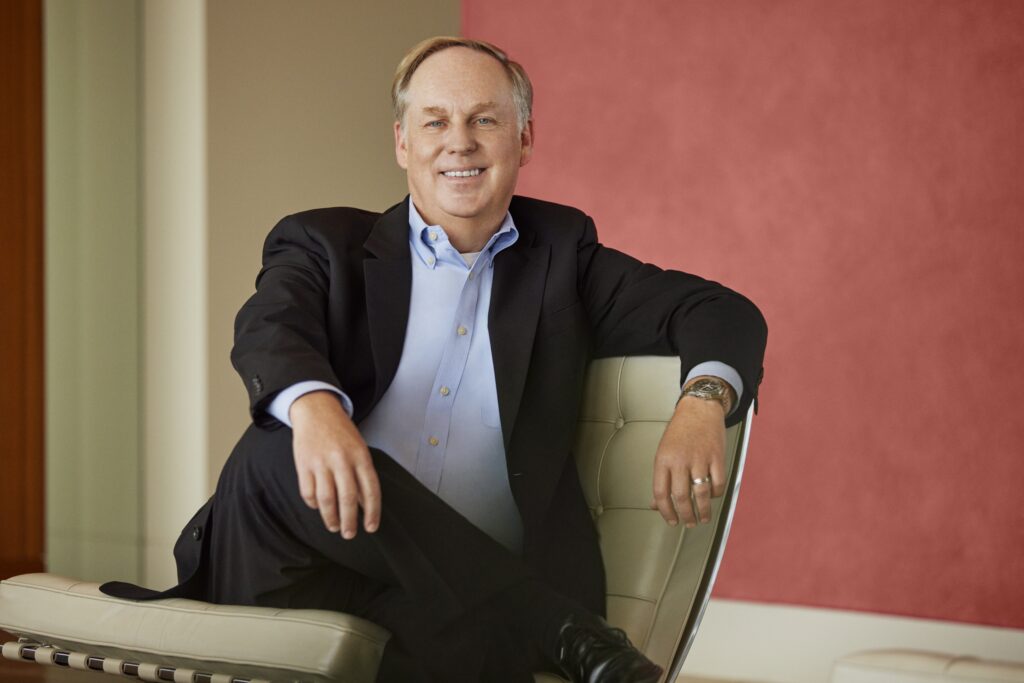
Schwab hired two Dallas lawyers — Winstead shareholder Michael O’Neal and Jones Day partner and former U.S. Securities and Exchange Commission Regional Director Shamoil Shipchandler — as part of the transition. O’Neal is chief counsel for banking and trust services. Shipchandler is chief counsel for litigation and enforcement. Morgan and Shipchandler are former prosecutors. Morgan was an assistant district attorney in Santa Cruz.
“Peter is a brilliant, creative lawyer who excels at providing deep strategic insights through all sorts of complex matters,” said Shipchandler, whose team is a finalist for the 2025 DFW Corporate Counsel Award for Legal Department of the Year by the Association of Corporate Counsel’s DFW Chapter and The Lawbook.
The Lawbook interviewed Morgan about Schwab’s move to Texas, the increased interest of large corporate financial institutions in expanding in the DFW area, the critical legal issues companies like Schwab face and why he hired Shipchandler.
Texas Lawbook: How have you found the Texas legal community since moving to DFW? And how is the DFW region different from San Francisco in leading a corporate legal department?
Peter Morgan: The Texas legal community is extremely networked and interconnected. People know each other, they make introductions quickly, and they take pride in being helpful. The best thing I did early on was hiring Mike O’Neal. Mike was our first DFW-based legal hire in 2020, and he came to us from Winstead. Before he joined Schwab, he had already been helping us from the outside with regulatory approvals and Texas-specific issues as we were expanding our footprint here. When I asked him to come in-house, he immediately helped me plug into the community, made the right introductions and helped us get off to a fast start while we built the headquarters legal presence.
I have also been impressed by the depth of talent in DFW. Pre-pandemic, we had essentially no lawyers based here. Today we have a fully staffed headquarters legal function that spans everything Schwab needs, from banking, securities and retirement to regulatory affairs, contracts, employment, M&A and corporate governance. San Francisco is a world-class legal market, but it can feel more fragmented and more shaped by the Silicon Valley ecosystem, and it is harder to recruit people into the region. DFW is still fast, but it is more personal and more civic. The in-house community is visible and collaborative, and that helped us recruit and build culture quickly. And the move itself was real legal work, including banking charter conversions and building new relationships with Texas regulators and the Dallas Fed, and we found the same constructive, execution-oriented approach throughout.
Lawbook: Schwab was early in focusing its expansion efforts in DFW, and now other banks (CapOne and Goldman Sachs) are expanding here. What is attracting large financial services to this metro?
Morgan: DFW is attracting large financial institutions for a very practical set of reasons. You have a deep and growing talent pool, strong national connectivity and a cost structure that lets companies grow at scale. For Schwab, the logic was always tied to scale and integration. As we put the TD Ameritrade combination together, we were clear that Westlake would become the combined headquarters because it is a centrally located hub for a nationwide firm and because consolidation creates meaningful efficiencies.
The other thing that has changed quickly is that DFW is increasingly becoming a real capital-markets center, not just a great place to do business. We are proud to be the largest retail financial services firm headquartered here and the largest bank by assets. And we have been supportive of the broader ecosystem, including through Schwab’s investment in the Texas Stock Exchange.
Lawbook: What are the advantages of operating in DFW versus other major metros?
Morgan: DFW gives us a very pragmatic set of advantages compared to other big banking metros. The first is connectivity. For a firm like Schwab with clients, operations and regulators spread across the country, being in a centrally located hub matters. It makes it easier to convene leadership teams, move people efficiently and operate like a truly national company. The second is talent. The DFW market is deep across financial services, regulation, technology and corporate functions, and you can scale a team quickly without lowering the bar.
The third advantage is cost and flexibility, which is not just about saving money, it is about being able to reinvest. DFW lets you build at scale with a durable cost structure, and that supports long-term investment in client service, technology and risk management. And the culture here matters. There is a positive, growth-minded, community-minded energy in DFW. The legal and business communities are unusually connected and civic, people collaborate and make introductions quickly, and the default tone is constructive and execution-oriented. When you are managing complex issues across a large institution, that combination of momentum and mindset is a real competitive advantage.
Lawbook: What are the critical legal issues today facing financial institutions like Schwab?
Morgan: The critical issues for a firm like Schwab start with meeting regulatory expectations across a complex set of legal regimes. We operate in a highly regulated environment, and a big part of Legal’s job is not just interpreting the law but being strategic advisors to our executives and business partners on how to navigate those frameworks in a way that is consistent with Schwab’s strategy of seeing things through clients’ eyes. A big part of that is simplification. Our lawyers have to take complexity and turn it into clear choices, easy-to-navigate processes and plain-language communications that make it easier for our business partners to execute and, more importantly, easier for clients to manage their assets.
What feels different today is the pace of change. And in that sense, it reminds me of when I first joined Schwab at the start of the internet era. Back then, we were learning in real time how the internet would reshape investing, and we were building answers to brand-new questions around online privacy, security, IP and electronic commerce. Today’s version is AI, alongside crypto and the broader, unfortunate trend that is seemingly trying to blur the line between investing and gambling. The lesson I take from both eras is the same: You move with the technology, but you do not move off your principles. You stay anchored in what is best for the client, and you build decision frameworks and controls that let the business innovate responsibly, at scale and at speed, while keeping the experience straightforward and transparent for clients.
Lawbook: Shamoil and his team excluded, what have been the Schwab legal department’s biggest challenges and biggest successes during the past year?
Morgan: One of our biggest challenges this past year has been the pace of legal and regulatory change coming out of Washington and doing that work while supporting major leadership and business priorities. My government affairs team in Washington, D.C., led by Kevin Petrasic, has also been extremely busy. I am proud of the advocacy work they have done to make sure policymakers are hearing the voice of the retail client.
Our biggest successes reflect how the team responded to a fast-moving environment while still advancing Schwab’s growth agenda. We have been deeply involved in advising on strategic initiatives, including supporting Schwab’s planned launch of spot crypto trading in the first half of 2026, where the legal and regulatory questions are complex and evolving quickly. We have also partnered closely with our businesses on enhancements and tools clients are asking for, particularly around taxes, trusts and estates, including a strategic investment in Wealth.com. And we helped Schwab execute other strategic investments, including the acquisition of Forge, which will help broaden how clients can access pre-IPO private investments within a well-governed framework.
At the same time, we stayed inwardly focused on strengthening our team in DFW, hiring new leaders like Rob Peters to lead our corporate transactions legal support and Britney Prince to lead our employment and benefits legal team. Celeste Molleur, who leads our regulatory liaison office, relocated from San Francisco to DFW, and Walter Yurkanin, who leads our retirement and ERISA legal, relocated to DFW from Chicago. The through line across all of it is the operating model we are building — a legal department that delivers advice early and proactively, with one voice and with no surprises in a way that stays anchored in what is best for the client.
Lawbook: What attracted you and Schwab to hire Shamoil in 2021?
Morgan: We hired Shamoil Shipchandler in 2021 very deliberately to lead our litigation and enforcement defense team because his background fit exactly what we were trying to build. Our approach is straightforward: be constructive and reasonable where that is the right answer but vigorously defend the firm and our clients when litigation is frivolous, unmerited or when we see government overreach. We needed a leader who could handle high-stakes matters, set the right tone with regulators and adversaries and bring discipline to how we make decisions early in a case.
That same lens is how I have approached building my broader leadership team. I have tried to hire leaders who combine deep subject-matter expertise with judgment, courage and the ability to lead through influence and relationships. Shamoil is a great example of that. He has real first-chair litigation capability, he understands enforcement from the inside, and he brings the credibility and network to be effective in complex matters. When you put leaders like that together across practice areas, you get something special — an integrated team that I would put up against any legal department in the country.
Lawbook: What do you think sets Shamoil apart from other in-house counsel leaders?
Morgan: I would start by saying I am careful not to single anyone out too much, because one of the best parts of Schwab’s culture is that we put our clients and each other before ourselves. We do not build “stars.” We build teams. Shamoil is representative of that mindset, and, frankly, so are all nine of my direct reports. Each of them brings a different set of strengths, and together, that forms the leadership mosaic that makes the department work.
If I had to point to what Shamoil brings to that mosaic, it is the combination of high-end litigation and enforcement judgment with a very grounded, client-first way of leading. He is rigorous, steady under pressure, and he has good instincts about what matters and what does not. He knows when to push and when to resolve, and he keeps the focus on protecting clients and the firm, not “winning” for its own sake. Most importantly, he collaborates early and shares information freely so we show up with one integrated point of view, which is exactly how we want the entire team to operate.
Lawbook: Everyone knows Shamoil as one of the smartest and funniest lawyers in the region. But what is something that our readers should know about him?
Morgan: One thing I would want readers to know is that, behind his humor, Shamoil is very much a “Schwab culture” leader and a fierce litigator. Like a lot of Schwabbies, he genuinely cares about the community and about developing other people, and he puts real time into it. A concrete example is his commitment to teaching and mentorship. Shamoil serves as an adjunct professor at SMU, and he brings that same educator mindset into how he leads inside the department. Jay Johnson, who leads our privacy and cybersecurity legal support, does the same. Both of them invest in the next generation and treat knowledge-sharing as part of the job, not an extra. That is a big part of what makes our team work and what makes the DFW legal community strong.
And, on a lighter note, Shamoil is also intensely competitive in the best way. He is a fierce chili cook-off competitor, and he is known around here for his Hollywood-quality makeup skills when it comes to his Halloween costumes. It is a fun reminder that high-stakes legal work and high standards can coexist with personality and joy, and he brings that balance in a way that helps the whole team.
Lawbook: What am I not asking that I should be asking?
Morgan: What you are not asking, and I think it is the most interesting question, is “What makes the Schwab legal department unique, and why have we been able to attract and keep such strong talent?” The simple answer is that people come here because the work matters and the standards are high but the culture is healthy. I have been in this department for 26 years, and I have watched Schwab grow from roughly $600 billion in client assets back in 1999 to a firm with $11.83 trillion in total client assets as of November 2025. That growth has created career-defining work, including the TD Ameritrade integration, which was the largest, most complex and most successful acquisition integration in our industry.
But talent does not stay for transactions. It stays for how the team operates. I genuinely believe Schwab Legal has been a meaningful contributor to Schwab’s growth because we help the company innovate and scale without losing what makes Schwab, Schwab — a relentless focus on doing what is right for the client. We do not measure success by internal wins. We measure it by client outcomes and by whether we helped the business make good decisions consistently. That is why we have invested so much in our operating model. We work early and proactively, we aim to speak with one voice, we look at issues through clients’ eyes, and we drive for no surprises. When you combine that culture with the scale and complexity of the work, it becomes a place where top lawyers can do the best work of their careers and feel proud of how they did it.