
Brandon Duke gazed out a glass wall overlooking downtown Austin and the Colorado River from the 33rd floor of O’Melveny & Myers’ office.
It was April 9, and he had just concluded a nine-day federal trial over a lack of air conditioning in Texas prisons. Outside, the sky hung gray from afternoon rain.
Duke was already worried about the heat inside prison walls that will only intensify in the months ahead.
“People are definitely going to get sick because they’re going to be exposed to high heat,” he said.
The Section 1983 case, brought by prisoners’ rights advocacy organizations, challenges conditions in the Texas Department of Criminal Justice facilities without air conditioning, where summer temperatures can exceed 100 degrees. Duke and a sizable team of pro bono lawyers contend the conditions amount to cruel and unusual punishment and say the state has failed to treat the issue as an emergency. State attorney general lawyers counter that steady progress is being made to update facilities and deny deliberate indifference to the risks of extreme heat.
U.S. District Judge Robert Pitman is expected to decide whether to require the state to expand air conditioning to all its prisons by 2029 or add cooling beds for all inmates. Throughout the trial, attorneys described the case as among the most significant of their careers — a view Judge Pitman echoed after closing arguments.
“These cases, while they’re the most difficult, they’re also the most important that we are likely to do in our careers,” Judge Pitman said. “And it helps enormously to have dedicated, talented, professional lawyers who help you through that process, and you certainly fulfilled every expectation that I could have.”
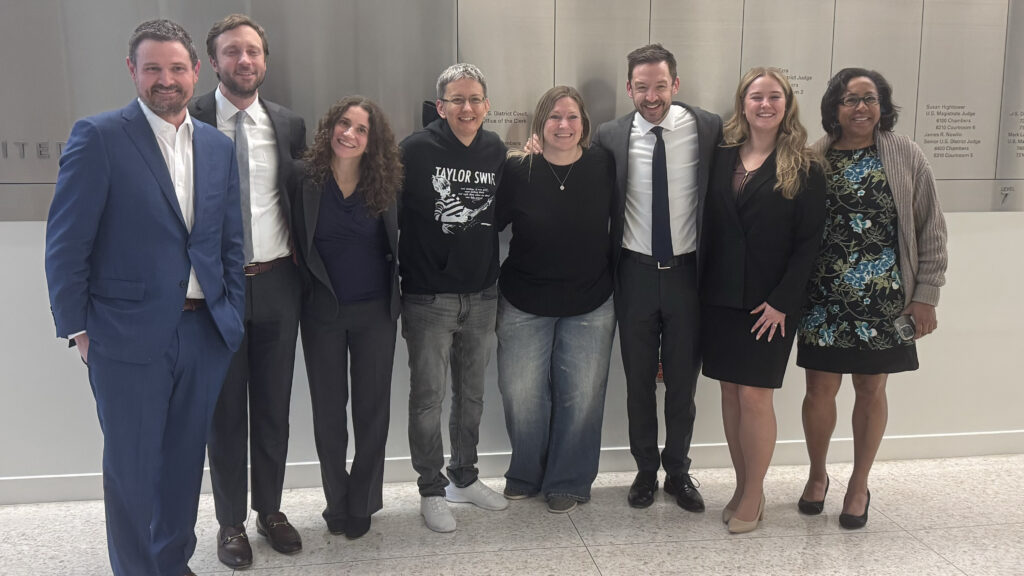
More than 30 lawyers from six firms, including the Texas offices of corporate law firms O’Melveny & Myers and Winston & Strawn, worked on the case, contributing over 5,000 pro bono hours valued at more than $5 million, plaintiffs’ attorneys said.
The team also included civil rights lawyer Jeffrey S. Edwards, who has brought individual cases against the state over prison heat, and his Austin firm, as well as solo practitioner Jodi Callaway Cole, known for representing Berne Tiede whose murder case inspired a film starring Jack Black. Denver firms Wheeler Trigg O’Donnell and Holland, Holland Edwards & Grossman also participated.
Duke, a Houston-based litigator who focuses on energy matters and previously served as board chair of Disability Rights Texas, had worked with Edwards on a Covid-19 protections lawsuit while at Winston & Strawn. The lawyers continued collaborating on prison conditions cases and broader Section 1983 litigation, searching for a way to address the issue on a systemwide level.
The current case originated with Tiede, whose medical emergency prompted the initial lawsuit. He was later removed from the suit after the state argued that his transfer to an air-conditioned cell meant he was no longer at risk.
Duke entered the case in March 2024 while at Winston & Strawn. By July, he had moved to O’Melveny, which expanded the team and committed additional resources. His former firm remained involved, and lawyers from both firms took active roles in examining witnesses at trial.
“I told O’Melveny, ‘Hey, I want to start on this day, but then I need to go to Austin for two weeks for a [hearing], and they were like, ‘Yeah,’” Duke recalled. “I mean, before I was even officially starting, they were like, ‘How can we help?’”
Duke said his ability to handle large, resource-intensive pro bono cases reflects the firms he’s worked for — places he described as genuinely committed to the work. He said he sees himself as both a beneficiary and a product of it.
Prison cases can be difficult, Duke said, and they often lack the public appeal of other pro bono work, which can make firms hesitant to take them on. But those are the cases where legal help is most needed, he said, and that challenge is what draws him.
“People need lawyers and issues need lawyers,” Duke said. “If it’s an area that’s going to be hard and not necessarily popular, that is more of a draw to me because that’s just a need that needs to be met.”
“What could be more popular than protecting the lives — whatever lives they are — of people all across the state,” Duke added.
About 90,000 Texas prisoners live without air conditioning, according to plaintiffs’ attorneys. They are asking that cell temperatures be maintained between 65 and 85 degrees, in line with requirements set by the Texas Commission on Jail Standards for pretrial jail facilities.
In a March 2025 ruling on a preliminary injunction, Judge Pitman said plaintiffs were likely to succeed at trial but declined to order temporary relief, writing that requiring interim air conditioning “would be to the detriment to the ultimate goal of permanent air conditioning.”
At the time, the Texas Legislature was considering bills addressing the issue. Then-TDCJ Director Bryan Collier testified in 2024 he was working toward systemwide air conditioning. Collier retired last summer and was succeeded by Bobby Lumpkin, who testified at trial.
“Considering these bills and Collier’s representations that he moves in good faith towards permanent air conditioning, it remains at the forefront of the Court’s mind that Plaintiffs, Collier, and members of the legislature are striving for the same end,” Judge Pitman wrote in a 91-page order.
By the end of the session, however, legislation that would have mandated air conditioning passed the House but stalled in the Senate.
“We’re here because we know that despite this court saying a year ago, ‘This is plainly unconstitutional, people are dying,’ the heat mitigation measures are still insufficient,” Wheeler Trigg O’Donnell partner Kevin Homiak said in closing arguments. “There is nothing short of a court order to get this done that will make TDCJ do it.”
In closing arguments, Ryan Kercher, a lawyer with the Texas attorney general’s office, argued the plaintiffs’ estimated $1.5 billion price tag is too steep for the Texas Legislature, and that plaintiffs ignored TDCJ’s efforts to scale up.
“The court’s preliminary injunction order pointed out that at the time, TDCJ had only spent $115.5 million in installing the air conditioning since 2018. In the 21 months since then, TDCJ has more than doubled that amount. … And they are not done,” Kercher said.
Amite Dominik, executive director of Texas Prisons Community Advocates, said having high-caliber lawyers lend their services pro bono is the only way to get the lawsuit done.
“We’ve had several incarcerated individuals who have filed lawsuits, and those lawsuits get dismissed quickly,” Dominik said. “For us having pro bono attorneys, we just can’t do it any other way.”
Jennifer Toon, executive director of Lioness Justice Impacted Women’s Alliance and a formerly incarcerated person who testified at trial, said the lawyers’ pro bono work carries significance beyond legal representation — from affordability to credibility — and that it affirms the humanity of those incarcerated.
“We see [lawyers] with all this expertise and who we admire and have all this education treating us like people and valuing our lived experience,” Toon said.
Duke said Lioness’ advocacy and Toon’s willingness to share her story has been deeply motivating for the legal team. He said the women’s candor about their experiences has reinforced the team’s commitment to push through challenges in pursuit of change.
“She had to go and talk about her experience and how horrible it was and relive that, and that makes you want to do a good job,” Duke said. “Because they’re investing more than just time and effort. They’re investing their story to try to get change, and you want to help that too.”