
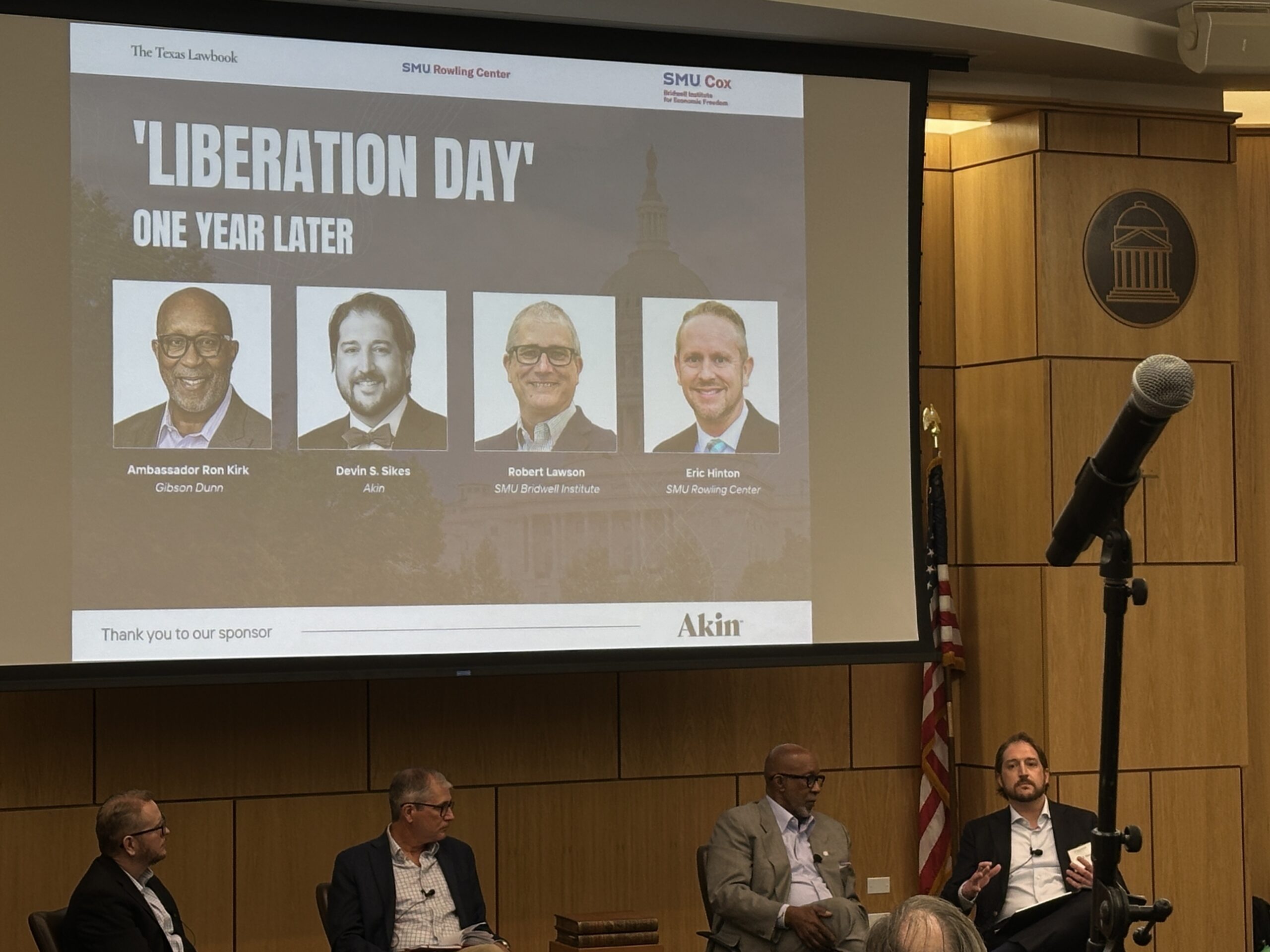
As policymakers continue to recalibrate U.S. trade policy in the wake of “Liberation Day,” the real-world effects are still rippling across boardrooms, factory floors, and checkout counters. At a recent economic roundtable, four international trade experts offered a look at how tariffs and the uncertainty surrounding them are reshaping decision-making for Texas businesses and consumers alike.
For SMU economist Robert Lawson, free trade is the key to prosperity, allowing countries to specialize and also grow richer over time. Even if that efficiency comes with localized pain, it’s worth it, said Lawson, adding that efforts to reverse those dynamics through policy often run up against economic reality.
Eric Hinton of SMU’s Rowling Center pointed to the logistical and regulatory hurdles that make reshoring manufacturing far more complicated than politicians suggest on either side. Former Dallas mayor and current Gibson Dunn Dallas senior counsel Ron Kirk, who served as the U.S. Trade Representative from 2009 to 2013, shared that skepticism, saying that high domestic costs continue to push production out of the U.S., while also warning that tariffs are squeezing small businesses and farmers.
Akin Houston partner Devin Sikes highlighted the growing complexity of the tariff system itself. From the rollout of the refund platform from U.S. Customs and Border Protection to the emergence of a secondary market for tariff claims, companies are navigating a process that is both financially significant and operationally uncertain, as the administration said Wednesday that the first refund payment for IEEPA tariffs is likely to go out around May 11, according to Bloomberg.
Here are highlights from the conversation, which has been edited for length and clarity:
Trading Dynamics
Robert Lawson: Like the United States, The Wealth of Nations is 250 years old this year. I often think about Adam Smith’s book, published in 1776, as he was a free-trade economist, and I’m one, too. His core argument was simple: We should be in favor of free trade because it makes us rich. Countries grow wealthier when they focus on what they produce efficiently and trade for everything else. That idea still holds up today.
He illustrated it with a straightforward example. Scotland could produce wine, but at a cost far higher than importing it from France. Instead of wasting resources making something so inefficiently, it makes far more sense to buy it from a country that can produce it cheaply and focus on what your country does best. So, the Scot said, “We’ll be much better off buying French wine than making our own.”
That argument is still true.
It’s true in my family. It was true in his family. It is true for our nation. That argument held sway throughout the 19th and into the 20th centuries and the U.S. became a leader in a global movement toward free trade.
I’m from Ohio and you don’t have to explain to me some of the downsides of free trade. I’ve had family members who lost jobs in the Rust Belt. So, I’m fully aware of the cost of trade, and the dislocations it has caused.
But the U.S. is at historic highs in manufacturing output to this day. We’ve lost manufacturing jobs, but we haven’t lost manufacturing output. We are an industrial manufacturing giant, the envy of the planet. It just takes very few workers to do it.
We’re also an agricultural giant, and for the very same reason, we’ve lost agricultural jobs. The good news is we are so incredibly productive in this economy at making food; we don’t need farm workers, and we’re still incredibly productive at making stuff, so we don’t need as many factory workers.
Many of the things that people believe about trade simply aren’t so. One of them is that we’ve lost our manufacturing. We simply haven’t.
Another one is that deficits are bad. For example, I run a massive trade deficit with Kroger, but they give me food. When I go there, I buy the food and I hand over my dollars to the grocery store. Usually, I return in two days.
Division of Labor
Eric Hinton: I think what we’re really talking about is the economic underpinning of the post-war regime. And Ron’s going to go into more of the legal framework behind the trading structures we have. But these are now being questioned in a very significant way. It really goes to the ideas behind The Wealth of Nations, but also to democracy and the separation of powers. That gets to your point about how people get rich when there’s free movement of goods, persons, services, and capital.
Lawson: We get rich because we divide labor, because people specialize. When people specialize, they leverage their natural differences. You know, we grow salmon in Alaska and oranges in Florida. For good reason, because salmon grow better in Alaska and oranges don’t grow there. Floridians grow oranges and trade them for salmon with the Alaskans.
But we also learn that when we do things, we can acquire a comparative advantage, as the economic term goes. And so when we get rich, we get rich by advancing this specialization. Has anybody ever seen the movie Cast Away with Tom Hanks? It’s the worst movie about economics. In real life, what happens to a middle-aged executive from FedEx who ends up washing up on that island? He dies.
But we don’t live in a world like that. We live in a world where if we get too sick, we go to the doctor. If we need food, we go to the store. That’s division of labor: People who specialize in being dentists, people who specialize in food production and distribution and so on that allows us to have our standard of living.
Manufacturing and Supply Chain
Hinton: So how does that look then? You mentioned Florida and other states, but how does that look in an international environment? And what are some of the special or additional challenges you have with, like, say, natural barriers, or national culture, or even attitudes about international trade?
Lawson: For the U.S., our labor is very expensive. The reason it is goes back to that we’re really productive. Our workers are very productive, so we get paid well. But that means anything labor-intensive is going to be tough for us to do. Our competitive advantage is in capital-intensive and low labor-intensive items, and then we trade.
We trade manufacturing output and agricultural output. Those are the capital-intensive industries in the U.S. We export those things, and we import labor-intensive goods like textiles and furniture. For us, the division of labor in the economy now is mostly about producing capital-intensive goods, because we’ve got a lot of capital, but not many workers. And we’re going to trade with other nations and other groups of people who have a lot of labor but not much capital.
Hinton: One of the main rationales for tariffs is to bring manufacturing jobs back to the United States.
Lawson: Look, if manufacturing comes back to the U.S. for authentic reasons, because it passes a profit and loss test, I’m all for it. But I think P&L is how we should decide to allocate resources; we are not going to make the U.S. richer by making things ourselves that costs us more to make in our country. We can just buy them from abroad. Resources are scarce. We only have so many to work with, and if we devote them to things that are too costly, that’s not good. If we force the manufacturing to come back, and you can do that with tariffs, what you’re doing is you’re forcing us to take resources that are better used elsewhere and using them for things that we shouldn’t be doing. We should be buying our cheap pots and pans from Taiwan or from Indonesia.
Ron Kirk: Manufacturing has not come back. And, in fact, you’ve had some industries lose because of the fact that it is so expensive for the kind of manufacturing jobs that you want. Those are multi-billion-dollar investments, and they aren’t going to turn over in time. Having been in the unique position of serving as our U.S. Trade Representative under President Obama, the first thing I did when I became trade rep was assemble all my staff and tell them you can never use the phrase “free trade” again, because Americans have soured on free trade. My wife’s from Ohio, and all of my relatives would burn me at the stake for what I did.
Because they believe every job ever lost, every factory closed, was because of trade. But the reality, as sad as it is, those jobs were lost over the last 40 years because we’re so productive. We went to the assembly line, then we went to automation, now robotics and AI, but that doesn’t make you feel any better if you’re an out-of-work steelworker or autoworker in Pennsylvania, Ohio or Michigan.
It is the angst about where they will find jobs. The reality is that the only time the United States ever imposed tariffs at the level this administration put in place a year ago was during the Great Depression. Almost any economist will tell you the Great Depression was prolonged because of the Smoot-Hawley Tariff Act, because tariffs operate against innovation and the supply chain.
If you want to buy American, that’s great. But if you can find the product better, faster, and cheaper, and it helps your small business and your family, you should be able to do that.
And the other thing you would come away with is that “Made in America” is still the most treasured brand in the world. One of our biggest exports is actually our intellectual capital, whether it’s books, technology or even music. It’s all valued around the world. And so, when we make ourselves isolationist, all our other trade partners that we normally do business with are rushing into that void we created, or to China.
Hinton: There is this international trade legal infrastructure that was put in after World War II to really give rise to the economic benefits that have been mentioned. And this is that multilateral system, involving the World Trade Organization or our trade deals, that’s being challenged. All these things come into play with those tariffs, because those mechanisms are really designed to reduce barriers and increase the flow of goods.
Kirk: Yes, the other element of job creation is our intellectual capital, and particularly our investment in higher education. What I find interesting and amusing, particularly in my travels in developing economies that didn’t quite share our embrace, our levels of democracy, or the rule of law, is we would lecture them about how we want them to at least respect some labor laws, not use child labor and not abuse women. You know, show them respect.
They would often, almost singularly, say that they don’t have to bother with that with China, which just gives them money in exchange for goods.
The one question I would always ask them is, “So, if you are so enamored with China, how is it when you got your freedom, where did you choose to send your kids to school?”
In every case, they go, “Oh, my daughter’s at SMU or in Chicago or in California.” Our intellectual capital is a huge advantage, because we’re one of the few countries in the world that can not only educate most of our young people, but international students, as well.
Devin Sikes: We have a prior example of how to do this. It’s called trade adjustment assistance, and it’s a program that’s been on the books for decades, and regrettably, it’s been underfunded for a very long time and now defunct. But it allowed folks to retrain, reeducate and relocate and tap into that intellectual capacity that we have as a country, to move forward and harness the new things that make our economy unique and special.
There are very noble aims about why you might want to reshore certain industries. Something that you hear a lot these days is pairing economic security with national security is a policy matter. I think there are healthy debates on both sides about whether that’s wise or not.
For the longest time, the national security exception was just that. It was the exception to the normal trade rules. For example, there’s been a long-running trade dispute between the U.S. and Mexico over tomatoes. Texas has its own significant interest in the tomato trade. In Florida, for better or worse, climate change is impacting the ability to grow there. It’s increasing insurance costs. There’s a migrant labor problem in the state. Their soil is worsening due to salinity, among other factors. So, as we might have these noble aims to reshore for various reasons such as national security or economic security, however you want to define it, we also have to come to grips with the reality that we’re just going to have certain limitations. It’s a question of how we allocate our resources to give us the best advantage relative to our peers.
Small Businesses and Farmers
Kirk: 90 percent of U.S. exporters are what we define as small businesses. And I’m not saying they aren’t being hurt, but this isn’t all about General Motors, Ford, Caterpillar or Boeing. These are small businesses, and they cannot stand another year of uncertainty. They paid these tariffs, and I mean, it’s heartbreaking.
Even though our farmers aren’t paying the tariffs, agriculture always pays the most immediate price whenever the United States engages in a tariff war. Why? Because all of our competitors around the world understand one simple truth: the single greatest common denominator of every elected official in the world is that they represent a farm.
Although U.S. farmers do not directly pay these tariffs, they are often the first and hardest hit. Foreign governments target agriculture because it affects nearly every political district, making it a powerful pressure point. Retaliatory tariffs include Canadian restrictions on American whiskey or China stopping soybean purchases, because they directly impact lawmakers’ constituents back home.
This creates a financial strain for our farmers, who depend on stable export markets to plan planting and secure financing. When key buyers pull back, crops can go unsold, leaving farmers uncertain about future production. Those farmers need that revenue because they’ve got to make decisions about whether they’re going to plant crops again. And they are still in a state of flux.
Additionally, financial markets reacted sharply to the first tariff announcements, which meant a temporary six-month pause to allow for negotiations with trading partners. While the administration later pointed to market recovery as a sign of success, the repeated pauses and delays meant the full economic impact of the tariffs was never fully realized.
Implementation was postponed multiple times, often for political reasons. Members of Congress aren’t stupid. They were most afraid of parents getting ready to shop for their kids for back-to-school, Halloween and the holidays. They were delayed again and again. It’s really taken a while for the impact of these tariffs to sort of work their way through the economy, and that’s one reason I think we haven’t seen it show up as much. I think what’s driving the hit now is what’s happening in Iran, more so than the tariffs.
Sikes: I always like to analogize this to a stack of pancakes. We’re talking about one pancake on the stack. But there are all these other tariffs that are in play.
The current tariff landscape is best understood as layers rather than a single policy change. The recent actions represent just one “pancake” in a much larger stack of overlapping tariffs. Existing Section 232 measures, the national security tariffs, remain significant, including duties on steel and aluminum that have risen as high as 25 percent to 50 percent. These tariffs have expanded to cover additional sectors such as copper, automobiles, and auto parts, broadening their economic impact.
On top of that, Section 301 tariffs on Chinese imports remain in effect. Originally implemented to address intellectual property concerns, these duties, about 25 percent, continue to affect a wide range of goods.
Taken together, these multiple tariffs compound one another, creating a cumulative burden on importers and businesses. The result is a complex, layered trade environment in which costs are driven not by a single policy but by the combined effect of several overlapping tariff authorities.
China and Global Trading
Lawson: There are countries that mean to do us harm and do our allies harm. Trade is a very powerful weapon in that conversation. I’m absolutely in favor of that. On the other hand, I’m willing to trade with Democrats and Republicans and socialists. I’m willing to trade with people who are Baptists. And I think it’s generally a good thing to be willing to trade with people who don’t see the world exactly behave the way you would like it to behave. I think trade brings us peace.
Kirk: We have so degraded the World Trade Organization. But we did create a post-World War II order, which we were anchored in the middle of that. And whether it’s through the WTO or the G20 and others, we have built a world in which a number of countries have said they want to trade and play by the rules.
One way we can constrain China is to say, “OK, you don’t want to play in our sandbox.” You’re not going to play in the U.S. or Europe. And we’ve used alliances that we have built up around the world, both strategic, economic and others, to box China in. That’s what the Trans-Pacific Partnership was all about, recognizing the fact that there are these markets and that we can create enough economic force that China will realize, because they still are an exporting economy than they are a consumer-based economy. That’s one way to get them to change their behavior. But if you’re going to do that, you don’t throw away the strongest multinational alliance in the world, which NAFTA is: a $3.5 billion-a-day success, and the majority of that flows through Texas. It’s a huge alliance.
The rest of the world wants to do business in an alliance with the United States because of our adherence to the rule of law and free and fair play. That’s my biggest fear of the way we’re going at this with the tariffs, hitting everybody rather than singularly focusing on the problems of China and Iran.
Tariff Refunds and Private Equity
Sikes: The tariffs have affected about 330,000 importers to the tune of $140 billion. Customs is establishing a system, and you, as the importer of record, or your broker, will be able to file a claim, assuming customs sticks to this. Customs will examine and review your claim. In theory, the money will flow back to the importer of record or the broker, who pays the duties in the first instance.
Meanwhile, a lot of small and medium-sized companies have really struggled to pay these tariffs, and they’re facing liquidity problems. There’s an interesting secondary market that’s now emerged where these importers who pay these tariffs are selling their rights to these refunds to private equity companies and other kinds of companies for cents on the dollar, so that they can get the cash on hand. The private equity folks will then receive the eventual refunds that flow from customs later on down the line. There are a lot more details there in terms of how those agreements work, and they vary by parties, but it’s really interesting.
Debt and Deficits
Lawson: I don’t think the trade deficit is a problem at all. The federal government is just piling on massive amounts of federal debt, and large portions of that are being purchased by foreigners, foreign governments, foreign banks and foreign companies. They’re using it on their balance sheets, just as you know, as anyone else who buys a sovereign debt. Part of the reason foreigners aren’t buying our goods and services is that instead, they’re buying this massive amount of debt that the U.S. Treasury issues every week. And if you really want to address a trade deficit, the simplest, mechanical way is to stop borrowing so much. Foreigners will spend dollars on our widgets rather than on our debt. There isn’t actually a connection between the trade debate and the fiscal problems that we’re dealing with concerning the debt. Fix the national debt, fix the borrowing. And that’s not happening.
Kirk: Our trade deficit is a very tiny part of the national debt. That’s because of what we spend on health care and tax rebates. The hotter our economy runs, the better we’re doing and the more we buy from other countries. So much of what we buy is because it’s an input into what we’re making. You can’t farm without potash. I don’t know what it is, but I know we don’t make it here.