© 2014 The Texas Lawbook.
(March 13) — Mediation is designed to serve as a simpler alternative to litigation for clients, but that doesn’t always mean the attorneys will have it easy. Fortunately, Will Pryor can help you out.
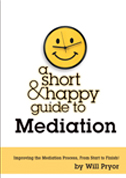
The Dallas ADR expert recently published A Short & Happy Guide to Mediation. The book speaks to all audiences on mastering the craft of mediation – whether you’re an attorney who wants better results from mediation, a client curious about an upcoming mediation, a mediator who wants to become more effective, or a student who wants to explore career options for dispute resolution.
And Pryor lives up to his word in the title; the book is only 141 pages long. This means you don’t have to wait until your summer vacation with the kids to pick it up for poolside reading. For some of you, Pryor’s book is shorter than that judge’s opinion sitting on your desk on your big case that you need to get to.
Pryor tells us a little more about his latest work below.
TLB: What caused you to want to write a book about mediation?

WP: In recent years, the continuing popularity of mediation has been matched by concerns that the process is not what it once was. We may have crossed a satisfaction threshold with how we use mediation, and I have a lot of ideas about how we can make mediation work the way it is supposed to.
TLB: Who should read the book?
WP: Lawyers who participate in mediations and want to learn how to achieve better results. Mediators who want to improve their skills. Students or anyone thinking about pursuing their interest in mediation and ADR. I especially want all of my lawyer friends to buy a big stack of them, and give them out to clients when an important mediation is around the corner. It will give the client confidence in the process and help them to understand how to make it work.
TLB: Why do you think we have reached a satisfaction threshold with mediation?
WP: Because it has become routine. It is our nature to become mechanical about anything we do repetitively. Unlike 20 years ago, mediation seems to have all the drama these days of a fresh set of interrogatories. I may be an outlier on this, but I am concerned that we mediate too often. So my book is sort of a “refresher course”, a suggestion that we recapture the magic that mediation once was in the past.
TLB: That doesn’t sound very “short and happy!”
WP: In the book I compare the state of mediation to Yogi Berra’s line about a restaurant, “Nobody goes there anymore, it’s too crowded.” The popularity of mediation, measured in the number of mediations being conducted, is at an all-time high and going nowhere but up. My concern is with success rates and satisfaction rates. I think there are many things a lawyer and a client can do to improve their overall satisfaction with the process of mediation.
TLB: What is an example of the mechanical approach to mediation you see lawyers taking?
WP: I can give you lots of examples! Too many mediations scheduled on a “half day” basis when a “full day” would be more appropriate. Too many suggestions by counsel that we skip the joint session that classically is the first step in the process. And too many occasions where even experienced advocates fail to communicate with the mediator in advance of the mediation, relying on the mediator to quickly “get it” once the mediation convenes.
TLB: Wow! Anything else?
WP: Too many agreements by counsel to let someone participate in the mediation by phone. Based on my experience, the likelihood of success of the process plummets when an important player is not physically in attendance. It’s like they call a room at a hospital “semi-private” and what that really means is “not private.” Well, participation “by phone” really means “not participating!”
TLB: You referred to a trend in favor of skipping the joint session. Why is that happening?
WP: When the mediation rocket left the launchpad in the late 1980s, joint sessions were virtually automatic. Convening the parties for face-to-face communication was considered appropriate, even essential to the process. In mediator training courses, practically half of the curriculum was devoted to how to conduct the joint session. Only in the most extreme, highly emotional circumstances would we skip it. But a few years ago advocates began expressing a preference for skipping the get-together at the beginning of the process. The objections to this day fall into two categories. One category is the “it will be too emotional, too adversarial, too polarizing, counter-productive,” blah blah blah! The other category is “we were in depos (or hearings) all last week, we know each other’s case inside and out, it will be a waste of time, let’s just get right to the negotiation,” etc. I try to be open-minded, but I like joint sessions! I began to ask myself, “how did we go from thinking that getting the parties together was essential, to thinking that getting the parties together was polarizing and a waste of time?” I realized that the only thing that changed in 20 years is that every lawyer I know participated in dozens of mediations. It is my view that lawyers began to use the joint session in a more polarizing and adversarial manner than in days gone by. So naturally I blame the lawyers!
TLB: What do you think we can do to correct this behavior?
WP: First, mediators need to be mindful that they are not immune to this “mechanical approach” phenomenon, and must guard against it as the number of mediations they conduct climbs from the hundreds into the thousands. Second, we all need to be reminded that even though as professionals, as advocates and neutrals, our participation in mediation is routine, the same is not true for most clients. For the client, a mediation may be one of the most significant events in their lives, a day when a lawsuit that has put at risk their business, their reputation, their marriage, their health —you name it — may be resolved. I try to take a moment every morning to remind myself that I may be dealing with someone for whom this is a very special event.
TLB: There are many books on mediation on the market. Why read yours?
WP: I love what I do, and I think the passion that I have for helping people resolve disputes, and the sense of humor I try to maintain at all times, comes through in the book. It is more readable than other mediation books. Each chapter ends in an essay about a memorable mediation experience. And in each anecdote there is a lesson — about how parties got into the dispute at hand, and how we got them out of it. Some are sad, some are hilarious. Like mediation.
TLB: Do you have a favorite mediation story?
WP: I have a hundred favorite mediation stories. Unfortunately, many of them involve celebrities, and I can’t tell them. Many are based on the pure satisfaction I get when a few days after a mediation I get a letter from one of the parties, thanking me for assisting them in getting out of a messy problem. But I always try to remember that about half of the disputes I mediate would settle if you put a stuffed animal in the chair where I am sitting. I believe that the baseline success rate of the process, where the mediator does nothing, would be about 50 percent, simply because the parties have agreed or been ordered to convene for the single purpose of trying to resolve their dispute. I like to think that an experienced mediator is responsible for pushing the success rate well above 50 percent.
A graduate of Yale University and Harvard Law School, Pryor has mediated more than 3,000 disputes in his career and teaches alternative dispute resolution at SMU Dedman School of Law. He is also a former courtroom lawyer, trial court judge and First Assistant Attorney General of the State of Texas. Pryor’s book can be purchased here.
© 2014 The Texas Lawbook. Content of The Texas Lawbook is controlled and protected by specific licensing agreements with our subscribers and under federal copyright laws. Any distribution of this content without the consent of The Texas Lawbook is prohibited.
If you see any inaccuracy in any article in The Texas Lawbook, please contact us. Our goal is content that is 100% true and accurate. Thank you.