
When Karen Mitchell started at the Northern District of Texas in 1995, the federal court system ran on paper. Lots of it.
A room that once held decades of litigation, from floor-to-ceiling filing cabinets packed with lawsuits, motions and more, now sits empty on the 14th floor of the Earl Cabell Federal Building in Dallas.
The filing cabinets are now gone in the digital era. And the job of running one of the nation’s busiest federal courts looks different from when she first started, a transformation that is more than symbolic. It captures a quarter century of change inside the Northern District of Texas: from paper to pixels, open buildings to hardened security and from routine operations to working through moments of national crisis.
Over those three decades, the longest-serving clerk of court in the nation has helped steer it through seismic shifts that included the Oklahoma City bombing, 9/11 and the pandemic, all while managing the day-to-day operations most people will never see.
Mitchell joined the Northern District of Texas in 1995 and became its clerk of court in 2001.
She has occupied the same office her entire time with the court.
“You can’t tell from the carpet?” she joked, gesturing to the green plush carpet that has never been replaced out of fear of potentially disturbing asbestos.
As clerk of court, Mitchell manages the court’s non-judicial functions, maintaining court records and dockets, court information technology systems, providing courtroom support services and even helping new judges set up their chambers.
Mitchell recently spoke with The Texas Lawbook about what’s changed and what’s stayed the same during her time managing the district’s day-to-day functions.
Adversities
In April 1995, shortly after Mitchell joined the court, Timothy McVeigh bombed the Alfred P. Murrah Federal Building in Oklahoma City. In the wake of the tragedy, some staff members from the Northern District made the trip to help. Because electronic filing didn’t exist at the time, the Northern District staff had to physically be there to assist.
The act of domestic terrorism was a wake-up call for the courts, Mitchell said, recalling the lack of security present at many federal buildings.
“But that was a turning point,” she said. “And we all are very conscious of security now, obviously, and that need for security has grown significantly over the years.”
Six years later, another terrorist attack affected the nation.
Mitchell was getting on a plane to Amarillo for a quick trip to that division within the Northern District’s footprint on Sept. 11, 2001.
Good Morning America was airing on a TV at the gate where Mitchell was waiting with her chief deputy to board, and smoke was pouring from the first World Trade Center tower.
They got on the plane and experienced an unusually quiet 75-minute flight to the Panhandle.
“I saw these huge jets on the tarmac, and I looked at my chief deputy, and I said, ‘These planes are not supposed to be in Amarillo. This is really weird,’” Mitchell said.
While they were in the air, an order was issued to ground all planes immediately. Mitchell, worried they would be stuck in Amarillo, tried to get a rental car, but when she was quoted an exorbitant price for the escape vehicle, she moved on to Plan B.
Chief Judge Mary Lou Robinson assured Mitchell the courts would be resilient in the face of the attacks, and Mitchell recalled taking comfort in her resolve.
Eventually, Mitchell and her chief deputy were able to borrow a federal government car from the Northern District’s probation department and drove the six hours back to Dallas.
“That event in history brought people together in a way that I haven’t seen since. Suddenly, all of our differences were not so important,” Mitchell said.
While the terrorist attack on 9/11 didn’t cause the courts to shutter, in March 2020, the COVID-19 global pandemic halted court proceedings across the country.
“It was so surreal,” Mitchell said.
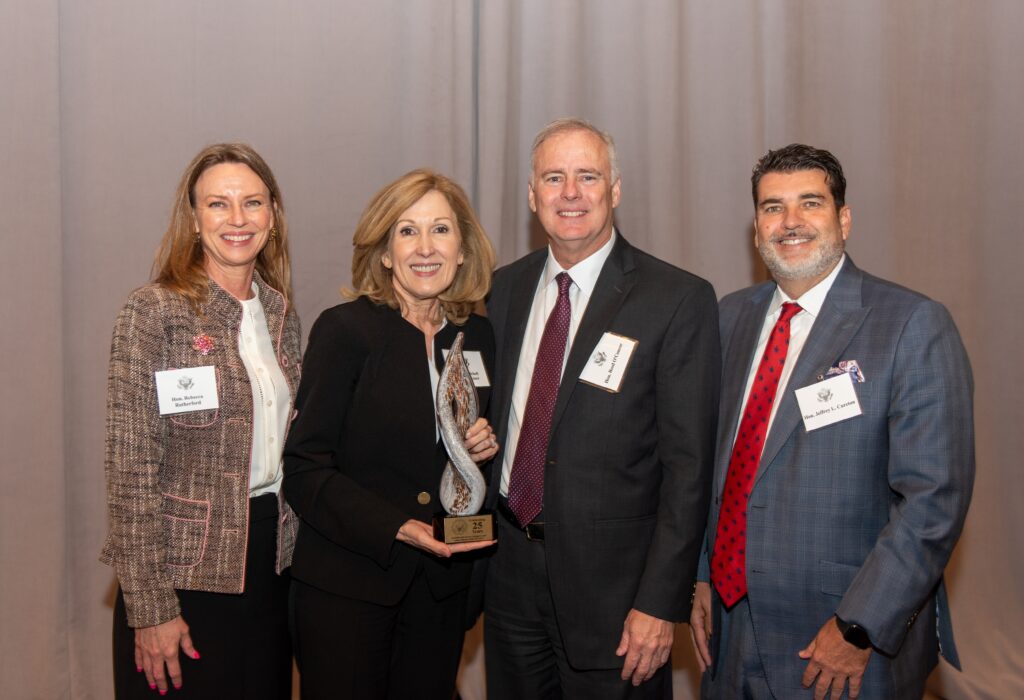
Lynn Pinker Hurst & Schwegmann partner Barbara Lynn was the chief judge of the Northern District of Texas at that time. Mitchell commended the judge for “keeping on top of what was going on within the medical arena.”
Mitchell worked with Judge Lynn to determine how to hold a jury trial while complying with social distancing restrictions and mask requirements.
The Dallas division used one courtroom for everything, which was sanitized frequently.
“There was just no time to even think. We just did it,” Mitchell said.
She recalled working from home and not moving from her computer for hours because there was so much work to be done.
“It was just constant coordinating and dealing with the issues. And that was a really hard time,” Mitchell said.
Between her, her children doing online school, and her husband, Mitchell was concerned the Wi-Fi would give out.
“I hope we never go through that again. It was terrible,” Mitchell said.
Then, five years after the COVID-19 pandemic, the government shut down for 43 days in 2025.
Mitchell said the Northern District is deemed essential, so the court continued to operate despite some staff not being paid.
She has weathered eight government shutdowns during her time working for the federal courts, including a 76-day shutdown that ended in April 2026, the longest in the country’s history.
In an effort to keep morale high during the last government shutdown, the court staff brought in pizza and had swap meets.
“People brought things that they would ordinarily put in a garage sale, or just stuff they didn’t need. Just bring anything. It could be clothes, it could be food, it could be jewelry, books, toys,” Mitchell said.
Advents
Change within the legal system can be slow, but Mitchell said the switch to electronic filing was a quick transition.
When she first joined the court, there was one person who would receive all of the copies of the signed orders and judgments, fold them, stuff them into envelopes and mail them out.
“Well, you can imagine the potential for human error,” Mitchell said.
Mitchell recalled that former U.S. District Court Judge Barefoot Sanders had his courtroom deputy fax orders so counsel received them more quickly than by mail.
“It turns out that our colleagues in Houston had developed a system where the case management system you could actually attach a PDF, or you could scan a document, attach it, and then fax it out to a lawyer,” Mitchell said. “So I said, ‘We’ve got to do that.’”
The lawyers, predictably, were happy with the change, she said.
The Northern District was selected as a pilot court for electronic case filing around 1999.
When every document was a piece of paper in a filing cabinet, they would periodically be archived and sent to the Federal Records Center in Fort Worth. Documents designated as historic would be sent to the National Archives. Now, everything is online.
Amusements
Mitchell recalls plenty of happy memories with the court, like bringing in a small pot-belly pig after a charity fundraiser for the judges to kiss.
The court can fundraise through the Combined Federal Campaign, which allows federal personnel to make tax-deductible donations through payroll deductions or one-time gifts to approved charities.
One year, in an attempt to encourage participation, some of the court managers and judges agreed they would kiss a pig if the court reached its goal.
“People thought that was really funny. So we got a lot of participation,” Mitchell said.
She recalled that they may have gotten in some trouble for bringing the pig into the building because animals are not allowed.
Another fond memory of Mitchell’s stems from a team-building event featuring a picnic and games across the street from the courthouse.
Strategizing how to beat their colleagues in the egg race, Mitchell and the IT director took some gum and stuck it to the bottom of the egg so it wouldn’t fall off the spoon.
“We walked very, very fast because we weren’t worried about the egg falling out. And so we won,” Mitchell said, laughing. “Then somebody said, ‘Wait a minute, let me see that egg. You’re cheating again.’”
Appreciation
At the Northern District Bench Bar Conference on April 24, Mitchell was surprised with a video honoring her 25 years as clerk.
“I was extremely shocked,” Mitchell said.
Included in that video was a message from Judge Lynn praising Mitchell’s work with the Northern District.
“Karen Mitchell is one of the most competent, terrific people I have ever worked with and will ever work with,” Judge Lynn told The Lawbook. “She is a remarkable person in every way. She is brilliant, incredibly knowledgeable, very well informed, and has a wonderful attitude.”
Judge Lynn said she is a big ideas person, but knows not everything can get done.
“Karen was so diplomatic that even when she was telling me no, she made it sound like she was telling me yes,” Judge Lynn said.
When there was a courthouse shooting in Dallas in 2019, the court got permission for people to bring their dogs to work for emotional support. Judge Lynn said it was a very traumatizing experience.
“She was a great representative of her own staff and a great person to work with the judges on the court, and she was just so very knowledgeable of all the issues that affected our district, and I had to learn that most of the time the best thing was for me just to get out of the way,” Judge Lynn said.
In 2008, U.S. District Judge Royal Furgeson transferred the Northern District from the Western District when he took senior status. He said Mitchell made the move smooth.
Furgeson was seated in San Antonio, but his wife was in Dallas, so he wanted to move. First, he needed the approval of the two districts and the Fifth Circuit.
“Karen took hold of that process, and it was seamless,” Judge Furgeson said.
He said he was dreading moving his chambers to a different city, but Mitchell handled that, too.
“I was just kind of dreading it, because I just thought the red tape would just kind of overwhelm me, and boom, Karen took a hold of that project, and the next thing I knew I was sitting in Dallas in a chambers with everything just the way it was supposed to be,” Judge Furgeson said.
The other wrinkle in his move across the state was that he wanted his courtroom deputy to move with him.
“That was going to impact her payroll, because all at once she has a new person that she has no involvement at all under any circumstance, hiring or vetting, working with, and I just show up, and that clerk is now a member of her staff, and that’s asking a lot,” Judge Furgeson said.
But in the blink of an eye, she welcomed Judge Furgeson’s courtroom deputy without hesitation.
“She has a really good heart, a servant’s heart,” Judge Furgeson said.