
In mid-April, the Department of Justice accelerated plans to revoke the citizenship of hundreds of naturalized citizens who “committed fraud” in the naturalization process, according to media accounts. In part, this effort will rely on a provision allowing revocation when the citizen is convicted after naturalization of a crime that started or occurred before naturalization.
Ironically, such a move could provide the legal predicate to invalidate the very convictions the government will use to seek denaturalization. As explained below, most criminal cases are settled by guilty pleas, not trials. Citizens who pled guilty to pre-naturalization crimes likely had no idea that doing so could lead to denaturalization. Unless they were warned of this risk — and in our experience they were not — their guilty pleas may now be subject to challenge as uninformed and involuntary, even after the fact.
The Principles of Voluntariness and Effective Counsel
In the federal criminal system, over 95 percent of indictments are resolved when the defendant pleads guilty. As the Supreme Court held in McCarthy v. United States, to be valid, a guilty plea must be “voluntary,” “knowing” and intelligent — that is, voluntarily made while “the defendant possesses an understanding of the law in relation to the facts.” In Henderson v. Morgan, the Court noted that a guilty plea is voluntary if the accused understands the nature of the charges against him and the constitutional protections that he is waiving. A plea is knowing and intelligent if it is done “with sufficient awareness of the relevant circumstances and likely consequences,” according to the Court’s opinion in Brady v. United States.
The Supreme Court in Padilla v. Kentucky acknowledged that the immigration consequences of a criminal conviction are “intimately related to the criminal process” and that non-citizens who plead guilty must be warned that pleading guilty could result in deportation. Such a warning to non-citizens is now codified in Federal Rule of Criminal Procedure 11(b)(1)(O), and defense counsel must discuss that consequence with their clients as a feature of constitutionally effective assistance. Failing to warn a non-citizen about possible immigration consequences may be grounds to set aside his guilty plea and conviction via a post-conviction challenge.
The same principles of voluntariness and effective assistance of counsel that apply to non-citizens apply equally to naturalized citizens. A naturalized citizen who pleads guilty has the same right as an alien to know that his guilty plea might be used to remove him from this country.
Revoking Citizenship
To revoke naturalized citizenship, the government must show by “clear, unequivocal, and convincing” evidence that naturalization was obtained by illegal means, concealment of a material fact or willful misrepresentation, according to the Supreme Court’s interpretation of 8 U.S.C. § 1451 in Fedorenko v. United StatesNaturalization is illegally obtained, and thus revocable, if “congressionally imposed prerequisites to the acquisition of citizenship” were not satisfied, the Fedorenko opinion states.
Possession of “good moral character” preceding application for citizenship and during the post-application process is a prerequisite for naturalization, according to 8 U.S.C. § 1427. Conviction of a crime involving moral turpitude, making false statements before or during the citizenship process or committing unlawful acts that “adversely reflect upon the applicant’s moral character” before naturalization are all potentially disqualifying, as found in 8 U.S.C. §§ 1101 and 1182 and 8 C.F.R. § 316.10.
Moreover, all applicants for naturalization must complete U.S. Citizenship & Immigration Service Form N-400. On it they must declare whether they have ever “committed, agreed to commit, … helped commit, or tried to commit” any crime “anywhere in the world,” even if they were never charged or arrested.
The pertinent section of Form N-400 is extremely broad:
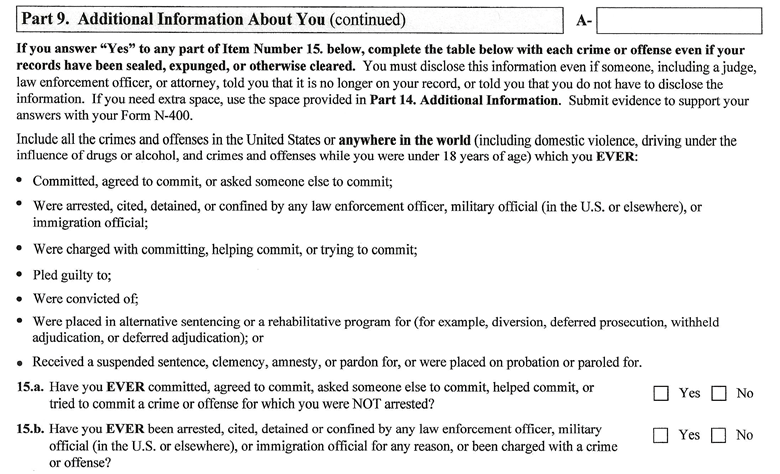
Any naturalized citizen who committed a crime before or during the naturalization process and then pled guilty to the crime after becoming a citizen potentially risks denaturalization. And if the applicant fails to disclose the past uncharged crime, he could be accused of making a false statement or concealing a material fact to obtain citizenship and thus be subject to revocation for that reason. In our experience, courts do not warn naturalized citizens of these risks, which undermines the voluntariness and validity of their pleas.
Conclusion
The particular post-conviction vehicle for seeking relief from an involuntary or ill-advised guilty plea will depend on many factors: whether the conviction was in state court or federal court, whether the citizen is in custody or not, how much time has passed since the plea and what if any warnings were given. But in appropriate cases, naturalized citizens who were unaware of denaturalization risks should be able to challenge their convictions. DOJ’s push for revocation could thus lead to unintended results — but results that the Constitution requires.
David Gerger and Matt Hennessy practice at Gerger, Hennessy, Martin & Peterson in Houston.