
Just days before Christmas, Holland & Knight partner Justin Cohen and associate Morgan Delabar stood before an immigration judge to plead for asylum for a Honduran mother and her youngest son.
The family had fled Honduras claiming gang members murdered the family’s patriarch, shot the couple’s oldest son in the head and later beat him and set him on fire — all in an effort to seize the family’s land.
For Cohen and Delabar, whose practices focus on patent and trademark litigation, the pro bono case bore little resemblance to their day-to-day work. The stakes were immeasurably higher, and the procedural landscape is the most challenging asylum lawyers have faced in decades.
Under the second Trump administration, asylum grants have plunged even more sharply than during the president’s first term, when the grant rate fell to 29 percent in fiscal year 2020, according to the Transactional Records Access Clearinghouse, a nonprofit, nonpartisan research arm of the S. I. Newhouse School of Public Communications at Syracuse University.
This year, asylum grants have reached their lowest level since 2009. An investigation by The New York Times published in April revealed that immigration judges granted just 7 percent of asylum applications in February, placing Cohen and Delabar among a small group of attorneys nationwide who have secured asylum victories in an increasingly inhospitable environment.
“Looking back, we are incredibly thankful that our immigration judge fully considered our clients’ circumstances and correctly applied the law,” Cohen told The Texas Lawbook.
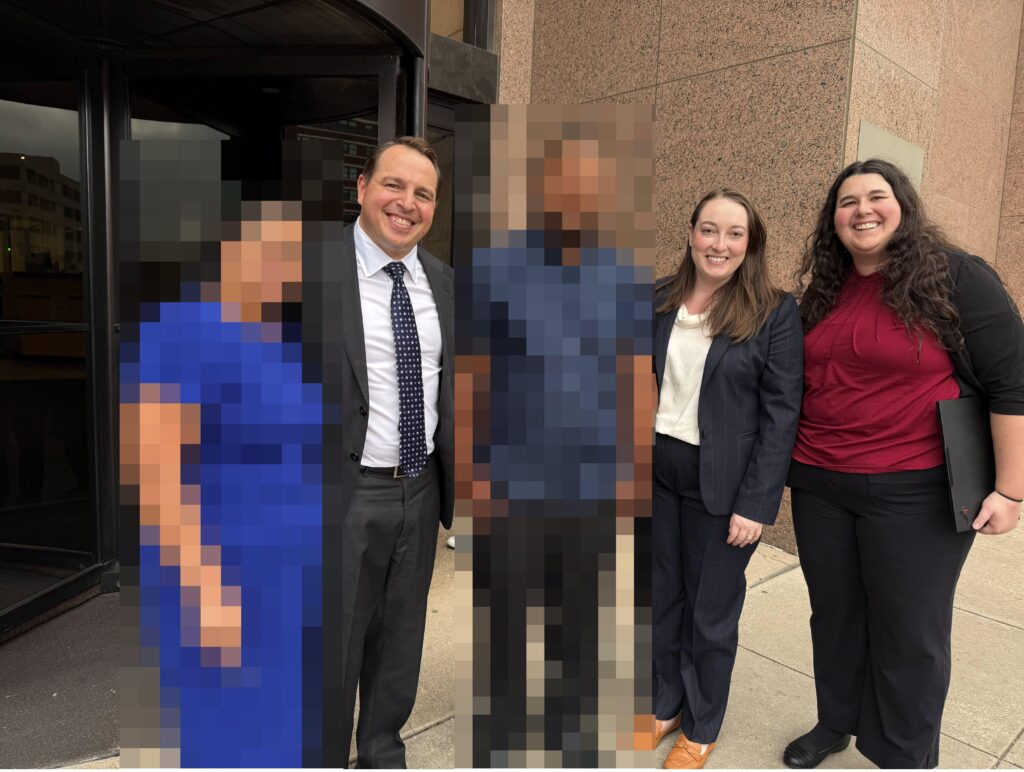
A Dallas-based immigration judge found that the mother and son qualified for asylum because they belong to protected social groups and because the Honduran government was unable or unwilling to protect them, the lawyers said.
The Lawbook agreed not to identify the family, whose youngest son was a minor when they crossed the border into Texas in 2015.
The lawyers also declined to identify the immigration judge, citing reports that the Trump administration has removed judges it viewed as insufficiently aligned with its immigration enforcement policies.
A Family Under Threat
Under the country’s Agrarian Reform Law, the family’s patriarch inherited land from the Honduran government. Photos presented to the judge showed the family’s idyllic home surrounded by goats, chickens and other livestock.
A neighboring parcel was inherited by his brother, whose sons later divided the property. According to the lawyers, one of those sons sold his share to an alleged MS-13 gang leader.
Cohen and Delabar told the judge that the gang sought to acquire the family’s remaining land and began threatening the patriarch to force him to sell. When he refused, he was killed. His body was discovered on the bank of a river.
Although the family reported the killing to police, no one was arrested and the investigation went nowhere.
Three months later, the family fled the area, but the violence followed.
In February 2015, the oldest son went to inspect the land. He was shot in the head and survived after emergency neurosurgery. Again, his family sought help from authorities and human rights officials, but no action was taken.
After relocating once more, the oldest son and one of his brothers attended a nearby fair, where they were attacked again.
The younger brother said assailants covered his head, separated him from his brother and wanted him to tell his mother the family would be harmed if they ever returned to the land.
Meanwhile, the oldest son was beaten and set on fire. While bystanders intervened and saved his life, he had to spend eight days recovering in a hospital. The family once again reported the attack, but nothing resulted.
In July of that year, the family arrived in Texas. The two older sons, who were adults at the time, were detained, setting their asylum claim on a faster track through the system, the lawyers said.
‘Arguing on Quicksand’
The immigration judge said it was clear that the gang would inflict further harm on the family if they were returned to Honduras, the lawyers said.
The ruling was significant because proving a family relationship alone generally is not enough to establish membership in a “particular social group,” one of the five protected grounds for asylum under U.S. immigration law.
In September, the U.S. attorney general revived a stricter 2019 precedent holding that relatives cannot automatically qualify as a particular social group based solely on familial ties.
Immigration judges, unlike Article III district court judges, serve under the Executive Office for Immigration Review within the Justice Department rather than the judicial branch, making attorney general decisions binding precedent in immigration court.
That created an additional challenge because the controlling legal interpretation changed after the attorneys filed their brief but before the final hearing, the attorneys said.
“This felt like arguing on quicksand, because it’s just really unsteady as to what exactly the standard is and how the judge was going to interpret and apply it,” Cohen said.
To qualify for asylum, applicants generally must establish that they suffered past persecution or that they have a well-founded fear of future persecution because of their race, religion, nationality, political opinion or membership in a particular social group, explained Daniel H. Weiss, a former deputy chief immigration judge and an adjunct professor at SMU Dedman School of Law. According to Weiss, “the protected characteristic must be one central reason for the persecution.”
A finding of past persecution creates a presumption that the applicant has a well-founded fear of future persecution, shifting the burden to the government. If past persecution cannot be established, the applicant retains the burden of proving that his or her well-founded fear of future persecution is objectively reasonable, Weiss said.
“You win or lose your case largely on the nexus,” Weiss said.
Applicants claiming persecution based on membership in a particular social group must satisfy three requirements, Weiss explained: The group’s defining characteristic must be immutable, the group must be defined with sufficient particularity, and it must be socially distinct within the relevant society.
To illustrate the concept for his law students, Weiss pointed to the family of Tsar Nicholas II, who were executed by the Bolsheviks during the Russian Revolution.
“They have a social distinction. You can look at them and say, ‘We know who this group is. We know that within their society they would be recognized as a distinct group of people, and they have an immutable characteristic that they cannot change.’ So that makes them a particular social group,” Weiss said.
But belonging to a family alone is not enough. Asylum applicants must also show they were persecuted because of their membership within that family.
“It has to be because, like with the Romanovs, they wanted to have a revolution and get rid of the royal family. ‘We’re persecuting you on account of you being a member of this group, as opposed to you’re a member of a group, but it’s not your family that we have a beef with,’” Weiss said. “The question is whether the persecutor targeted you because you were a member of that family. If the family relationship is merely incidental to some other dispute, the nexus requirement is not satisfied.”
In Cohen and Delabar’s case, the judge went a step further. The judge concluded that the family’s ownership of land passed down through generations under Honduran law created a distinct social group that gang members specifically targeted. Land ownership has been shown to be a cognizable particular social group by the Board of Immigration Appeals for decades.
Finally, the judge concluded the record demonstrated the government of Honduras was not able or willing to protect them, satisfying the third requirement for asylum, the lawyers said.
Time Very Well Spent
Even as experienced litigators, Cohen and Delabar said the case pushed them outside their comfort zones.
“Our IP clients are very important to us. Their inventions or their businesses are very important, but it is different dealing with what could have been a life-or-death situation for those individuals,” Delabar said.
Over the course of two years, they devoted about 200 hours to the representation. They leaned on training and guidance they received from Human Rights Initiative of North Texas, a nonprofit that provides legal and social services to immigrants. According to HRI, immigrants with lawyers are five times more likely to secure legal status than those without.
Delabar said the case underscored how large firms are uniquely positioned to take on pro bono matters of this scale, crediting Holland & Knight’s support — including associates, paralegals and legal assistants helping prepare exhibits and translations — for making the work possible. Firm partner Lauren Becker and associate Jordan Paine also worked on the case.
When the judge announced the decision, the mother and son let out audible sighs of relief before embracing each other and their lawyers, Cohen said.
Today, the family is living in Texas, and two of the sons have children of their own. The mother has held a job as a housekeeper at a hotel, and the youngest son delivers furniture for a furniture store.
“This was one of my most emotional and hardest cases,” Cohen said. “It just felt like the stakes were really high. Our clients were very deserving.”
Delabar said she knew the statistics in asylum cases made clear the result could have gone another way.
“If it didn’t go well, I think I would think about them every day for forever,” Delabar said.