
By Friday before Thanksgiving, jury selection had slowed to a churn. The three Texas lawyers from Dean Omar Branham Shirley were weary.
In a cramped, cold courthouse room overlooking downtown Pittsburgh in 2024, the trial team gathered with the son and daughter of Michaeleen Lee, a grandmother, chemistry professor and marathon runner whose once active body had been ravaged by mesothelioma in the final days of her life.
Over subs and salads from a local sandwich shop, they lamented oddities in the process and the trial strategies of their opponent, pharmaceutical giant Johnson & Johnson. Lee’s family was among thousands of plaintiffs suing J&J over allegations its talc-based baby powder contained cancer-causing asbestos.
For as frustrated as the lawyers were, the jury pool seemed many times more aggravated. The lawyers were feeling their aggression, and they worried they wouldn’t be able to fill the jury box.
Partner Jessica Dean looked down the table at Michelle Felton and offered a candid truth. “We’re exhausted.”
By this point, the Dallas-based litigation boutique had gone to trial against J&J seven times that year, winning five, settling during one trial and enduring one mistrial after the client died during the proceedings.
DOBS, with about 39 lawyers and 35 support staff, belongs to a small group of firms in the country that continues to reject J&J’s offers to resolve all of its talc litigation through firm-level settlement agreements.
Instead, DOBS lawyers have taken J&J to trial one case at a time in courtrooms across the country, facing a roster of major law firms, including Kirkland & Ellis, King & Spalding and Gibson Dunn.
The few settlements DOBS has agreed to have been on behalf of individual plaintiffs, Dean said, allowing the firm to resolve those cases without giving up its ability to continue fighting J&J in court.
And they’re winning.
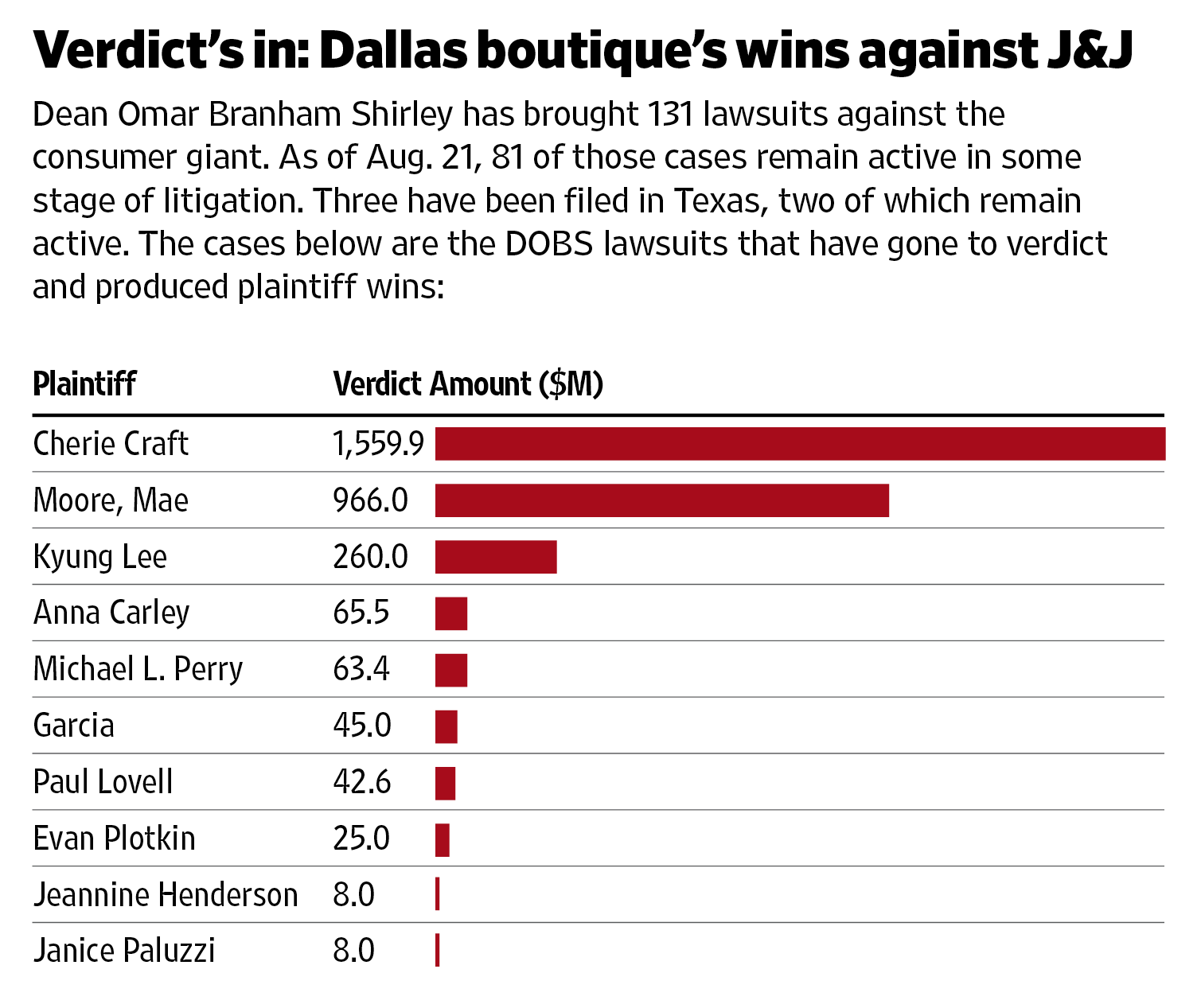
Last year, a Maryland jury awarded $1.5 billion to a DOBS client — widely believed to be the largest award yet to an individual in the ongoing litigation over the company’s baby powder.
Juries have awarded DOBS clients about $2.7 billion in damages in cases against J&J in 2024 and 2025, plus another $32 million so far in 2026.
With 12 future trials scheduled, and one ongoing this week in New Orleans, Dean said the firm’s win-loss record in these trials is 10-4, and the only case so far decided on appeal affirmed the jury verdict against J&J.
To report this article, The Texas Lawbook has covered DOBS trials from Pittsburgh to Dallas to Spokane. Along the way, DOBS lawyers gave Lawbook reporters extraordinary access to their war rooms.
This is their David versus Goliath story.
Built for the grind
The firm’s senior lawyers are built for the grind, Dean said. It’s how they were trained.
“I also just think we are a little bit on the edge of crazy,” Dean said in a January interview with The Texas Lawbook.

“We’re not on the edge. We’re free-falling,” fellow name partner Trey Branham added, sipping from a mug depicting a cartoon dog calmly drinking coffee as flames close in around him.
Shortly after Branham graduated from the University of South Carolina School of Law in 1999, he joined Dallas asbestos firm Waters & Kraus and sat between experienced litigators Jeffrey Simon and David Greenstone.
“I was so lucky to be able to sit between those guys and just listen to them talk,” Branham said. “I jokingly say that every time I stand in court, I hear one of them talking.”
When the duo left to start their own firm, Simon Greenstone, Branham went with them.
A few years after Dean graduated from the University of Texas School of Law in 2003, she interviewed with Branham at Simon Greenstone.
At their prior firms, Branham and Dean said they developed the skills that primed them for this protracted battle.
The barrier to entry in asbestos litigation is high, Dean said. A trial requires intelligent experts with time constraints, a mastery of thousands of corporate documents and the ability to go toe-to-toe with a company that brings dozens of attorneys and enormous resources to each trial.
Even outside the courtroom, mundane things can turn adversarial, according to Dean. DOBS will reserve hotel blocks and set up war rooms, only to learn — at the last minute — that J&J has secured the space at a higher rate, forcing them out, Dean said.
It took years for the plaintiffs’ law firms that initiated the litigation to recover from the all-in nature of the fight, the DOBS lawyers said.
DOBS combats the better-resourced firms by being quick on its feet.
“You never have the same resources that a Kirkland & Ellis has,” Branham said. “So, the only way to deal with that is to be more nimble than the other side is.”
“Ultimately, you don’t have control,” Dean added. “And if you get too fixated on that, you’re not going to do a heck of a job.”
Dean was initially skeptical about the allegations against J&J. How could a widely regulated product like J&J’s baby powder — promoted as gentle for babies and trustworthy for mothers — be on store shelves if it contained cancer-causing asbestos, she wondered.
The answer, Dean now tells juries, is found in internal J&J documents that became widely public in 2018 as a result of litigation. The documents revealed that company executives knew for decades that the company’s raw talc and finished powders sometimes tested positive for small amounts of asbestos. The documents also showed that executives worried about public backlash while failing to disclose the findings to regulators or the public.
In 2022, the company announced that it was discontinuing talc-based baby powder in favor of cornstarch, though the company denied the switch was due to unsafe talc.
The internal documents now serve as key evidence in lawsuits brought by women who allege the baby powder caused ovarian or other gynecological cancers, as well as those brought by plaintiffs who say it caused mesothelioma, a cancer in the lung lining.
Mesothelioma has only one cause, DOBS lawyers tell juries: asbestos.
“Experts in scientific literature talk about it being a signature disease, and so if you have mesothelioma, your doctor doesn’t try and figure out what caused it. What your doctor says is, ‘Where were you exposed to asbestos?’” Branham said.
At trial, the question boils down to who caused the exposure, Branham said.
In many cases J&J points to other possible exposures. In the case of Kyung Lee, for example, J&J argued Lee was exposed to asbestos from a factory near a home where she lived for a year and a half as a child. Though the home was half a mile away and upwind from the factory, the defense theory posed challenges for DOBS, attorneys said. Nevertheless, the jury awarded $260 million.
Since DOBS formed in 2015, its lawyers have filed approximately 130 cases against J&J, including three in Texas. Of those, about 80 are currently active in pretrial or appeals, including two Texas cases. Those figures are fluctuating daily, the firm said. DOBS attorneys have filed 10 cases so far this year.
“I’d rather have nothing”
J&J transferred potential liabilities from lawsuits by women who claim its baby powder caused their ovarian cancer to Red River Talc, its Texas-based subsidiary that then filed for bankruptcy. Federal appeals courts in New Jersey and the Third Circuit ruled the company was not in financial distress and could not hide behind the bankruptcy system. In July, J&J said it would pay an estimated $5.5 billion to resolve the ovarian cases.
The mesothelioma cases, however, are not part of that resolution. Instead, J&J has resolved many of them through confidential settlements with individual law firms.
“It’s really odd which ones they settle and which ones they don’t,” Dean said. “We have very little control over them engaging.”
Some cases settle during trial. Unlike firm-level offers, these settlements are negotiated between the company and an individual plaintiff.
Jerry Newton, a Texas man who arrived at his Dallas trial frail and in a wheelchair with his wife by his side, sat before the jury. He sometimes smiled as a slideshow of photos with his grandkids was displayed for the jury. His cheeks were dramatically fuller in the photos.
DOBS partner Aaron Chapman told jurors they would see J&J’s internal documents, and he displayed an excerpt in the slideshow stating there would be public “furor if it became known that our talc formulations contained any significant amount of tremolite … the law department should be consulted.”
Gibson Dunn partner Collin Cox represented J&J in the trial. He cautioned jurors to be aware of confusing terminology.
The case settled after just one witness testified.
In open court, J&J has offered settlements that would cover not only a firm’s current cases, but those filed up to 10 years into the future, Dean said. The Texas Lawbook could not independently find a transcript of a hearing confirming those terms.
J&J, Dean said, often returns to DOBS with the same pitch, coaxing the firm with, “Here’s the deal everyone else has taken.” Sometimes the offer comes months later when a trial is delayed, after a DOBS loss or after lawyers have left the firm.
But the amounts offered are — in Dean’s words — “offensive.” And DOBS is firm in its stance that it won’t agree to stop bringing cases for future clients.
“We’re not going to resolve cases with no option for people to have their day in court that we haven’t met yet. We’re just not,” Branham said. “We’re not going to do that because we don’t think it’s proper. These are the clients’ cases. These are not our cases. And I think sometimes that gets lost.”
In the cold Pittsburgh courthouse room, Dean huddled along the far side wall with Michaeleen’s adult children, Charles Lee and Michelle Felton. J&J had offered $100,000 to settle the case, she told them.
“No,” Lee said quickly.
“I’d rather have nothing,” Felton added.
So they forged on.
A powerful chip

As opening statements were underway, talc supplier IMI Fabi, which was also a defendant in the case, settled with the plaintiffs.
Those kinds of settlements make it possible for clients to reject J&J’s offers, Branham said.
The firm doesn’t keep track of certain statistics, Branham said. But a few years ago, the lawyers did look at the percentage of cases in which other defendants settled.
They found that in 87 percent of cases, other defendants settled. That allowed plaintiffs to pay their mortgages and medical bills.
“When we talk about the power of being in these cases, what we’re talking about is the ability to go into the courtroom with your client understanding that their family is going to be taken care of and hold the actor that refuses to accept responsibility accountable,” Branham said.
That was the case for Anna Jean Houghton Carley, who at the time of trial last year was a 37-year-old mother of three young children. Jurors in a Minnesota court awarded $65.5 million.
“[J&J] looked at that case and did not see the same risk that we saw for them, and it was OK for the Carleys to go take that risk, because we had been able to make sure that the family was going to be taken care of, win or lose,” Branham said.
Gold standard science
The Pittsburgh trial extended past Thanksgiving, Christmas and New Year’s Day of 2025 — far longer than the judge and lawyers initially told the jury it would. One of DOBS’ trial lawyers — Sam Iola — left the firm during the trial and eventually opened his own firm. Dean later told The Lawbook it was the hardest period of her life.
When the jury returned its verdict, confusion was obvious.
The jury returned a defense verdict, finding no causation. However, jurors tried to award $22 million to the plaintiff on the verdict form. DOBS filed an appeal, calling it an inconsistent verdict. The appeal remains pending.
“It was clear from [the jurors’] expressions, they thought that they had punished Johnson & Johnson,” Dean said at the time. “While we didn’t recover, it’s unequivocal that they not only thought Johnson & Johnson committed bad conduct, but outrageous conduct.”

J&J has consistently maintained that its baby powder never caused cancer and has accused law firms including DOBS of using “junk science” to win verdicts.
After the Carley case, Erik Haas, J&J’s worldwide vice president of litigation, issued a statement saying: “The company will continue to advocate for gold standard science in the U.S. judicial system. For far too long American juries have been permitted to review junk science supporting plaintiff lawyers in search of jackpot verdicts, instead of science from scientific agencies authorized by congress to evaluate such matters.”
The company has countered the internal documents by saying some tests were flawed or preliminary. J&J’s lawyers point to independent tests by regulators that they say prove the powder’s safety.
In March, during a DOBS trial in Spokane, Kirkland & Ellis partner Bill Oxley told jurors that while the U.S. Food and Drug Administration found small amounts of asbestos in J&J’s powder in two 2019 tests, the FDA did not immediately notify the company because it was concerned an exposure in the lab caused the positive result. Oxley also argued that the amount discovered was less than hazardous. That case also settled mid-trial.
Dean and Branham take issue with J&J’s assertion that junk science is allowed in courtrooms.
“[Erik Haas] knows that courts have gatekeeping processes that are required as a matter of law,” Branham said. “Every state and every federal jurisdiction has it. … All of this is vetted.”
J&J lawyers declined The Lawbook’s requests for interviews for this article. Haas provided a statement: “We will continue to pursue appropriate legal action to expose these practices and make clear that litigation tactics driven by profit, rather than science or evidence, do not serve patients, consumers, or the public.”
In 2024, Oregon Judge Katharine von Ter Stegge overturned the $260 million verdict in a case where DOBS represented Kyung Lee, citing attorney misconduct and stating that their violation of a motion in limine likely influenced the jury. She granted a new trial, which was appealed. Dean said she was involved with the pretrial work, but a former partner led the trial.
J&J has appealed every verdict DOBS has won, Dean and Branham said.
Last month, DOBS notched an appellate win in the first J&J case it took to verdict.
Theresa Garcia’s daughter, Stephanie Salcedo, pursued the litigation on behalf of her mother, who died of mesothelioma.
After a four-week trial in Cook County, Illinois, the jury awarded $45 million to Salcedo and her siblings, including $30 million for Garcia’s claim brought under the Survival Act. The trial court later awarded Salcedo more than $4.66 million in prejudgment interest.
On July 10, the First District Appellate Court of Illinois affirmed the judgment.
DOBS has also seen verdicts wiped.
In October 2025, a Los Angeles County jury awarded $16 million in compensatory damages and $950 million in punitive damages against J&J in a lawsuit brought by the family of Mae Moore, who died in 2021. In March, Judge Ruth Kwan agreed with J&J that there was insufficient evidence that the company acted with malice or hid information about its products, which wiped out the punitive damages award.
Regardless, the verdict vaulted DOBS to the top of the list for top law firm plaintiffs’ jury verdicts in Los Angeles Superior Court between 2023 and 2025, according to data compiled by Lex Machina.
The decision is now on appeal.
The toll of fighting
DOBS lawyers are currently in trial in New Orleans for the surviving children of Lynne Roy, a Louisiana woman who died in 2020, about four months after her mesothelioma was diagnosed.
The case could go to the jury as soon as today.
After each win, Dean returns to her Dallas home and lies on her floor with her dog. She likes to put on a sad movie and cry.
“It’s somehow therapeutic,” Dean said. “I think it helps you process what just happened.”
She isn’t much for posttrial celebrations.
The other edge of winning is the weight of the case.
The time away from friends and family.
The focus on the case even when trying to have conversations with loved ones.
And the deaths of beloved clients.
On a wall in the DOBS office in Dallas’ historic West End, the lawyers keep photos of themselves with their clients. They’re snapshots of smiling lawyers and clients — many times arms around one another. Some of those clients have died.
Has the firm ever considered throwing in the towel?
“I’m not going to talk about what we’ve talked about internally,” Branham said. “What we’d always told J&J is that we are willing to resolve on reasonable and fair terms.”
But the cases are not going away. With the latency period for mesothelioma being 10 to 15 years, Branham predicts another three decades of asbestos cases regarding J&J’s baby powder.
“To me, part of the lens through which J&J has viewed this has been the mass torts [litigation] where they stop,” Branham said. “You’re looking at it the wrong way, because these are not going to stop.”
What’s their goal?
“The real hope,” Dean said, “is for someone in that company to change.”
Mark Curriden contributed to this report.