
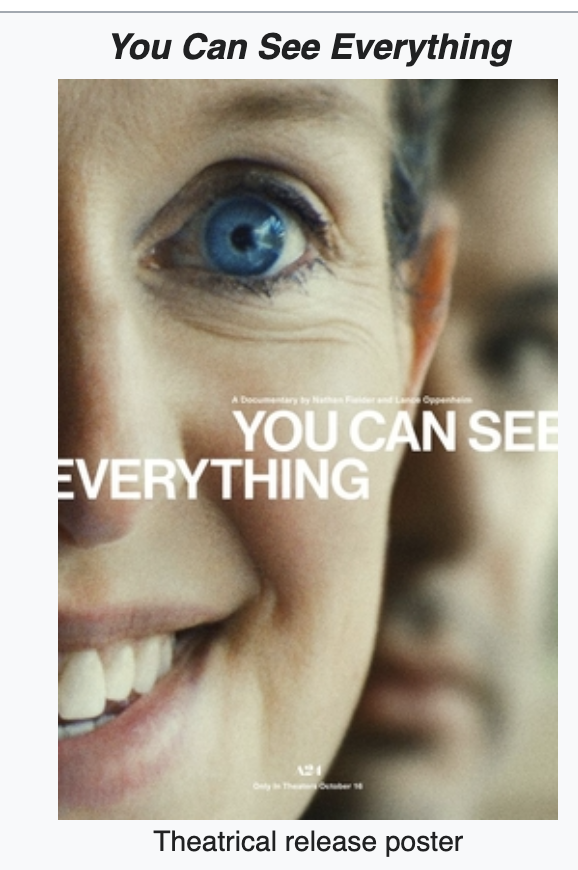
You Can See Everything is a documentary film about the weeks before Theranos founder Elizabeth Holmes begins her prison sentence for conspiracy and wire fraud. But it is also a film about the nature of truth and how we both perceive it and uncover it.
The fundamental question of the movie was also the fundamental question of her jury trial: Was she lying or telling the truth to investors and others when she made claims about the efficacy of the Theranos blood testing machine? The movie, an inventive masterpiece, seems to have planted doubt for some viewers about her conviction. The jury concluded otherwise. Who got it right — the movie, its audience or the courts?
The co-director, Nathan Fielder, eventually moves in with his subjects, Holmes and her partner Billy Evans, and interrogates them together and separately, often with penetrating questions and great skepticism. A repeated question is whether Holmes sincerely believed in the efficacy of the blood-testing machine that was the centerpiece of her company. Insiders at the company, including scientists, said it never worked as described by Holmes. In the movie, she tearfully describes her belief in the product and her vision for a health care revolution. In one sequence, the director makes the point that the dispute may come down to what Holmes meant when she said the machine “can” perform certain tests, versus the assertion that it actually did perform those tests.
In one of the most memorable scenes in the film, Fielder confronts Holmes with the iconic Abbott & Costello “Who’s on First” comedy routine. The famous bit, which hinges on a fundamental misunderstanding of simple words, seems to perplex Holmes in real time. She laughs but claims not to understand why it was funny. Fielder suggests this kind of misunderstanding may have been the root of the accusations against her.
What people take from the movie likely hinges on what they brought to it. Certainly, by giving Holmes a platform to repeat her claims of innocence, there is the potential for people to question her conviction.
But for all its insight and creativity, the movie is no jury trial. Which is to say it is not an effective search for the truth of what happened. Although Fielder does his share of “confronting” Holmes, he does so with incredulous expressions and invasive camera angles, as opposed to challenging her narrative with evidence.
That difference matters. In a courtroom, a witness who says “I believed” can be met with what she said and did at the very moment she claims to have believed it. A prosecutor confronts a defendant not with a look but with a document, and then with the next one. Fielder had no shortage of material for that kind of confrontation. He simply chose not to use it.
At her trial, the government showed that reports sent to investors and potential partners carried the logos of major pharmaceutical companies, which suggested that those companies had vetted and endorsed Theranos technology when they had not. Holmes acknowledged on the stand that she had added the logos herself. Fielder could have placed the same pages on the table in front of Holmes and asked her to explain them in her own words, and the film would have been far more revealing for it.
The same is true of the “can” versus “did” question that the film turns into a puzzle about language. At trial, that issue was not left to semantics. It was tested against the record. Insiders, including the company’s former lab director and its scientists, testified that the machine produced unreliable results and could run only a small fraction of the tests Theranos advertised. The government adduced internal data and emails showing what the device was actually doing, and evidence that patients’ samples at retail partners were often run on commercial analyzers made by other companies rather than on the Theranos device. Fielder did not make use of this evidence in the film.
Holmes gave countless interviews and presentations, and sent countless emails over the years, and her private communications with her partner and chief operating officer, Sunny Balwani, were part of the evidence as well. The government made ample use of this evidence at trial; Fielder did not. He certainly evinced incredulity at times at the steadfast way Holmes maintained her innocence. Those moments are highlights in the film. But he did little to use the factual record against her. In his “defense,” he wasn’t trying to recreate the trial, of course. She had already been through one and found guilty. And yet by creating a film that injected at least some doubt into that conclusion, whether intentionally or not, it’s fair to critique his ultimate product.
So who got it right? You Can See Everything is a remarkable and unique exploration of how a person sees herself, and it deserves to be watched for that reason alone. It is truly Oscar-worthy. But the question at the heart of the case was never how Elizabeth Holmes feels about her story. It was whether she told investors the truth. A jury that heard the insiders, examined the documents and watched Holmes live and in person was far better positioned to decide that. So in that sense the title of the movie was, like Holmes’s much-memed wide-eyed expressions and barely perceptible nodding, a head fake. You didn’t see everything. The jury, however, did.
Thomas M. Melsheimer is King & Spalding’s global head of trial and managing partner of the firm’s Dallas office.
Alex C. Wolens is a senior associate in the Dallas office of King & Spalding.