
In this edition of P.S., retired Fifth District Court of Appeals Justice Kenneth Molberg urged lawyers to defend the rule of law and ensure their efforts extend beyond the privileged to those most in need, while accepting the Dallas Bar Foundation’s 2026 Fellows Justinian Award.
“Our bar card is not merely a ticket to a better bank account,” Molberg said to a room of about 350 attendees.
In Austin, Jackson Walker is hosting the 5th Annual Hispanic National Bar Association Region XII Summit at the firm’s office there.
In Houston, the nonprofit outreach program Girls Inc. of Greater Houston honored Pye Legal Group President Stacy Humphries with its Melanie Gray Vanguard Award for her “unwavering commitment to community leadership and philanthropy” at its 2026 Strong, Smart & Bold Luncheon last week.
And back in Dallas, the much-anticipated opening of South Dallas’ Halperin Park is set for May 9 with lawyers from Greenberg Traurig, T-Mobile and Cienda Partners among those leading the transformative project.
Also, TODAY is the deadline to nominate an appellate lawyer or judge for the Texas Center for Legal Ethics 18th annual Chief Justice Jack Pope Professionalism Award. The award will be presented at the Texas Supreme Court Historical Society Dinner in September. Find details for how to nominate below.
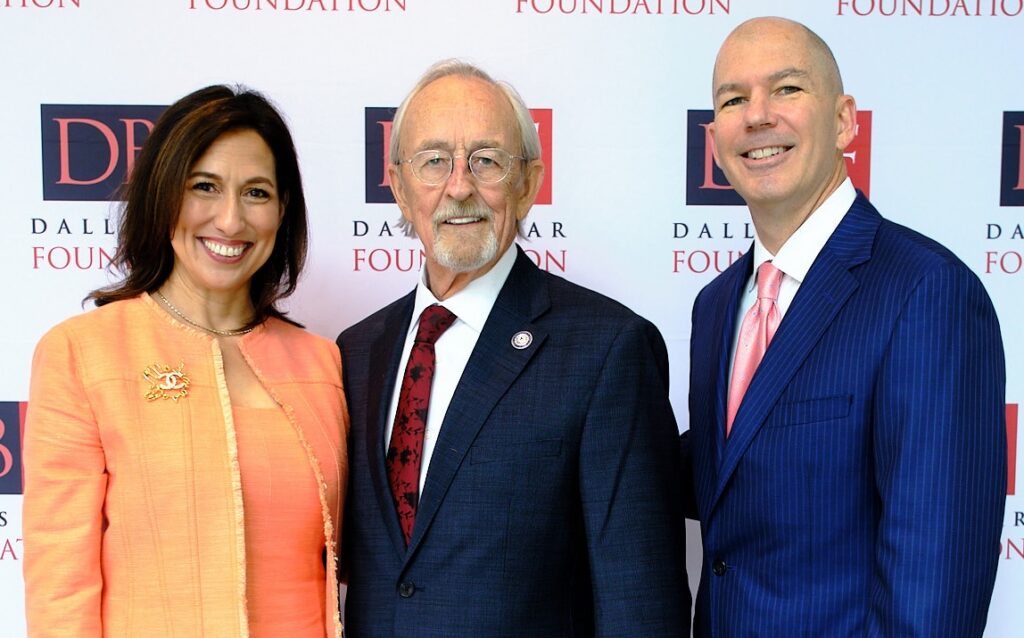
Retired Justice Kenneth Molberg Accepts Dallas Bar Foundation Award, Urges Lawyers to Defend Rule of Law
Accepting the Dallas Bar Foundation’s 2026 Fellows Justinian Award, retired Fifth District Court of Appeals Justice Kenneth Molberg urged lawyers to defend the rule of law and ensure their efforts extend beyond the privileged to those most in need — a mission he said aligns with the foundation’s work.
“Our bar card is not merely a ticket to a better bank account,” Molberg said to a room of about 350 attendees. “Ultimately, we cannot lose sight of our responsibility to safeguard the rule of law, ensure that our citizens and others among us — the least of us — do not become casualties of callous disregard, deliberate indifference and intentional hatred by the most powerful among us.”
Former 5th Court of Appeals Justice Erin Nowell introduced Molberg, calling him “the epitome of justice.”
“Ken doesn’t just have a servant’s heart. He has a service mind, heart, body and soul,” said Nowell. “If we had a million Kens in the world we wouldn’t worry about the law, we wouldn’t worry about ethics, we wouldn’t worry about how the law is applied to individuals.”
Foundation Chair Laura Benitez Geisler announced that its fundraising dinner, An Evening With, will feature prominent criminal defense lawyer Abbe Lowell, who represented Hunter Biden. He will be interviewed by Tom Melsheimer, global head of trial at King & Spalding. Both lawyers previously worked at Winston & Strawn. The event is scheduled for Oct. 8.
Geisler also highlighted the 40th anniversary of Bar None, the lawyer-cast variety show that raises funds for the Sarah T. Hughes scholarship for local law students. This year, the show will take place June 17-20 at the Greer Garson Theatre at Southern Methodist University. Ticket information and more may be found here.
Since 1981, the foundation has awarded more than $7.6 million in total grants and scholarships, Geisler said.
Molberg’s full speech, which Sheppard partner Bill Mateja said “stole the show,” is available at the bottom of this column.

Dallas’ Halperin Park Opens May 9 with Lawyers Helping Lead Transformative Project
The much-anticipated opening of South Dallas’ Halperin Park is set for May 9.
The deck park, built over Interstate 35E across from the Dallas Zoo, is designed to reconnect neighborhoods that were divided when the highway cut through the community decades ago.
The May opening marks the completion of the park’s first phase, while a second phase remains underway. In total, the project is expected to cost about $300 million.
Community leaders have said the park is poised to help drive economic opportunity in one of Dallas’ historically underserved areas.
The Southern Gateway Public Green Foundation, chaired by Greenberg Traurig shareholder G. Michael Gruber, spearheaded the park’s concept design and fundraised millions of dollars for the project. Attorneys serving on the board include Alan Dorantes, senior corporate counsel at T-Mobile, and Philip Wise, partner at Cienda Partners.
Gruber said he and his wife lived in southern Dallas for two decades, during which all three of their children attended school in Oak Cliff. Frustrated by the longstanding lack of investment in a community he believed had enormous untapped potential, he said he eagerly accepted the opportunity to lead the project when it was offered a decade ago.
“Halperin Park is a gift that the community surrounding it deserves, and the city of Dallas needs,” Gruber said.
Jackson Walker Hosts Hispanic National Bar Association Regional Summit in Austin
This week, Jackson Walker is hosting the 5th Annual Hispanic National Bar Association Region XII Summit at the firm’s Austin office.
The keynote event features Dallas-based Marissa Solis, senior vice president of global brand and consumer marketing for the National Football League.
Juan Alcala, who has served as the HNBA regional president since 2022, joined Jackson Walker from Holland & Knight last year. The region includes Texas, Arkansas, Louisiana and Oklahoma.
Houston Nonprofit Honors Stacy Humphries for Advocacy
The nonprofit outreach program Girls Inc. of Greater Houston honored Pye Legal Group President Stacy Humphries with its Melanie Gray Vanguard Award for her “unwavering commitment to community leadership and philanthropy” at its 2026 Strong, Smart & Bold Luncheon last week.
Humphries is recognized as a longtime advocate for empowering girls and women. She served for 10 years on the Board of Girls Inc. of Greater Houston, including two years as Board Chair. She currently serves as Vice President of the board of Impact100 Houston which funds nonprofits.
Before joining the legal search firm Pye Legal Group, Humphries worked for MS Legal Search, served as vice president of legal affairs for the Houston Rockets, and was an associate at Vinson & Elkins and Alston & Bird. She is a 1996 graduate of Harvard Law School.
P.S. — TODAY is the deadline to nominate an appellate lawyer or judge for the Texas Center for Legal Ethics’ 18th annual Chief Justice Jack Pope Professionalism Award. The Award will be presented at the Texas Supreme Court Historical Society Dinner in September. Named for organization co-founder, former Chief Justice Jack Pope, the award recognizes an appellate lawyer or judge who personifies the highest standard of professional and integrity, the center has said. Last year’s honoree was Haynes Boone attorney Mike Hatchell. Details for how to nominate may be found at the Center’s website here.
Related Coverage
Facing a “tsunami of litigation” driven by the Trump administration’s expansive classification of noncitizens as “applicants for admission” — making them ineligible for bond — lawyers and judges in the Northern District of Texas have “answered the call,” with attorneys stepping forward to represent immigrants on a pro bono basis and with judges working around the clock to issue timely, thoughtful orders, U.S. District Judge James Wesley Hendrix said Friday during closing remarks at the district’s annual Bench Bar Conference, held this year in Arlington. Read the judge’s remarks here.
The nonprofit public interest justice center Texas Appleseed has launched a fundraising campaign aimed at raising $1.5 million in celebration of its 30th anniversary. The Lawbook has the details on how you can help.
More than 30 lawyers across six firms, including the Texas offices of O’Melveny & Myers and Winston & Strawn, have worked on a lawsuit challenging the lack of air conditioning in Texas prisons, contributing over 5,000 pro bono hours valued at more than $5 million. The Lawbook has the story.
How You Can Help
Krista Torralva is The Lawbook‘s full-time pro bono, public service and diversity reporter. Her position is funded by the Texas Lawbook Foundation, a nonprofit 501(c)(3). Your support is essential in helping us sustain this position, ensuring we can continue to provide in-depth reporting that matters to the Texas legal community. To learn more about the Foundation and how you can contribute to its mission, click here.
The Lawbook also seeks examples of pro bono projects and cases and public service efforts. Please contact krista.torralva@texaslawbook.net.
Ken Molberg Remarks as Recipient of the Dallas Bar Foundation Fellows Justinian Award, April 30, 2026
Thank you, Rob Crain, for those introductory remarks, and thanks to the Fellows of the Foundation for bestowing this prominent and respected award on someone who is still just a kid from the rural Texas Hill Country and whose childhood friends still often remind me that they could always envision me being in a courtroom—just not on that side of the bench.
And thanks to Elizabeth Philipp, the Foundation’s Executive Director, who does yeoman’s work for the Foundation and in putting this event together.
I want to extend congratulations to the new Fellows of the Foundation, a distinct professional honor, and highlight the important role each of you plays, alongside the existing Fellows, of advancing the Foundation’s mission to provide legal aid to the under served; grant scholarships and secure summer clerkships for area law students; and support other charitable initiatives of the Foundation.
And I want to specially acknowledge the spectacular performance of Rob Crain, DBF Fellows Chair, who has recruited the largest number of Fellows in the more than 50- year history of the Foundation. More than 100. Thank you so much, Rob, and you, too, Laura Benitez Geisler, and thanks to all the officers of this important organization for your dedication to the Foundation’s undertaking and its governance.
There are so many here who deserve to be recognized for who and what you are. And there are so many thanks that need be extended. If you have escaped mention, you haven’t escaped notice and my gratitude.
I want to thank and extend my undying love to my family members here today at our table. My sons Cameron and Travis, along with their better sides, respectively, Emily Erickson and Christy Ramos. And my dear daughter Rachel Chovanetz, the mother of our two granddaughters, who, along with Dad Koda, will arrive later today. Our oldest, Collin, along with his wife Carolyn and our two grandsons, understandably could not make the trip from the so-called “war-ravaged city of Portland, Oregon.” And then Karin Alonzo, my good friend of decades. Karin and I worked together from the time she was in high school in the 1980s, ultimately serving as my main legal assistant in a hectic trial practice, and came with me to the 95th District Court on January 1, 2009, where she remained when I left in 2019 for the Fifth District Court of Appeals.
And finally, and most prominently, my wife Linda, the prettiest girl in Fredericksburg. I don’t remember much of my life when Linda was not around. We met in grade school at St. Mary’s, and in one form or another, we’ve been partners since, soon to have been married 51 years. Before we were dating age, we had to sneak around to be together. And even when we were old enough to date, her parents, Clemens and Frieda Pehl, wouldn’t let me date her. That’s no slight of her folks, I might add. There was not girl in Fredericksburg I was permitted to date, given that I had somewhat of a renegade reputation, ran with a rough crew, played rock music—even among the hippies and heathens in California—had long hair, rode a motorcycle in what some considered a gang, possessed some strong political opinions, and other stuff I won’t mention. Hell, even my father referred to me as a Bolshevik, a term familiar to his generation. Luckily, Linda’s parents relented and let me take her to the prom. Fast forward, her parents and I became very close over the years and I loved them dearly. With Linda, I was beside both of them when they drew their last breaths. She still works long hours as a registered nurse at Big Baylor here in Dallas, where she has been for over 20 years. I love you.
When Rob called and informed me of the Fellows Justinian Award, Linda and I were in a small boat in the middle of Lake Petén Itza, in the remote Petén Jungle of Guatemala. It’s a magical place that I hadn’t returned to in more than three decades. It had changed, of course, but it still retained most of the soul it had when I first met it. We hadn’t been able to receive calls for at least a day, so it shocked me when Rob’s name unexpectedly appeared on the screen. I was equally shocked when he told me of the purpose of his call. Truly, I was humbled, knowing full well that others were equally or more deserving.
For those of you who know me, it may surprise you to learn that I actually suffer from stage fright, along with varying degrees of impostor syndrome and Catholic guilt—a type of medicine that is valuable in keeping you humble if not taken in too large a dosage. To be included in a list of luminaries—many of them good friends—is a bit jarring. People and friends like Judges Barefoot Sanders, Jerry Buchmeyer, Barbara Lynn, Royal Furgeson, Merrill Hartman, Linda Thomas, Cooter Hale, Karen Scholer, L.A. Bedford, Ron White, and others. Legal legends and friends like Jack Hauer, Adelfa Callejo, Harriet Miers, Jim Coleman, John Estes, George Bramblett, Mark Shank, Beverly Godbey, and more.
I only have some minutes of your precious time to say something to you today. I asked Rob what I should say. He offered a few topics and said talk about your story, where you came from, and what got you here. Many of us have heard snippets over the years. Another said you always seem to be the Forrest Gump of the Dallas legal profession—always in the wrong place at the right time, or something like that. Words often fail me, so bear with me.
When I was growing up in Fredericksburg, I would walk out our back door and beyond my father’s large garden, and miles and miles of hills covered in live oaks became my playground. My folks didn’t have much, if any, financial wherewithal, but they
enriched me with a spirit and determination that have never left me. I would run those hills to my friend’s house more than a mile away, stopping to eat some agarita berries or pecans and try to catch a glimpse of the foxes that lived on one of the hills. Once there, we would hang out together, along with other friends, swapping lies, talking about girls, playing music, writing poetry and songs (believe it or not), and planning our next hunting or fishing trip, or some other escapade or bout of mayhem. Out the front door of my house, across the road, lived an old woman who spoke no English. She spoke German, my dad’s native language. Further down the road lived the Kunzes, and at times I’d go help Mrs. Kunz with her chickens. We weren’t in the city limits at the time, so we relied on groundwater from our well and the rainwater the cistern collected.
My father was a construction worker and my mother, a former “saleslady,” as the word was used, left her job to raise me. Her name was Maxine Houston before they were married, but only a few people knew her real first name was Lula. In the first seven years of my life we traipsed all over parts of Texas, from Houston, to the southern Texas border, to El Paso, to the Llano Estacado, from construction site to construction site. Then we came back to my dad’s hometown of Fredericksburg, where he and his family had ultimately arrived after emigrating from Germany in 1898. Yes, you heard that date right. I was blessed with an old father, who had clearly robbed the cradle when he married my mother—or at least that’s what people said, particularly my maternal grandfather, a fervent Baptist, who was younger than my dad, a Catholic.
Not long after we arrived in Fredericksburg, my dad—his name was Henry, Heinrich, actually—was tragically disabled in a bridge construction accident in Hunt—a stone’s throw from the Camp Mystic we sadly read about today. His life was saved by a young Mexican flag man, who from a distance on the nearby hill, saw the dragline knock my dad off the bridge, where he remarkably fell head first into a hole to be used to pour a concrete bridge support. His shoulders, scraping against the walls of the excavation,
broke enough of his fall so his head was smashed when he hit bottom. And it was the only hole without some few feet of water in it. Little Joe, as we called him— “illegal immigrant,” some would derisively call him now—stopped the work just before the dragline operator was about to put the drill bit back in that hole to dig it deeper. As it turned out, they removed the bit, tied Little Joe to the line, and lowered him into the hole where he miraculously freed and brought up my father. Our lives changed forever, but at lease I had my daddy.
My mother returned to the labor force to support us. And I got a job early—from cutting weeds, picking peaches in the orchards, stenciling leather, working livestock, mixing mud and laying brick, hanging sheet rock and, ultimately, securing a high-paying job on a construction crew for a dollar sixty-five and hour. I had the high honor of helping complete the Interstate 10 bridge in Comfort, Texas, over the Guadalupe River. That’s also where I was arrested by the Border Patrol, along with the five other members of my crew. Luckily, my detention ended quickly. The others’ did not, although I’m happy to report they all returned to work a couple of weeks later.
Swirling around all of this were the close friends and the music. I first hit Los Angeles when I was 14, a year after the Watts riots. Four of us had left the Hill Country to make our mark. I lived there off and on for the next several years. We snagged a contract with Capitol Records on its Tower label, then Columbia on its Colgems label, that also had the Monkees and Linda Ronstadt, among others. In addition to recording our own band’s work, I was privileged to play, at least in studio sessions, with Steppenwolf and the Monkees, along with Hoyt Axton and a host of others, some whose names you might not know. When back in Texas, we played all over the state, and we ran and sometimes played with the iconic Thirteenth Floor Elevators, who many claim were the birth-fathers of psychedelic rock, and it was not odd to see me out back of the Luckenbach store picking guitar with Jerry Jeff Walker and, a couple of times, Willie Nelson—before my friend Hondo Crouch made Luckenbach famous.
We didn’t have much, but we had each other. And Linda was always around, so she knows this history, too. Sometimes I go visit my group’s bass player and lead player and remember the old times and what they meant. Gary Itri, my bass player, is buried steps away from Linda’s folks Frieda and Clemens; Gary Jenschke, our lead player, not far to the south; all of them are to the west of Maxine and Henry. Only last June, I reunited with two of the living Thirteenth Floor Elevators—John Ike Walton and Ronny Leatherman—we had not seen each other in almost 50 years.
The confluence of the civil rights and anti-war movements of the 60s was a pivotal moment for me. I wasn’t gonna be a rock star. I didn’t want to work construction. I was rehearsing with the group in April of 68 when Martin Luther King was shot. It was godawful. MLK was a hero to me. In June, Robert Kennedy was assassinated at LA’s Ambassador Hotel, less than two miles from where I and my fellow musicians were living at the time. I had known Lyndon Johnson, who abandoned his presidential re-election bid a few months earlier. He’s the reason I met John Kennedy years earlier. I knew soon I’d be carrying a draft card. My bandmates and I were watching the California primary returns that June night and it was clear RFK would win. I had been supporting Sen. Eugene McCarthy, but, given the circumstances, I told the others—who were RFK supporters—that I’d be with them in the morning. The morning never arrived, as the night lit up with flashing lights and sirens 30 minutes after my commitment. I was sick of the body bags coming back from Nam. I was sick of the racial injustice that permeated our nation.
Burned out, down-and-out, I was feeling like I was somewhere in a ditch beside the highway of life, as Leon Russell would put it. I ultimately left the group, amid threats
of lawsuits by Columbia that persisted for more than a year. What were they gonna get? More importantly, what was I gonna do? Luckily, I had had a school teacher who believed in me and taught me the true value of reading and writing, and, coupled with the examples of my parents’ endurance when times were at their worst and Linda’s love, I worked my way to North Texas State University, and became an editor-in-chief of their award-winning newspaper, the North Texas Daily. Linda soon joined me in Denton, attending TWU to further her quest to become a registered nurse. That’s where I and some others were also arrested for registering the women students to vote.
Realizing that she and I could not live on a journalist’s salary given the family we hoped to start one day, I migrated to SMU Law School to be its token poor kid and Democrat. It’s where I met Barbara Lynn and so many others who have made a bigger difference in this community than I ever have or ever will. I clerked for Jim Barber, a noted Dallas trial lawyer, and tried cases under the third-year practice rule. That association led to me meeting and knowing some of the best trial lawyers this state has had to offer. I was raised at the knees of great trial lawyers. Judge Mac Taylor, a man I genuinely loved, swore me into the Northern District of Texas What all these people taught me was priceless. We smoked cigarettes together in his chambers. They made me the youngest director of the Texas Trial Lawyers Association. It would not have happened if they hadn’t taken their valuable time to help me along.
Later, I joined noted trial lawyers John B. Wilson and Roger Williams, to form Wilson, Williams & Molberg, a firm that continued for 28 years until my election to the district bench. They were two of the most accomplished lawyers I’ve ever known, and Roger was my best friend for 40 years until he died. I tried everything from breach of contract matters to med mal cases, and more old-law workers compensation cases than I can count—starting back when discovery was a subpoena and a one dollar bill. Some said I could try a coffee table if I had to. I found a concentration in employment law and
civil rights litigation. In the meantime, I served as chairman of the Dallas County Democratic Party and spent 30 years on the Party’s state executive committee. I filed suit to re-integrate the Dallas Police Department on behalf of Black plaintiffs—a successful case that lasted 26 years, during which time Linda and I had four children—and along with my dear friend Don Maison, a prominent and revered gay activist and lawyer, put your male flight attendants on Southwest Airlines. I fought countless battles on the sexual harassment front—at a time when that cause of action was not recognized under the Civil Rights Act of 1964. Many people laughed at and derided me, including lawyers. Some were outraged when, on behalf of the county law librarian, I sued a sitting district court judge, and our Bar Association convened a special panel to try the case, with the agreement of all parties. We won. It was during this case that the death threats started. After that, there were many cases you never heard of, some never filed, that resulted in justice for those victimized by the entitled and, in one case, led to the withdrawal of an ambassadorship and, in another, the sudden retirement of a national telecommunications executive. I stopped Mary Kay from preventing its production workers from speaking Spanish on the assembly line. And I wrote the language that increased the pay of beat cops and firefighters in the Dallas pay referendum of 1979.
I’m told those cases were important. But what mattered most? It was the little girl from Guatemala. Some of my Latino friends brought her to my office to see if I could help her. She crossed our border alone when she was fourteen. She was fifteen, maybe sixteen when I met her. She worked at a small manufacturing concern in Mesquite, too young by law to be working there. Her superintendent had been taking sexual advantage of her for some time. She was lost, powerless. The case ended, forcefully so in her favor. It made a profound difference to her and an equally profound difference to me. Someone believed her and, more importantly, someone believed in her. Even without that victory, sometimes just letting somebody know that you believe in them and that they have value makes all the difference in the world—something I have found true with many mentees over the years.
So what does all this mean—regaling you with stories, histories that may seemingly count for nothing? If you just wanted a collection of raconteurs, you could get me, Jerry Alexander, John Collins, and others of our ilk together and we could regale you with stories until the sun turns blue. Well, these are parables, insights, and even warnings in a way. It is so important to listen to people’s stories and to tell them yours. It is a window into who we are. In a time when distraction and fancy entertainment are the usual fare, when talking and thinking in sound bites is fast becoming the norm, when cruelty replaces compassion and empathy, and prosecution turns into persecution in the legal arena, when pulling the ladder up before others can use it becomes an applauded goal, when power and greed become the motivation for existence, we need to stop and revisit the important connections to one another that we must nourish. And knowing one another through each others stories is one of those important ways. And knowing the stories of those outside our own circles is equally important. It is so often an antidote to bad interpersonal conduct and helps return us to a missing belief in each other, allowing us to extend a hand to others because we have come to recognize their merit.
But this is the important corollary I hope we come to endorse: That, as lawyers, we are professionals with particular obligations. Your Bar card is not merely a ticket to a better bank account. Many of us have enjoyed successes that we are rightfully proud of, though none of us got here alone. We are also proud of our colleagues who have achieved much. But, at the same time, ultimately we cannot lose sight of our responsibility to safeguard the rule of law, insure that our citizens and others among us—the least of us—do not become casualties of callous disregard, deliberate indifference, and intentional hatred by the most powerful among us. We cannot succumb to a world where wrong is right, down is up, and lies are truth, and where, as my daddy would say, we fall into that group of people who know the price of everything and the value of nothing, those with more money than sense, and those who have forgotten all to soon where they came from and how they got where they are—that group to whom humility is a curse word and apology is impossible. Where benevolence is heresy and cruelty is the lauded misnomer of strength.
Three years ago, Frank Stevenson, when receiving this award, reminded us that we must resist the urge to become self-absorbed with our own professional achievements— “the size of the deals we close and verdicts we won.” But it was this line that particularly stuck with me. He said it is essential “[t]hat we care not only for the up-and-comers, but also for the down-and-outers. And that the ambit of our energies sweep beyond just the powerful, the purposeful, and the privileged to embrace the least, the lost and the last.” Like Little Joe and the girl from Guatemala. Like every other person you pass on the street.
Remarkably, this quote encapsulates the mission of the Foundation. I’m grateful to you all. Thank you. That’s all.