
Martha Hardwick Hofmeister was a freshly minted lawyer and new to Dallas when she joined the Dallas Bar Association because, she recalled, “I thought that’s what you were supposed to do when you’re a lawyer.”
She joined the association’s entertainment committee and had to miss a meeting. She got a letter shortly thereafter appointing her director of a new project, a show without a lot of structure, that would raise funds for the newly established Sarah T. Hughes Diversity Scholarship.
Four decades later, Hofmeister is still the director of that production. Bar None, a lawyer-written and lawyer-performed musical comedy, has raised more than $2.5 million for full-ride law school scholarships.
“At the beginning, Bar None was more of a project than a mission,” said Hofmeister, who is now a partner at Shackleford, McKinley & Norton. “Over time, all of us have become acutely aware of the impact and importance of what we do each spring on stage with our friends.”
Alongside former judge Rhonda Hunter, an original dancer and choreographer who became head choreographer in the show’s early years, Hofmeister is one of the show’s originals. Over the years, the cast and crew have cultivated a Bar None family that has celebrated cast members getting married and having children. They have rallied together in the hard times, including the loss of teammates. It’s become such a production that now some make annual trips to New York City together to draw inspiration from Broadway productions.
Recently, the group navigated changes to the scholarship it supports, including the removal of the word “diversity” from its name amid the Trump administration’s executive orders targeting diversity initiatives. The change nearly saw longtime devotees, including Hunter, leave the production.
The four-night production, this year titled “Only Lawyers in the Building,” runs June 17-20 at the Greer Garson Theatre at Southern Methodist University. It marks Bar None’s 37th year of performances and the 40th year of fundraising.
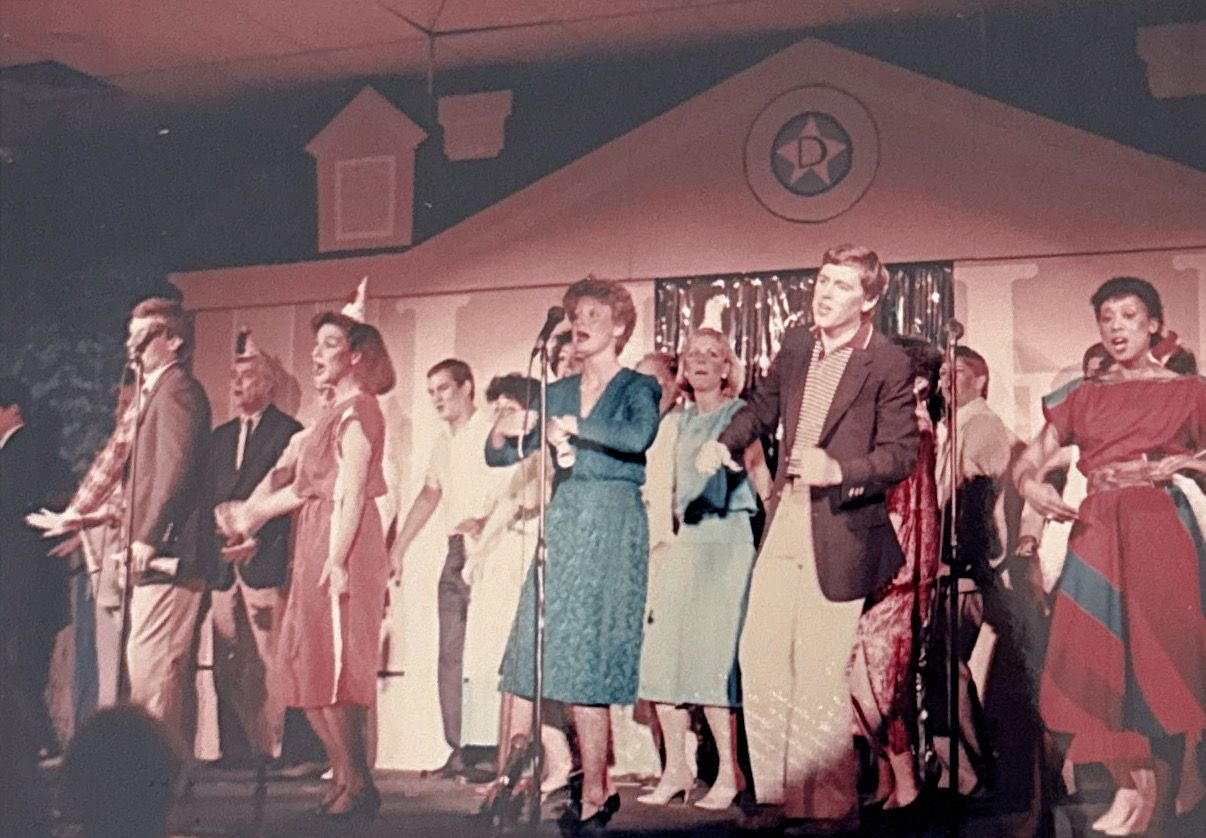
Back when it began, Dallas bar leaders were looking for a way to raise money for the newly created Hughes scholarship, named for the first woman state district judge in Texas who is best known for administering the oath of office to Lyndon B. Johnson aboard Air Force One following President John F. Kennedy’s assassination and for advocating for the rights of women and minorities.
The idea for a show emerged after a Dallas bar leader attended a large-scale production staged by the Chicago Bar Association and thought something similar could be done in Dallas.
Hofmeister’s understanding of the meeting she missed is that she had been chosen because of her experience directing “Assault & Flattery,” a student-led production at the University of Texas School of Law.
The other lawyers appointed to leadership roles got on the phone and agreed to create something similar to “Assault & Flattery,” Hofmeister said.
They would focus on choreography and splashy costumes. They would avoid elaborate sets. And anyone who wanted to participate could.
You may not get the role you want, Hofmeister said. It was not a talent show. But you would have a place in the production.
The group geared up to debut the production in 1985, but the venue at the time triple-booked and Bar None was bumped, Hofmeister recalled.
The show finally opened the following year with a three-night run at Union Station in downtown Dallas.
On dress rehearsal night, they were still building the set.
That first year, Bar None raised $7,000. (For comparison, the production raised more than $95,000 in 2024.)
“We were afraid we were going to lose money, which is why we had food and alcohol so they would be getting something even if the show was terrible,” Hofmeister said.
But the group has had a secret weapon. Hunter.
“She can make a silk purse out of a sow’s ear,” Hofmeister said.
On a Saturday morning in May, Hunter commanded the attention of about 16 dancers during rehearsal at the law office of Brown & Hofmeister (the firm of Martha’s husband, Kent Hofmeister, who juggles multiple roles including scriptwriter).
“Notice I’m not doing this,” Hunter said, crisscrossing her legs lazily.
Instead, she demonstrated a quick shuffle on her toes.
“Every year her choreography gets more challenging and I think there’s no way these lawyers are going to be able to do this, and she gets it out of them,” Hofmeister said.
Hunter’s dance career began at age 15 when she started dancing and teaching at the Mary Lois School of Dance, now located in DeSoto. Her mother — a creative and socialite — wanted her children to learn dance. Mary Lois Hudson Sweatt attended the family’s church, where she started her dance school. Hunter caught the bug and never really let it go.
Hunter co-leads a group of Bar None devotees who travel to Broadway each year, squeezing in four shows into a four-day weekend and returning home with inspiration.
But the show’s mission mattered as much as the performance.
Hunter, who integrated her junior and high schools and later became the first African American and first person of color elected president of the Dallas Bar Association, said the diversity scholarship was what kept drawing her back.
“That was very important to me and to a lot of the cast that we were giving away scholarships to people who could not otherwise go to law school,” Hunter said. Hughes scholars, including Ashley Wright, an associate at Winston Taylor, and Judge Dianne Jones, are performing in this year’s production.
But the mission came under threat last year.
Following the executive orders targeting diversity initiatives, the Dallas Bar Foundation paused the scholarship amid legal uncertainty created by the executive orders and potential fundraising challenges, then-Dallas Bar Foundation Chair Gabe Vazquez — himself a recipient of the scholarship — said at the time.
The decision forced difficult conversations within Bar None.
Initially, Hofmeister stressed that Bar None raised money for diversity scholarships, and that without that mission, there was not a need to fundraise.
At one point, about two dozen organizations reached out to express interest in becoming the show’s beneficiary, Hofmeister said.
The cast and crew discussed forming their own nonprofit organization. Ultimately, they did not want the responsibility of administering the scholarships and operating a 501(c)(3), Hofmeister said.
By the end of the summer, the Dallas Bar Foundation reinstated the scholarship, but dropped the word “diversity” from its title, and references to minority students were replaced with language focused on overcoming hardship.
Vazquez and Dallas Bar Foundation Executive Director Elizabeth Philipp made a series of presentations including to past Hughes scholars and the Bar None team explaining how the decision was arrived at.
After the U.S. Supreme Court issued its landmark decision in Students for Fair Admissions v. Harvard in June 2023, leading to heightened scrutiny of and legal challenges to diversity, equity and inclusion initiatives, organizations across the country faced legal challenges. Among them, conservative legal activist Edward Blum’s American Alliance for Equal Rights sued Fearless Fund, a venture capitalist firm that awarded grants to women entrepreneurs of color.
The lawsuit claimed the fund’s Fearless Strivers Grant Contest, open only to Black women, was discriminatory. The Fearless Fund settled the lawsuit in 2024, with founder Arian Simone saying the group wanted to avoid a court ruling that would end minority-based funding nationwide.
“I could list seven other examples, which I did in my presentation,” Philipp said.
For the Dallas Bar Foundation’s leaders, those cases underscored the potential financial and legal risks of maintaining a scholarship program that could become the target of litigation.
“It’s a privilege for us, for me, to be responsible for donor money,” Philipp said. “And I think all of the trustees would tell you they have a fiduciary responsibility — that’s probably their most sacred responsibility for honoring donor money.”
Citing the scholarship revisions, along with feelings that the foundation was not adequately recognizing the dedicated individuals fundraising with Bar None, Hunter resigned in December.
But the Bar None family wouldn’t let her go so easily. The foundation also addressed her frustrations, and Hunter returned to the show.
“As for this year, enough was done for me to come back, and we’ll see what the future holds,” Hunter said, declining to go into details.
In April, Hofmeister told The Lawbook, “We’re just trying to pick our way through a minefield. You know where your heart is, and you have legal training and understanding and can evaluate risk and can appreciate that people who are fiduciaries want to minimize risk.”
She elaborated: “I’ve spent decades of my life working for a show that fundraises for diversity scholarships and improves the diversity of our community, and I’m very sad and I’m very disappointed in the cultural shift in thinking that equates diversity, equity and inclusion to something that is bad and discriminatory towards white people. But I recognize that that cultural shift has happened and/or the administration’s DEI initiatives and executive orders have made adjustments necessary.”
“In this particular instance, the Dallas Bar Foundation has to recognize the change in the landscape,” she continued. “They don’t want to spend money that has been given to them for charitable purposes on fighting litigation. And I think the shift in the description of the scholarship will still enable that scholarship to bring great students to law schools and put them out in our community. The focus on race is gone but there’s still a real focus on underserved communities and underprivileged people and people who’ve overcome hardships. A need is still there, and this scholarship is going to fill that need and our show can help fund that scholarship.”
Hofmeister said some supporters hope the scholarship’s original name can someday return because “things that have been done with the stroke of a pen could be undone with the stroke of the pen,” Hofmeister said.
“But if we shut the show down and we don’t do a show at all until that’s over, I think it would be really hard to gear back up in the summer of 2029 and start Bar None again,” Hofmeister said. “We’re going to do this and hope it’s successful and we can reevaluate.”
Bar None is now so ingrained in the legal community, that participants say local judges respect the week of production and have made scheduling accommodations for trials and other proceedings.
One time, Kent Hofmeister received an order from Judge Jerry Buchmeyer scheduling a trial for the week of Bar None. That same day, Kent saw the late judge at the Arts District Mansion (then the Belo Mansion) and approached him. Before he could complain, the judge let out a cackling laugh and said, “I know, Kent, motion for continuance granted.”
Likewise, opposing counsel are often amenable to scheduling around the show.
“One time, opposing counsel said, ‘I’m not going to be the one to cause a problem,’” Martha recalled.
Sometimes, Kent said, he’s found himself facing off in trial against fellow cast members.
“You have a relationship with them in a way that you don’t have with any other opposing counsel,” he said.
Many friendships wouldn’t have happened, he and Martha believe, but for Bar None bringing members of the large Dallas legal community together.
Mary Elizabeth and Matt Anderson serve as an example.
Matt, a partner at Munck Wilson Mandala, joined Bar None after attending a show, seeing Mary Elizabeth and thinking he would like to meet her. The couple recently celebrated their 25th wedding anniversary. When their daughter was born, they asked Martha and Kent to be her godparents.
Had it not been for Bar None, both couples believe their lives might never have intersected.
Over the years, the cast and crew have weathered painful losses when one of their own passes away.
Among those losses was Elizabeth Turner, a Bar None performer and writer who died in 2003 at age 39 from complications of leukemia.
That following Bar None, the cast sang Wicked’s “For Good,” a song about friendship that includes the lyric: “Because I knew you, I have been changed for good.”
“I’m getting a little weepy now,” Kent said during a recent interview.
They’ve also comforted one another amid personal losses, longtime producer Tom Mighell said, recalling the support he received when his father died last year.
His dad, Ken Mighell, was a longtime Bar None volunteer and champion who liked to call himself the “producer of the producer,” Tom recalled.
During his life, Bar None recognized Ken as an “unsung hero,” a distinction that usually goes to a cast member. That honor was especially meaningful to Tom.
“The family aspect [of Bar None] has actually extended to my actual family,” Tom said.
Bar None’s impact goes far beyond the money it has raised, said Laura Benitez Geisler, the current Dallas Bar Foundation chair and partner at Sommerman McCaffity Quesada & Geisler.
“Bar None’s true legacy is the ripple effect created by generations of lawyers coming together to create opportunities for others, and by the scholarship recipients who have used those opportunities to serve their communities and pay it forward,” Geisler said. “What began as a fun show for a good cause has become a powerful reminder of what our profession can accomplish when we work collectively for a greater good.”
What Bar None means to Martha Hofmeister couldn’t be summarized.
“Bar None introduced me to my husband. … Some of my dearest friends I only know because of Bar None,” she said.
“We raised more than $2.5 million to improve the diversity of our legal community. I’m very proud of that,” she added. “A lot of people don’t really know what will be in their obituary. I think that’ll be a big part of mine.”