
Waking up for 5 a.m. weights. Navigating practices and travel for games with classes and exams. These are formative experiences former college athletes can immediately bond over.
It’s also a big reason why a 30-minute coffee appointment at Ascension in Uptown between Amy M. Stewart and Adam Sloustcher went into extra time and turned into a momentous 90-minute huddle for the two Dallas labor and employment pros.
Today, 12 weeks after their introductory coffee, Stewart and her firm – Stewart Law Group – are merging with Fisher Phillips, where Sloustcher is a regional managing partner.
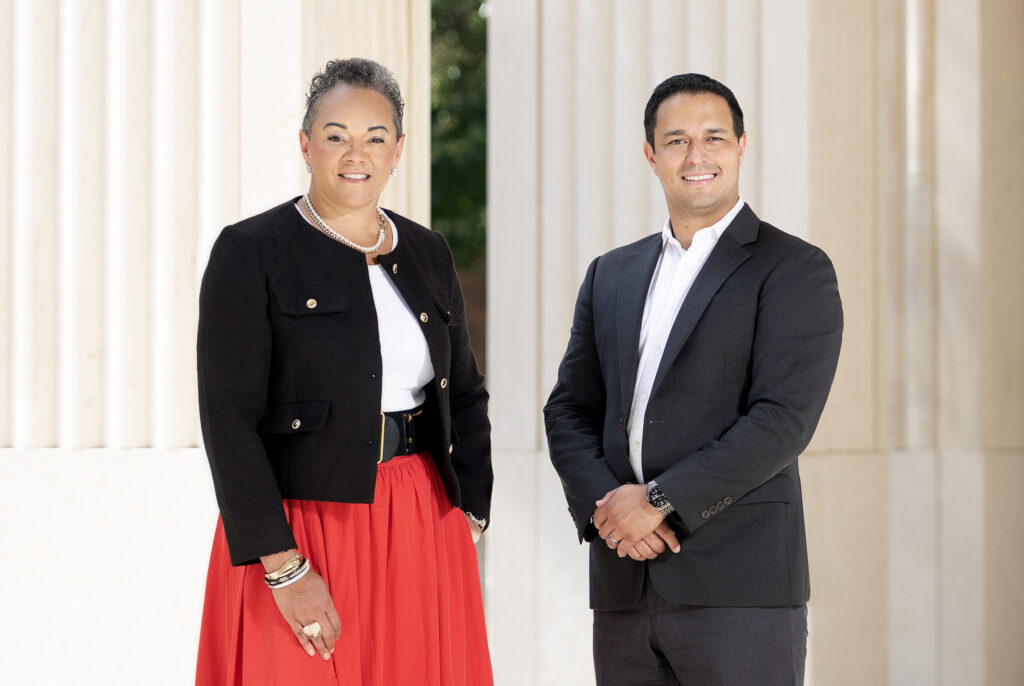
“One of the first people I heard about when I moved to Dallas [two years ago] was Amy Stewart,” Sloustcher said. “They are a brand in Dallas.”
Stewart, who is bringing along partner Andrea Cook and attorneys Conrad W. John and Blaine E. Adams in the move, said she and Sloustcher share a vision for teamwork, work ethic, and communication.
“We get each other,” she said. “The cultures are the same. The level of client service is the same.”
“Stewart Law Group is like my second child. What was really important to me was this guy’s leadership style. One thing about Adam is he is a consummate leader. He’s a listener and he builds teams. That’s what my brand has been at SLG.”
Another ingredient for the immediate chemistry between the two was being alumni of the Atlantic Coast Conference: Sloustcher played soccer for the Tar Heels of the University of North Carolina and Stewart hooped for the Demon Deacons of Wake Forest.
“What stood out to me is Amy went on to coach [for Wake Forest],” Sloustcher said. “That means she finds meaning in giving back and mentoring young lawyers.”
Sloustcher and Stewart’s love for sports will carry over in their practices as well, helping build out Fisher Phillips’ work for professional teams and leagues and sports-adjacent businesses. The two are engaged in a matter for a local Dallas team right now.
Stewart said the reaction from clients, including several mutual clients, has been “ecstatic.”
“The colors of our brand are even the same,” Stewart said. “I don’t have to change my wardrobe.”
“Next time you see us, we will be wearing the same uniform,” Sloustcher added.
Overtime
In an expanded interview with The Texas Lawbook, Stewart reflected on her practice and the legacy of Stewart Law Group. Stewart begins her term as chair of the American Bar Association’s Litigation Section in August.
Texas Lawbook: What are two or three of the most important trends that you are seeing in your labor and employment practice?
Amy Stewart: Since the pandemic, I describe the work environment as more volatile and unsteady. There is this simmering level of distrust toward institutions and corporations that is impacting the resolution of traditional labor and general employment matters, even on minor disputes. You have seen this recently in large plaintiff verdicts in employment cases. Texas Lawbook has covered some of them involving BB Sanford.
- Increase in overall EEOC discrimination and retaliation filings across the board, including reverse discrimination claims.
- Increase in labor grievance arbitrations going to full hearing when in years past, we could get these resolved between the company and union leaders.
- Increase in being retained to handle third party workplace investigations because of this growing distrust in corporations. In many instances, the complainant does not even trust the anonymous ethics and whistleblower complaint hotlines that are truly a valuable resource for employees and companies alike.
The Lawbook: What has been your best day as a lawyer?
Stewart: Recently, our labor arbitration team earned a huge win for a client on a contract interpretation matter that its CEO was watching closely. A loss would have been a crushing blow to my client — it would have impacted how it delivers its products to stores nationally.
Obviously, I love a full defense jury verdict, but there is something special (and nerve racking) about arbitrations. Unlike a jury trial when you learn the result within hours or a few days, in labor arbitrations you do not learn the result for three months after the hearing. There is this overwhelming anxiety when you realize the Arbitrator’s Award is sitting in your email box waiting to be read. It is analogous to standing on the sideline as a coach, watching the basketball leave the player’s fingertips on what could be a game winning buzzer beater. Is it a win? Or a loss? Fortunately, this was a huge win for our team, but more importantly our long-time client. This was one of the biggest wins of my career — coaching basketball or practicing law!
The Lawbook: What are two or three of the most important achievements over your career?
Stewart: As you can imagine, as we merge with Fisher Phillips, I am in a reflective, and also a thankful, mindset. Here are three:
- Opening the first minority and woman owned business litigation law firm in the DFW area that has employed so many wonderful lawyers and legal professionals.
- Growing SLG to become the sixth largest minority owned business in DFW per Dallas Business Journal in 2026.
- The opportunities and mentorship I have been able to provide over the last 8 years to minority and women legal professionals to handle complex commercial, labor, and employment matters. We created a platform that proves diversity and excellence are not mutually exclusive.
The Lawbook: Are there specific pro bono efforts or public service projects that mean the most to you?
Stewart: We do so much in the DFW community so it is hard to pick. For eight years, we have participated in the 9-11 community service project, Freedom Day, sponsored by the Communities Foundation of Texas. But I am really excited to be partnering with St. Philips School and Community Center to develop a legal pipeline mentorship program in the 2026-27 school year.