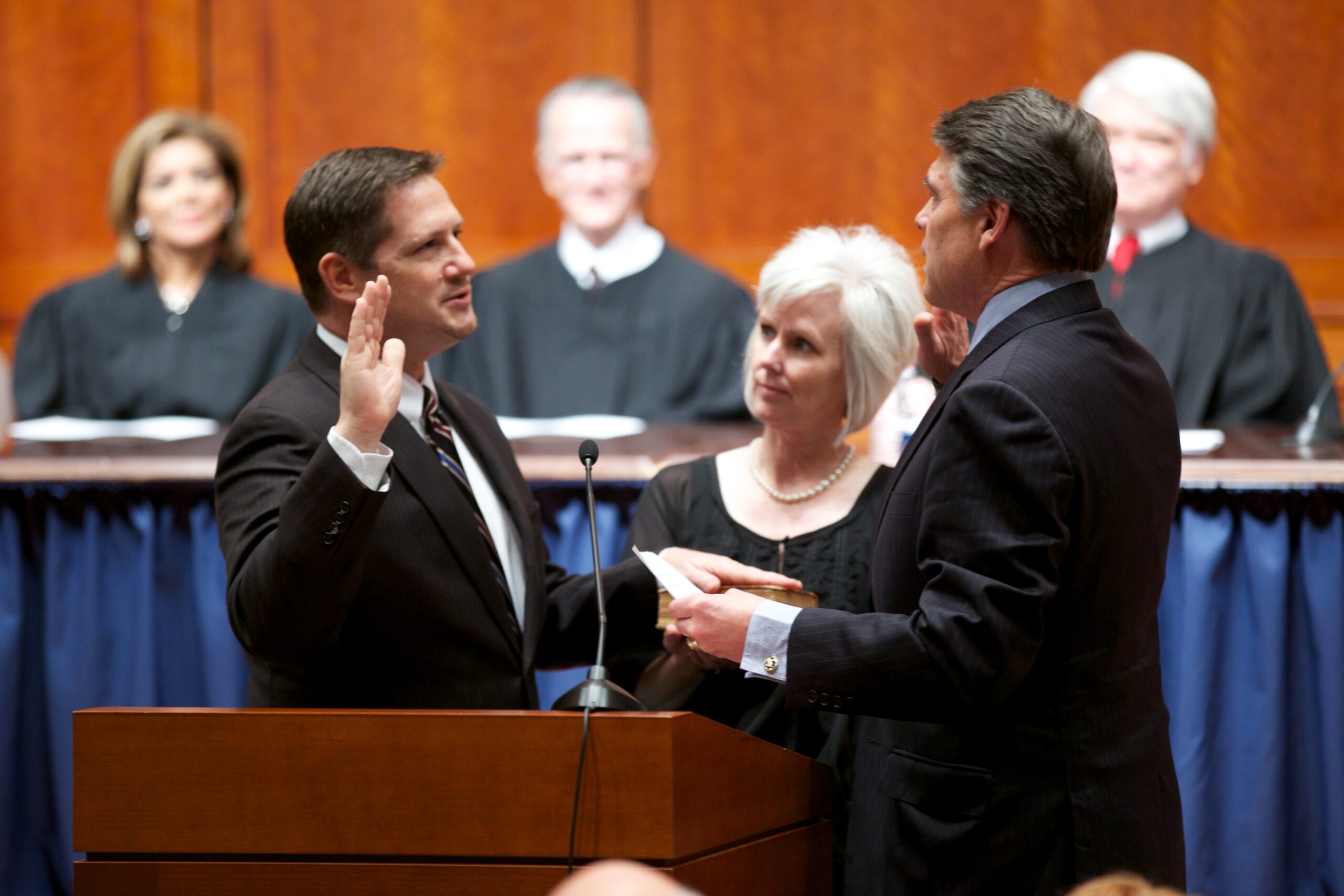
Houston Law Firm Adds Former Texas Supreme Court Justice to Name
Former Texas Supreme Court Justice Eva Guzman joined the Houston law firm of Wright Close & Barger in 2022 as a partner. Now, the firm is adding her name to the shingle.
Free Speech, Due Process and Trial by Jury
Former Texas Supreme Court Justice Eva Guzman joined the Houston law firm of Wright Close & Barger in 2022 as a partner. Now, the firm is adding her name to the shingle.
Longtime appellate practitioner joins Hunton Andrews Kurth’s Austin office to lead the firm’s state appellate practice. Ryan Clinton brings experience from the Texas Attorney General’s Office and private practice.
The Texas Supreme Court heard arguments in 63 cases and issued decisions in 62 of those cases during the past term. Those cases ranged from the typical cases the state's highest court hears each year — petitions for review arising from the state courts of appeals, a handful of certified questions from the U.S. Court of Appeals for the Fifth Circuit and a few mandamus petitions — to a few cases in less common procedural postures, like an appeal from the Board of Disciplinary Appeals and a direct appeal from a trial court. One of the first questions clients often ask when seeking to reverse or defend a decision at the Texas Supreme Court is, “What are my odds?”
Andrew Gould started a new job Monday as the leader of Hicks Johnson’s appellate practice in Houston.
Three federal district courts in Texas saw their judgments affirmed by the U.S. Court of Appeals for the Fifth Circuit Tuesday. The Fifth Circuit determined the district courts did not abuse their discretion in granting preliminary injunctions for SpaceX, Energy Transfer and Findhelp halting administrative proceedings before the NLRB while they pursue constitutional challenges to the agency’s structure.

The Texas Supreme Court has agreed to hear Forest Oil’s challenge to a $16 million arbitration award over drilling waste pollution on the 27,000-acre McAllen Ranch in Hidalgo County. The neutrality of an arbitrator and the panel’s jurisdiction over the dispute are among the issues raised in a long-running dispute that has been before the Supreme Court previously, producing a 2008 decision that allowed the arbitration to proceed.

Trinity Industries told a Fifth Circuit panel last week that the record-smashing $663 million judgment against it should be reversed because any alleged violations of the False Claims Act regarding its highway guardrail design were inadvertent, minor and immaterial. “You say they are minor and they say they are killer,” Judge Patrick Higginbotham shot back. “I mean, come on.” For 55 minutes last Wednesday, a three-judge panel showed that oral arguments intended to focus on lofty legal principles can be turned upside town when the judges instead decide to closely examine facts and evidence. This article examines the Fifth Circuit's concerns in the Trinity FCA case, Trinity's response and whether oral argument before a so-called "hot panel" of judges even matters.

Trinity Industries believed the conservative, pro-business Fifth Circuit was its protective barricade against a massive $663 million False Claims Act judgment facing the Dallas-based company. But for 55 minutes Wednesday, the appeals court appeared to be more of a buzz saw than a shield for Trinity. “The arguments you are making are not necessarily a winning argument,” Judge E. Grady Jolly told Trinity’s lawyers. The Fifth Circuit panel repeatedly raised doubts about Trinity’s legal and factual arguments. The Texas Lawbook has complete details.
The federal appeals court has reversed a $340 million antitrust judgment and placed significant limits on the activity to which antitrust laws apply. This case is a forceful reminder that a good business tort claim does not equate to a good antitrust claim – or, even any antitrust claim at all. It is also a reminder of two broader points about how the Fifth Circuit approaches business tort claims arising from federal law.
In a case with potentially huge implications for beer and wine retailers, the Texas Supreme Court is weighing how much of a stake in a brewery could trigger Texas laws designed to separate brewers and retailers. Mexican convenience store operator Cadena Comercial is appealing the state’s denial of a permit to sell beer and wine in its planned Texas stores. Wal-Mart and other retailers are closely watching the case to see if the court adopts a strict “single-share” standard in determining ownership interests.

Lawyers for Sam Wyly and his deceased brother were granted permission Thursday to appeal Bankruptcy Judge Barbara Houser's ruling that the Wylys committed tax fraud and owe $1 billion to the IRS directly to the U.S. Court of Appeals for the Fifth Circuit. The appellate court agreed to allow the Wylys to skip the usual step of having a federal district judge review their case. The Texas Lawbook has the details.

Two years ago today, an East Texas jury ruled that the Dallas-based Trinity Industries violated the False Claims Act when it failed to inform federal officials that it modified its highway guardrails but kept promoting the product as approved. The verdict was $663 million – the largest in the history of the FCA – and opened the door to a flood of lawsuits that seek billions of dollars in damages against the company. Now, Trinity Industries is in a legal war for its financial life and its reputation. What happens next could impact whistleblower lawsuits for decades to come. The Texas Lawbook examines the case and Trinity's legal strategy.
© Copyright 2026 The Texas Lawbook
The content on this website is protected under federal Copyright laws. Any use without the consent of The Texas Lawbook is prohibited.