
After 10 years of pro bono legal advocacy, lawyers with Lynn Pinker Hurst & Schwegmann secured asylum for a Venezuelan political activist after an immigration judge ruled he had been subjected to a systematic campaign of persecution by the Venezuelan government because of his political beliefs.
In a June 4 ruling from the bench, Immigration Judge Kevin Gross concluded that the evidence showed “an extreme level of conduct in the aggregate” against the man, a farrier and former member of Venezuela’s opposition party, Voluntad Popular, and that the Department of Homeland Security failed to prove conditions in Venezuela had improved enough to eliminate his well-founded fear of persecution.
The Texas Lawbook has agreed not to name the client.
“This is a very straightforward case,” Judge Gross said to the man, recounting months of violence, threats and intimidation. “It’s hard for the court to see how this is not a systematic set of actions by the government and/or groups the government is affiliated with.”
The U.S. government did not file an appeal, bringing the case to an end.
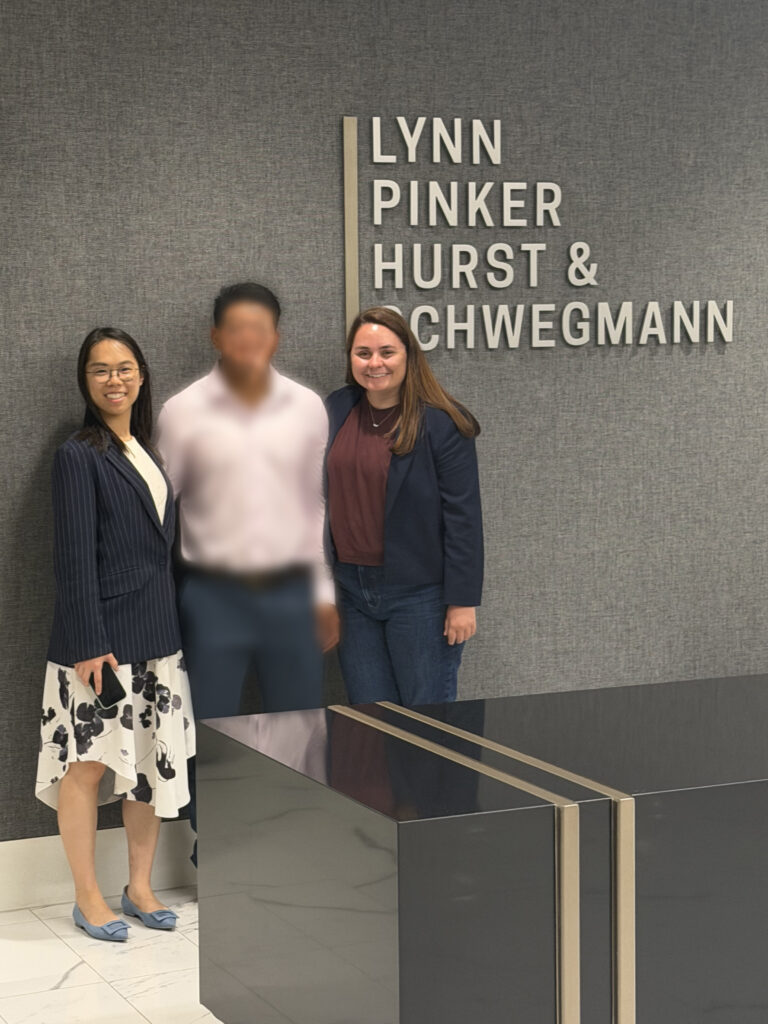
The case was handled pro bono by Lynn Pinker partner Andrés Correa, associates Chelsea A. Till and Shirley Xu and paralegal Lisa Mewbourn. They partnered with Human Rights Initiative of North Texas, which screens asylum cases and connects clients with pro bono attorneys while providing support throughout the representation.
“After we screamed, hugged and FaceTimed with Andrés [who handled the hearing remotely] to celebrate, the first thing [our client] did was call his young son to tell him the good news,” Till said. “I know [our client] felt immense relief for his own security and safety going forward, but I think knowing his U.S.-born son would get to grow up here with his father was just as big of a relief.”
Under the second Trump administration, asylum grants have plunged even more sharply than during the president’s first term, when the grant rate fell to 29 percent in fiscal year 2020, according to the Transactional Records Access Clearinghouse, a nonprofit, nonpartisan research arm of the S. I. Newhouse School of Public Communications at Syracuse University.
This year, asylum grants have reached their lowest level since 2009. An investigation by The New York Times published in April revealed that immigration judges granted just 7 percent of asylum applications in February.
In Texas, the rate is even smaller, with World Population Review reporting fewer than 6 percent of asylum requests granted in fiscal year 2026.
“It is incredible that they were able to partner with us and win that case during such challenging times,” said Shalaina Abioye, executive director of HRI of North Texas. “And the fact that it wasn’t appealed goes to show the work that they did and how incredible the cases are that we vet from the beginning.”
The client had testified that he became politically active with Voluntad Popular, a party opposed by the regime of then-Venezuelan President Nicolas Maduro. The client organized soccer tournaments, children’s puppet shows and other community events to draw people to the cause, and ultimately gained about 10,000 social media followers.
Judge Gross, who was appointed to the bench in March, found both the client and Rice University Latin America expert Dr. Mark Jones to be credible witnesses and said documentary evidence corroborated the man’s account.
According to the judge’s ruling, the campaign against the man began in early 2015 when he was beaten outside his home by members of the government-affiliated paramilitary groups “colectivos,” causing a traumatic brain injury.
Over the following months, the man received threatening phone calls, discovered politically charged graffiti on his vehicle, found regime pamphlets placed on his car while it was parked at a grocery store, survived an attack in which motorcyclists shattered one of his vehicle’s windows and later had a window at his home also broken by a rock.
The intimidation culminated when government officials visited the stable where the man kept his horses, questioned him about his political beliefs and insisted on administering vaccinations to the horses despite his objections. One of the horses died the following day. A veterinarian’s report submitted into evidence concluded the circumstances surrounding the horse’s death were suspicious.
The judge noted that recent Fifth U.S. Circuit Court of Appeals precedent describes persecution as “an extreme concept” requiring more than isolated threats or assaults. He concluded the man had met that standard because the cumulative evidence demonstrated a sustained campaign of politically motivated violence and intimidation.
The expert testified that conditions in Venezuela have deteriorated since the man fled the country in 2015 and entered the U.S. with a visa. Jones explained that colectivos function as government-backed paramilitary groups and described extensive neighborhood surveillance networks that would make the man’s return readily known to authorities and government affiliates
Although DHS introduced news articles suggesting conditions had improved, including reports that flights between the U.S. and Venezuela had resumed and that some political prisoners had been released, the judge found the government had “utterly failed” to show that the man no longer faced a well-founded fear of persecution or that he could safely relocate within Venezuela.
The judge also cited favorable discretionary factors, including that the man has a 9-year-old son, has worked in the U.S. as a farrier, pays taxes and has no criminal history.
In addition to granting asylum, the court granted withholding of removal in the alternative but denied protection under the Convention Against Torture, finding the man had not established it was more likely than not that he would be tortured if returned to Venezuelan.
At the end of the hearing, the judge thanked both parties for their professionalism and specifically acknowledged Lynn Pinker’s pro bono representation, saying “I appreciate your willingness to do that.”
“As rewarding as private practice has been, I have long struggled with whether I am honoring the blessings of my own immigrant journey by serving other immigrants,” Correa, who was born in Chile, told The Lawbook. The case was his first asylum matter and only his second immigration case. “These cases are my effort to dedicate some of the substantial resources of a law firm towards people who deserve their day in court.”
Till said that while immigration law is a polarizing issue, many people who debate it don’t understand the nuances of asylum law or how the process works. Her perspective comes from prior experience handling pro bono matters. In law school, she volunteered at detention centers, providing legal advice to asylum seekers. Since becoming a lawyer, she has handled two other pro bono asylum cases — one for a family from Venezuela and another for a young college student from Afghanistan. She has stayed in touch with both clients since they secured asylum and has watched them build new lives in the U.S.
“While I love being a corporate litigator and wouldn’t trade my job for the world, there is something so profound in knowing we can use our law license to change the trajectory of an entire family’s future,” Till said. “It is an immense privilege and responsibility.”
The Lawbook is looking to feature corporate lawyers who are handling immigration-related cases pro bono and are willing to tell their stories. We recently featured a Holland & Knight team who represented a Honduran mother and her son on a pro bono basis.
Please contact us by emailing krista.torralva@texaslawbook.net.