
No one has ever loved being a federal trial judge more than the Honorable David Hittner. And few have spent more years on the district court bench. This month marks the 40th anniversary of Judge Hittner’s appointment by President Ronald Reagan. By my count, that means he has presided over federal trials longer than all but two judges in the history of the Southern District of Texas. And that tenure places him well within the 10 longest-serving district judges in Texas history.
Forty years in any job is worthy of acclaim. But that anniversary is especially worthy of recognition when someone has spent that much time in the job the Supreme Court has rightly said is on the “front lines” of our justice system. Judge Hittner — a former Army captain and paratrooper whose journey from a Brooklyn childhood to Houston federal judge can be traced to being stationed at Fort Polk in Louisiana — is perfectly suited for the job in the trenches of the judiciary.
But the traits that have made Judge Hittner a great federal trial judge apply beyond the bench. They are ones that any lawyer can learn from. Here are the Hittner traits that stand out:
Enthusiasm
Anyone walking into Courtroom 8A in the Houston federal courthouse is immediately infected with Judge Hittner’s enthusiasm. He makes sure this starts the moment he enters the courtroom, because his law clerks — at his prompting — compete to see who can say the court cry the loudest.
After four decades on the job, Judge Hittner still displays the same joy on the bench that he must have shown when walking into Ebbets Field as a kid to see his boyhood hero, Jackie Robinson. In fact, even though judges aren’t paid by the trial, Judge Hittner routinely calls colleagues offering to take any impending trials. Because Judge Hittner is excited to be presiding over a trial, the jurors are excited to be deciding the case. With everyone happy to be there, there is no more fun courtroom in which to try a case.

The enthusiasm Judge Hittner displays is the essential quality of every great lawyer. Even great trial lawyers, whom television portrays with the single flamboyant archetype, come in a variety of styles: bombastic and soft-spoken, aggressive and congenial, folksy and professorial. Passion for the craft is the one through-line. As an exemplar of enthusiasm in the courtroom, Judge Hittner recognizes the quality in others. He bestows on lawyers a small, Lucite “Enthusiasm!” award that recipients value more than the shiniest plaques.
Humor
If Judge Hittner had not been a federal judge, he would have made a great stand-up comedian. He keeps large binders filled with stories of humorous incidents that have taken place in his courtroom. And as he has gone around the country sharing those stories in a talk that is akin to a standup routine, other judges have shared their stories, which Judge Hittner then adds to his binders. The result is what is likely the largest collection of courtroom humor ever compiled. Just one of the gems: A potential juror in rural Louisiana is filling out the questionnaire that asks basic information such as name, address, date of birth, etc. Under the box for “sex,” the person answers, “Once, in New Orleans.”
The title of Judge Hittner’s talk is “Humor in the Courtroom: Does It Really Exist?” When Judge Hittner is presiding, it certainly does. Practicing law can be grueling. Judge Hittner reminds us that laughter is effective and essential in the courtroom.
Judgment
Even though judges have no obligation to publish scholarship — heck, they don’t even have to do CLE — Judge Hittner has authored two different treatises and published dozens of law review articles, including an annual piece on summary judgment in Texas courts. Despite this lifetime commitment to legal education, Judge Hittner reminds us that knowledge of the law is necessary but hardly sufficient. Judging ultimately comes down to judgment. The same is true for lawyering. As a young lawyer trying cases in his court, he taught me that it’s one thing to know the rules — and he always tests young lawyers by asking them to cite the number of the Rule of Evidence being invoked — it’s another to know when to use them. More than two decades after my first trial in his courtroom, I still hear his words echoing in my ears when I’m thinking about objecting to evidence: “But does it hurt you? Does it hurt you?” Or his question in the opposite situation when I’m trying to introduce testimony that may be problematic: “Do you need it? Do you really need it?”
Each trial day is filled with countless questions like those, requiring the lawyer to meld the facts, the substantive law, the rules of evidence and the performance aspect of trial to rapidly make a strategic call. Judge Hittner, as an expert in the split-second decisions that trial judges make, teaches us that sound trial judgment requires mastery and balancing of each of those factors.
Mentorship
Judge Hittner relishes imparting his wisdom to others. For years, anyone walking into his courtroom during the summer would see an entire wall lined with interns from local law schools. The sense among trial lawyers was that you had to be even more on your toes than usual — the judge liked putting on a bit of a show for the interns.
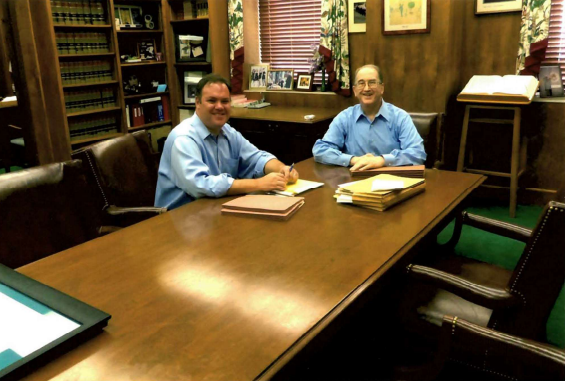
Judge Hittner’s mentorship goes well beyond those interns and his beloved law clerks. For over a quarter century, he went around the country presenting a Saturday morning CLE on trial practice. And I saw his mentorship firsthand when I was appointed as one of his colleagues on the Southern District of Texas. He invited me to visit his chambers the Sunday morning after he swore me in. I recall my wife Jennifer (a former Hittner intern, so she should have known better) asking, “When do you think you’ll be home?” I replied, “I’m sure by lunchtime.” I barely made it home for dinner. Judge Hittner spent that Sunday going over a comprehensive outline of every conceivable issue a new federal district judge might confront, from what stationary to purchase to how to deal with reluctant jurors.
After teaching me how to try cases as a young ASUA in his courtroom, Judge Hittner was teaching me how to be a trial judge. Like so many Houston lawyers, I’m fortunate I learned from the best.
Gregg Costa, a partner in Gibson Dunn’s Houston office, is global co-chair of the firm’s Trials Practice Group and a former federal trial and appellate judge.